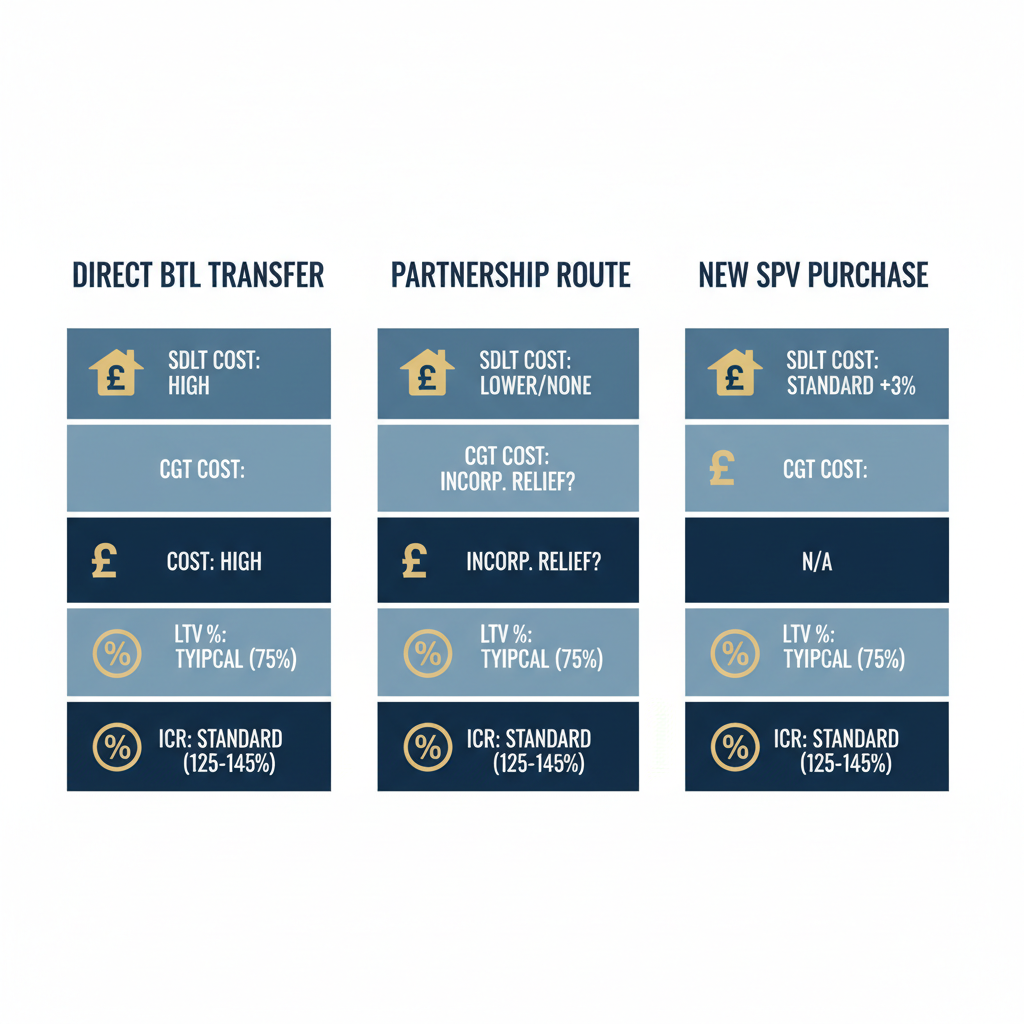
A £300,000 buy-to-let property bought for £180,000 generates an immediate £48,000 tax bill the moment you transfer it to a limited company — £20,000 in Stamp Duty Land Tax owed by the company, and approximately £28,000 in Capital Gains Tax owed by you personally. That is not a reason to abandon the idea of a transfer buy to let to limited company mortgage structure. It is a reason to do the numbers properly before you instruct a solicitor.
What the Numbers Show
The transfer is treated as a disposal for CGT purposes at market value, so gains accrued since purchase — after deducting allowable costs and any reliefs — become taxable in the year of transfer. CGT on residential property falls at 18% or 24%, depending on whether you are a basic or higher-rate taxpayer, against an annual exemption of £3,000 for the 2025/26 tax year.
On the SDLT side, the picture changed materially in October 2024. A company purchasing residential property pays the standard SDLT rates plus a 5% additional dwellings surcharge on top — raised from 3% in October 2024 — and this applies to every transaction regardless of whether the company owns other property. SDLT must be paid within 14 days of completion.
Multiple Dwellings Relief, which until 1 June 2024 allowed landlords moving several properties in one transaction to average the SDLT across them, has been abolished. Now each dwelling is taxed on its own value — so moving a portfolio means paying the higher rates on every property, one by one.
Two reliefs can change this calculation significantly, but neither is automatic for most landlords. Incorporation Relief under Section 162 TCGA 1992 allows property investors to defer Capital Gains Tax when transferring a qualifying business into a limited company in exchange for shares. It is only available where the rental activity constitutes a genuine business; HMRC does not accept passive letting of a small number of properties as qualifying.
Partnership Relief eliminates or significantly reduces SDLT liability when transferring properties from a genuine partnership into a limited company owned by the same partners in the same proportions. A property partnership must exist for a sustained period before it can be incorporated — while there is no specific timeframe stated in legislation, it is broadly recommended that the partnership operates for around three years before incorporation. HMRC is currently aggressively challenging paper partnerships — simply declaring a partnership on a tax return a month before incorporating will likely fail.
What This Means for Landlords
Even with the tax hurdles understood, many landlords press ahead — and for higher-rate taxpayers with growing portfolios, the long-term arithmetic often stacks up. Inside a company, all finance costs remain fully deductible, while personal landlords now receive only a 20% tax credit on mortgage interest under Section 24. Company profits are taxed at 25% (or lower for small profits), compared to up to 45% for an individual.
The structure also matters for the mortgage itself. Once the transfer is complete and the SPV holds the property, the new limited company mortgage is underwritten very differently from a personal BTL loan. An SPV — a Special Purpose Vehicle — is a limited company created solely to hold property, registered at Companies House for £50, typically within 24 hours, under SIC code 68100 or 68209. A limited company does not need years of accounts to obtain a buy-to-let mortgage — you can set up an SPV today and begin borrowing through it immediately.
Lenders assess the SPV application primarily through the directors behind it. A lender might require an ICR of 125% for a limited company but 145% or more for a higher-rate taxpaying individual — that more favourable stress test is one of the practical advantages of the corporate structure and directly affects how much you can borrow against a given rent. 75% LTV is the standard maximum for SPV products, with 80% available from a smaller panel of specialist lenders.
Personal guarantees are required from all directors and shareholders. If the company cannot pay, the debt reverts to you personally — the SPV's limited liability is, for the mortgage, effectively unlimited. This is the least-understood fact about the structure.
Most lenders require at least one director to have a minimum personal income — often £25,000 or more — to demonstrate the ability to cover void periods. Personal credit files of all directors and shareholders with 25% or more ownership are checked, and adverse credit on a director can block the application entirely.
When it comes to a transfer buy to let to limited company mortgage, the mortgage itself is only one part of a three-part decision: the tax on the way in, the mortgage criteria inside the company, and the ongoing tax efficiency once the structure is running. The upfront incorporation costs — CGT, SDLT, legal fees — spread across several properties become proportionally smaller. A £20,000 SDLT bill on a five-property portfolio is far more manageable than on a single property.
Setup costs at Companies House are £50, with an additional £250–£500 if an accountant configures the SIC code, share structure and chart of accounts. That is not the number to focus on. The number to focus on is how many years of corporation tax saving it takes to recover the SDLT differential — and whether your hold period is long enough to make that calculation work in your favour.