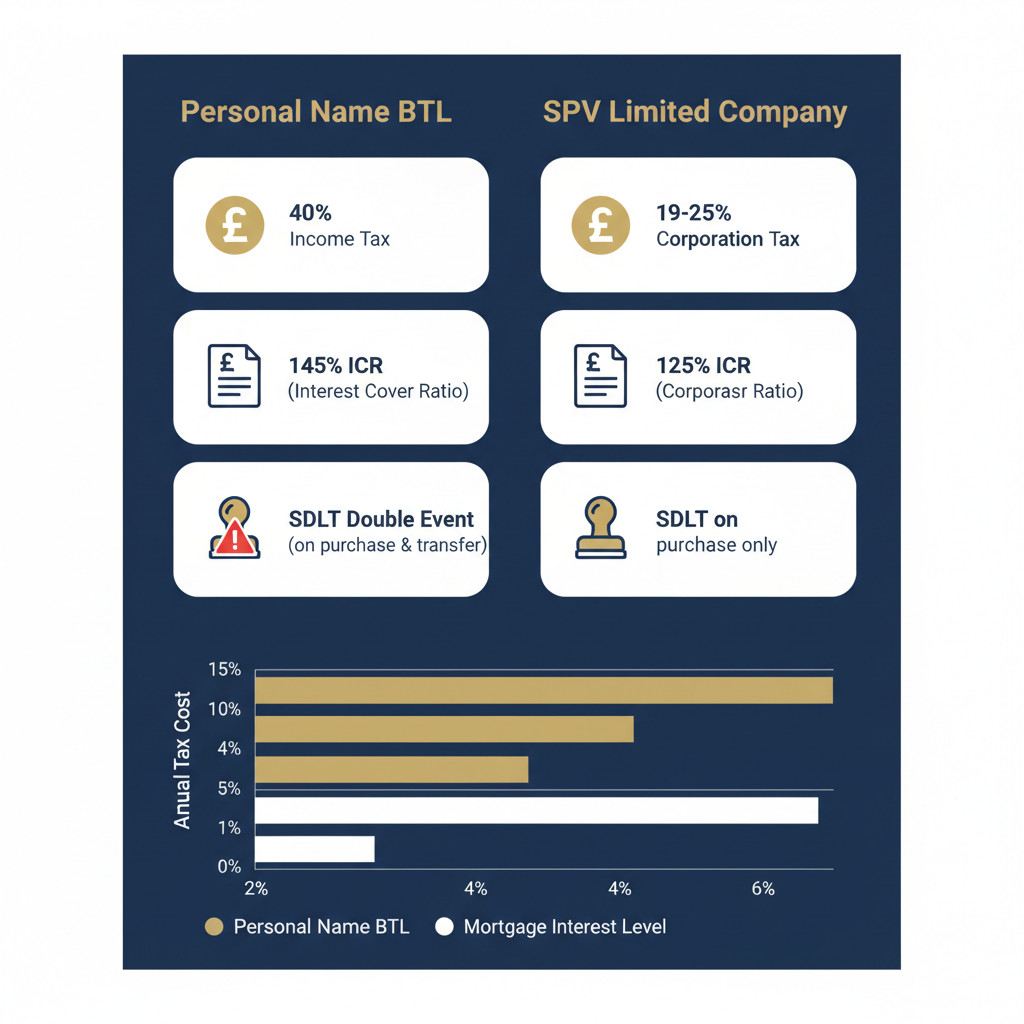
A 5% SDLT surcharge applies from the first pound when a limited company buys residential property in England. That single fact sits at the centre of every should-I-incorporate conversation — and it is the number most landlords underestimate before they run the full model.
What the Numbers Show
Section 24 has been fully in force since the 2020/21 tax year and remains in effect in 2026, with no planned repeal. Individual landlords cannot deduct mortgage interest from rental income and instead receive a 20% basic-rate tax credit on finance costs. A higher-rate taxpayer is significantly more exposed because Section 24 may tax part of the property profit at 40% while the qualifying finance cost receives relief at only 20% for 2026/27. On £10,000 of annual mortgage interest, that is a £2,000 annual shortfall in relief versus the pre-2017 rules.
Limited companies are not subject to Section 24. Within a company structure, mortgage interest remains fully deductible against rental profits, and the resulting profit is subject to corporation tax rather than income tax. Corporation tax for the financial year beginning 1 April 2026 has two headline rates: the 19% small profits rate for companies with profits up to £50,000, and the 25% main rate for profits over £250,000, unchanged at Budget 2025. For a portfolio landlord with modest retained profits, the 19% rate is a meaningful improvement over a 40% income tax bill.
The mortgage market has responded to growing SPV demand. The lowest two-year buy-to-let fix for a limited company was 3.62% at 60% and 75% LTV on 6 October 2026, with a fee of 5% of the loan. The lowest five-year fix was 4.55% at 60%. At 75% LTV on a five-year fix, published products include a 4.67% rate with a 3% fee and a 5.27% rate with a £1,499 fee. Those headline rates carry fees that need blending into a true cost calculation — a 3% fee on a £200,000 loan is £6,000 upfront.
Limited company buy-to-let mortgage rates in November 2026 carry a premium of approximately 0.10%–0.50% above equivalent personal BTL rates. That premium is real but smaller than it was two years ago and, for a 40% taxpayer losing Section 24 relief, it rarely outweighs the tax saving on a holding-to-maturity basis.
The interest coverage ratio (ICR) also works in the company's favour. At the standard stress rate of 5.5%, a limited company SPV borrower faces a 125% ICR threshold. That compares with 145% for a higher-rate personal-name landlord — a difference of about 16% more borrowing on the same rent. For a portfolio landlord managing lending headroom, the ICR advantage alone can unlock properties that sit just outside affordability in personal name.
The ICR maths is straightforward. Minimum monthly rent required = (loan × stress rate × ICR) ÷ 12. On a £200,000 SPV loan at 5.5% stressed and 125% ICR: (£200,000 × 0.055 × 1.25) ÷ 12 = £1,146 per month. The same loan in personal name at 145% ICR requires £1,329 per month — £183 more every month in rent just to pass affordability.
What This Means for Landlords
The tax case for limited company ownership is clearest for landlords buying fresh. A property bought by a company from the start carries no transfer CGT, and the SDLT is broadly what an individual landlord buying a second property would pay anyway. New purchases through an SPV are structurally the simplest route: no double-taxation problem, no incorporation relief question, just a straightforward BTL with SPV underwriting.
Transferring properties you already own is a different calculation. Should I Move My Rental Properties Into a Limited Company Now? is the right question — but the answer turns almost entirely on the SDLT and CGT costs of getting in. Landlords transferring existing rentals to their own limited company pay SDLT again, as the transfer to your company is a separate land transaction and there is no credit for the SDLT paid the first time round. HMRC treats the transfer as a purchase at market value, so the company pays the higher rates of SDLT with the 5% surcharge from the first pound, with no nil-rate band and no main-residence relief.
Multiple dwellings relief was abolished from 1 June 2024, which removes one route that previously softened the SDLT on larger portfolio transfers. Where a property business is carried on by a genuine partnership, Schedule 15 of the Finance Act 2003 replaces the market value rule with a chargeable consideration based on the sum of the lower proportions, which can lower the SDLT on a transfer to the partners' own company. This partnership route is real, but HMRC scrutinises it closely.
On the CGT side, incorporation relief under s.162 TCGA 1992 lets a genuine property business move into a limited company with no immediate Capital Gains Tax, but for transfers on or after 6 April 2026 the relief must be claimed. Finance Act 2026 amended section 162 so the relief is no longer automatic, and also repealed the old s.162A election that let taxpayers disapply the relief — so the position is now claim or no relief. Miss the claim and CGT falls due at once. Gains are taxed at 18% or 24%.
To qualify for incorporation relief, landlords must demonstrate to HMRC that they operate as a business and are not just considered passive investors. The leading case, Ramsay v HMRC, involved around 20 hours a week of management. A landlord with two properties and a managing agent is unlikely to meet that bar.
Should I Move My Rental Properties Into a Limited Company Now? comes down to three numbers: the annual Section 24 cost you are absorbing, the SDLT and CGT you would pay to transfer, and how many years of tax saving it takes to break even. For a higher-rate landlord with a large, highly geared portfolio they intend to hold for 15 or 20 years, the case can be compelling. For someone with two low-LTV properties approaching sale, it rarely suits a basic-rate landlord with one or two low-geared properties they expect to sell within a few years.
Run the full numbers — entry costs, annual saving, extraction costs — before committing.