The single factor that decides everything
The Autumn Budget 2026: what the new 24%, 44% and 49% property income tax rates mean for landlords comes down to one question before anything else: are you extracting profit now, or accumulating it long term? That single decision—income now versus wealth later—determines whether personal ownership or a limited company structure produces the better after-tax return from April 2027. Everything else is detail.
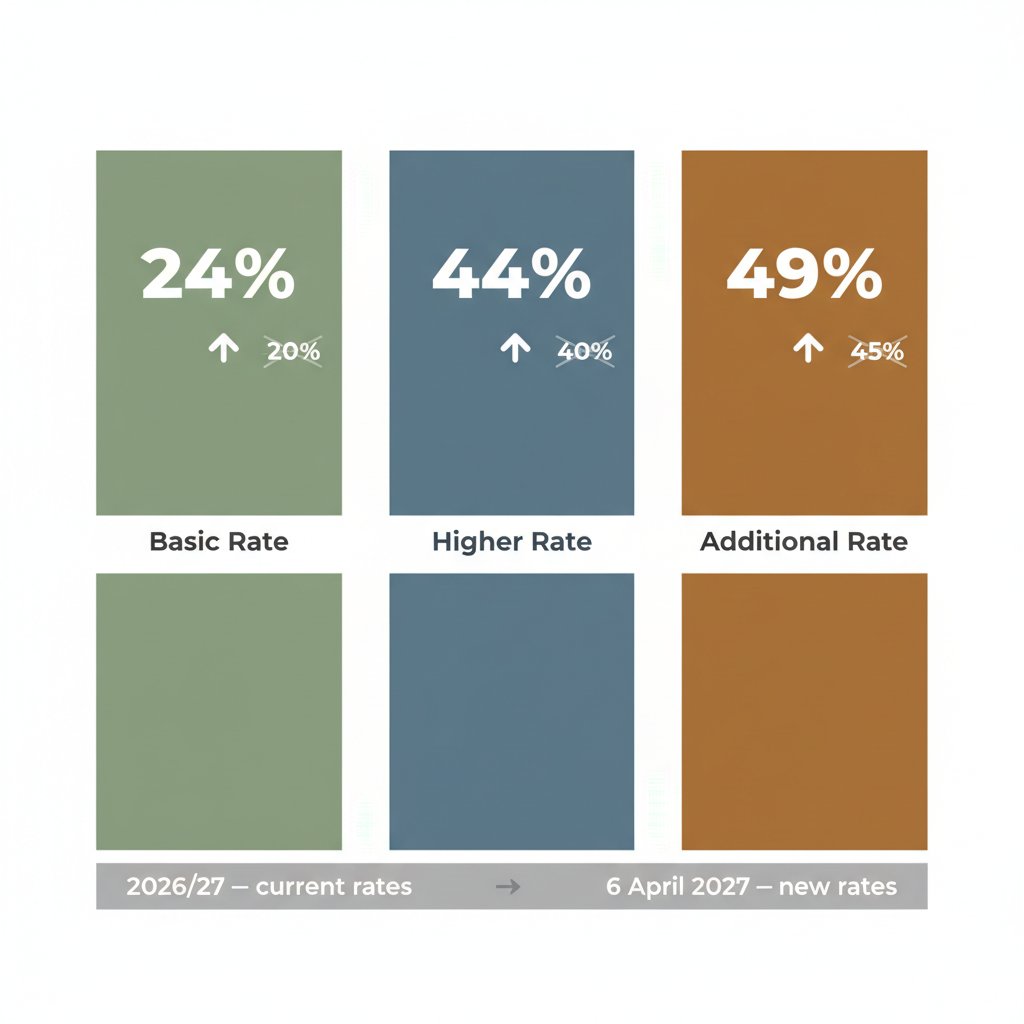
Chancellor John Healey confirmed a "further two percentage point" increase in tax rates on property and savings income from April 2027. The 2025 Budget had already set property income tax rates at 22%, 42% and 47% from April 2027; today's announcement adds another two percentage points to each band from the same date. Basic rate taxpayers will pay 24%, and higher and additional rate taxpayers will see their rates on property income rise to 44% and 49% respectively.
The new rates will apply across England, Wales and Northern Ireland, with legislation brought forward in the Finance Bill 2026–27. Scotland and Wales have powers to set property income rates in line with their existing income tax powers. For the current 2026/27 tax year, nothing changes: rental profits are still taxed at the normal rates of 20%, 40% and 45%.
The trading allowance for those with trading income is set to increase to £3,000 from £1,000, but there is no corresponding increase to the £1,000 property allowance. The £1,000 property allowance will remain unchanged, as will the Rent a Room Scheme.
The Office for Budget Responsibility said the income tax hike would raise £455m by the 2031–32 tax year. The OBR has confirmed the move will mean "a material reduction in returns to private landlords" and has warned the decision is not only likely to force landlords out of the sector, but will also force rents up.
When Personal Ownership Still Makes Sense
Personal ownership remains the right structure for a landlord who needs income today and carries low or no mortgage debt. If your rental profit sits entirely within the basic rate band—taxable income below £50,270 including rent—you will pay 24% on that profit from April 2027. That compares with corporation tax of 19% on profits up to £50,000 and 25% above £250,000, with an effective marginal rate of about 26.5% in between. Add dividend tax on top to extract company profits, and the advantage of incorporating evaporates rapidly for a basic-rate landlord.
A limited company avoids Section 24 but adds corporation tax (19–25%), dividend tax to extract profits, higher mortgage rates, and ATED for high-value properties. If you own properties outright or with minimal borrowing, Section 24 causes little damage because there is little interest to restrict. For these landlords, 24% personal property tax from April 2027 competes well against the blended cost of corporation tax plus dividend tax—particularly once you factor in the administrative overhead of running a company.
Personal ownership also suits landlords close to winding down. Capital gains tax on the sale of residential property is unchanged. The rates remain 18% for basic rate taxpayers and 24% for higher and additional rate taxpayers, with the annual exempt amount still £3,000. A company gets neither the £3,000 exemption nor the 18% CGT band when it sells. If an exit within five years is realistic, personal ownership usually wins on disposal tax.
When a Limited Company Makes Sense
Steve Cox, chief commercial officer at Fleet Mortgages, said the further increase in property income tax "is likely to make many landlords reconsider how they hold their rental properties, particularly those with larger portfolios." He added that more landlords are likely to consider "whether they should continue to hold their properties in their individual names or explore instead the potential benefits of limited company ownership."
The case for a company is strongest when three conditions align: you are a higher or additional rate taxpayer, you carry significant mortgage debt, and you can leave profit inside the company rather than drawing it immediately. Profits held within a limited company continue to be taxed at corporation tax rates of 19–25%, with full mortgage interest relief. That matters enormously post–Section 24. Since 2020, individual UK landlords cannot deduct mortgage interest from rental income before calculating tax; they receive only a 20% flat tax credit regardless of their actual rate. A 44% landlord loses 24p in every pound of interest to Section 24 drag. Inside a company, the same interest is fully deductible before tax.
You pay corporation tax at 19–25%, and the after-tax profit can fund deposits on further properties. Compounding within the company, without personal income tax on top, is the core long-term argument for the SPV structure for portfolio builders.
For the 2026/27 tax year, the Finance Act 2026 set dividend tax: the dividend ordinary rate is 10.75% and the dividend upper rate is 35.75%. The dividend allowance remains at £500. So if you need income now, the combined corporation tax plus dividend tax burden at 35.75% higher rate narrows the gap with the 44% personal property rate—but the gap still exists, and widens further at 49%.
The Calculation That Decides It
Run the numbers on your actual position, not the headline rates. The inputs that matter are: annual taxable rental profit, mortgage interest paid, your marginal income tax band, and whether you plan to extract profit or reinvest it.
Worked example — higher-rate landlord, £30,000 rental profit, £10,000 mortgage interest
Personal ownership from April 2027: Taxable profit = £30,000 (mortgage interest not deductible). Tax at 44% = £13,200. Section 24 credit = 20% × £10,000 = £2,000. Net income tax = £11,200.
Limited company (profit retained): Company deducts £10,000 interest. Taxable profit = £20,000. Corporation tax at 19% (small profits rate) = £3,800. If profit is retained, total tax = £3,800.
The saving on retained profit is £7,400 per year. Extracting that profit as a dividend adds 35.75% dividend tax on £16,200 net profit = approximately £5,791. Total tax then rises to approximately £9,591—still lower than £11,200 personally, but the margin is £1,609, not £7,400.
For illustration, somebody with £100,000 of taxable rental profits and savings income could ultimately pay around £4,000 more income tax a year than under the rates applying before these changes began.
The Autumn Budget 2026: what the new 24%, 44% and 49% property income tax rates mean for landlords is, ultimately, an arithmetic problem specific to your portfolio. From April 2027, the personal allowance and other general reliefs will apply to employment, trading or pension income first, before being set against property or savings income. This means landlords may find less personal allowance available to offset rental profits, potentially increasing tax liability further.
One more number to track: April 2027 also brings a reduction in the Making Tax Digital threshold to £30,000, bringing more individuals with property and/or self-employment income within the regime. Those affected will need to keep digital records using compatible software and provide quarterly updates to HMRC. From April 2028, the threshold falls again to £20,000. Plan your record-keeping now; the software switch takes time to embed.
What to Do Before 6 April 2027
Do not restructure on instinct. Model three scenarios against your actual figures: stay personal, incorporate new acquisitions only, or transfer existing stock. Each triggers different SDLT, CGT and mortgage costs. A transfer of existing personally held property into a company attracts the 5% additional dwellings SDLT surcharge on the full market value—a six-figure cost on a portfolio that can take years to recover. The tax saving from 44% versus 19% must comfortably outweigh that entry cost over your expected holding period. The Mortgage Works' Q2 2026 landlord survey found that 43% of landlords now say they intend to sell a property in the next 12 months, against just 6% planning to buy. If you are in the 43%, optimising for the new rates may be less important than optimising your CGT position on exit.