The factor that decides everything: your marginal tax rate on rental profit
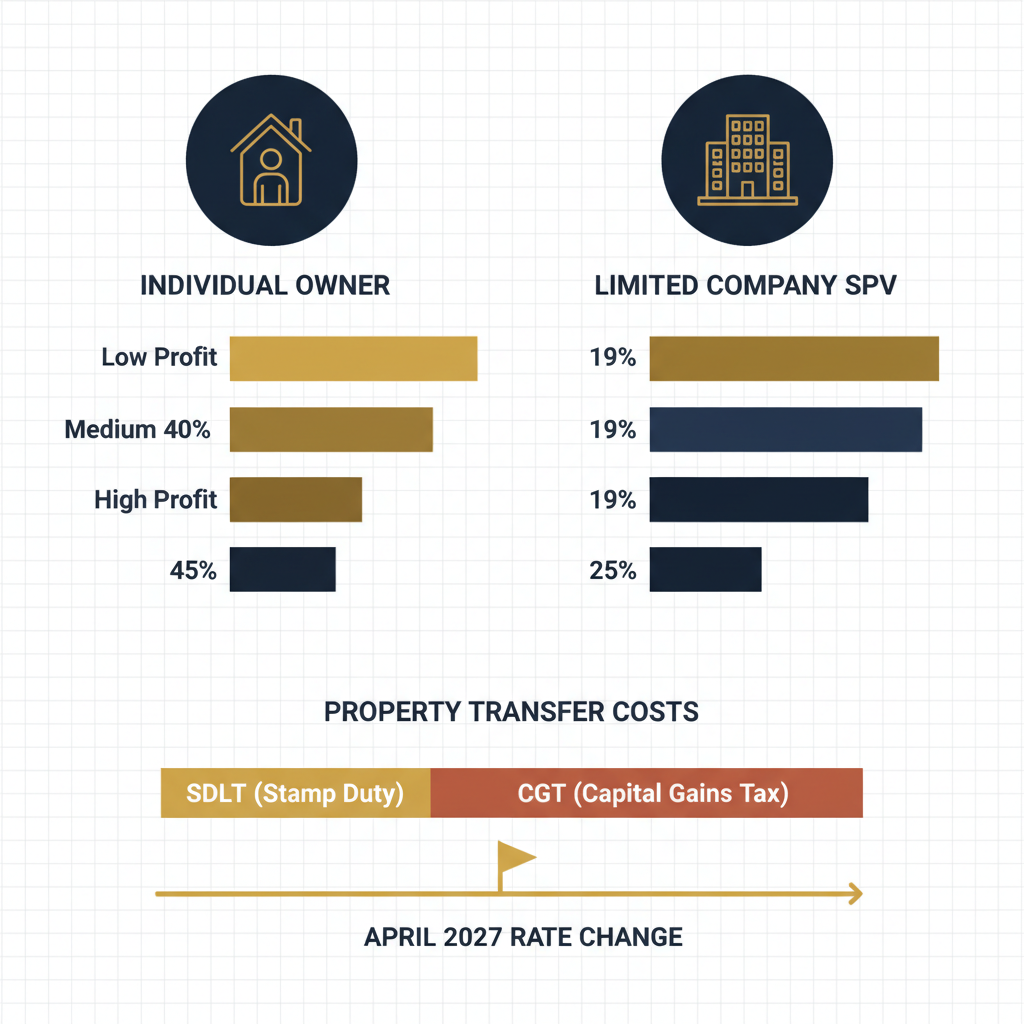
The whole personal-name versus limited-company question comes down to one figure: the rate at which rental profit leaves your hands after tax. Budget 2026, delivered on 28 October 2026 by Chancellor John Healey, added a further two percentage points to property income tax, on top of the two-point rise already announced by the previous Chancellor. From 6 April 2027, the rates in England, Wales and Northern Ireland will be 24% for basic-rate taxpayers, 44% for higher-rate taxpayers, and 49% for additional-rate taxpayers.
The Budget did not raise income tax rates across the board. Employment income, pension income and dividend income are not affected by this specific change. Only rental profits — and savings income — take the hit. That distinction matters, because a landlord with a salary already in the higher-rate band does not need large rental profits to reach 44%.
Limited companies are untouched by these changes. The corporation tax main rate remains 25% for the financial year beginning 1 April 2026 and applies to profits above £250,000. Companies with profits up to £50,000 pay only 19%. In the marginal relief band between £50,000 and £250,000, the effective marginal rate is 26.5% on each additional pound of profit. Budget 2026 introduced no new corporation tax changes for property companies.
When a limited company (SPV) makes sense
The break-even point is straightforward to calculate for new purchases. If you are already a higher or additional-rate income taxpayer, your rental profits face 44% or 49% from April 2027 in personal name. Inside a company they face at most 25%. That 19–24 percentage-point gap is the annual saving per pound of profit retained in the company.
Moving buy-to-let through a limited company is primarily tax-efficient for higher-rate taxpayers, due to full mortgage interest deductibility and lower corporation tax rates. In personal name, Section 24 restricts mortgage interest relief to a 20% tax credit regardless of your actual rate. Inside the company, every pound of mortgage interest is deducted in full before corporation tax is calculated. On a £200,000 interest-only mortgage at 5.5%, that deduction saves a 44%-rate landlord approximately £3,300 per year compared with the restricted personal-name relief.
The SPV route also carries a more favourable stress test. The standard ICR for a limited company SPV is 125%, whereas personal higher-rate taxpayers face a 145% ICR. On a five-year fix, SPV stress testing uses the pay rate rather than a loaded stress rate. That means you can borrow more against the same rent in a company than you can in personal name — relevant if you are trying to maximise leverage on a portfolio build.
A company also gives you exit flexibility. Retained profits can be extracted as dividends when your total income in a given year falls below the higher-rate threshold, or simply left to compound inside the company.
The SPV mortgage reality: Indicative pay rates for limited-company SPV buy-to-let on a 5-year fix at 75% LTV ran at approximately 5.25–5.85% in mid-2026, with SPV pricing typically 0.20–0.40% above the equivalent personal-name product. Arrangement fees on SPV products tend to be higher, often 2–3% of the loan. The rate premium is real but, for a higher-rate landlord, the income tax saving comfortably outweighs it across a five-year fixed term on most properties.
Active SPV lenders include Paragon, Kent Reliance, Foundation Home Loans, Landbay, Aldermore, Precise, The Mortgage Works, Vida Homeloans and BM Solutions. Most require the company to be a special purpose vehicle with SIC code 68209 or 68100 and no trading activity beyond property ownership.
When personal name still makes sense
Basic-rate taxpayers whose total income, including rental profit, stays below £50,270 face 24% from April 2027. Corporation tax rates are often lower than personal income tax rates, which is the primary reason landlords incorporate — but at 24% versus 19%, the gap for a small-profits company is only 5 percentage points. Set against a rate premium of 0.20–0.40% on the mortgage, higher arrangement fees, and accountancy costs of £800–£1,500 per year to run a company correctly, the numbers do not always stack up for a basic-rate investor with one or two properties.
Personal-name ownership is also simpler. No Companies House filings, no corporation tax return, no director's loan account to manage. For a landlord with a single property generating £8,000 annual profit, the additional administrative burden alone may consume a meaningful share of any tax saving.
There is one other scenario where personal stays ahead: the landlord approaching retirement, planning to sell in the next three to five years. CGT on residential property stays at 18% and 24% for 2026/27. Selling from a company involves extracting the net proceeds as a dividend or loan repayment, adding a layer of extraction tax on top of the corporation tax already paid. The effective combined rate on a corporate disposal can exceed the personal CGT rate, particularly once you factor in the loss of Business Asset Disposal Relief, which does not apply to a company's property portfolio.
The calculation that decides it: moving existing properties into a company
This is where the numbers most often kill the "just incorporate" argument. A transfer from personal ownership to a connected company is treated as a sale at market value, so SDLT applies at residential rates plus the 5% additional-dwellings surcharge, and Capital Gains Tax is due on the gain.
The additional-dwellings surcharge rose from 3% to 5% on 31 October 2024 and remains at 5% for the 2026/27 tax year. For a company purchase, the combined SDLT rates are 5% on the portion up to £125,000, 7% from £125,001 to £250,000, 10% from £250,001 to £925,000.
Work through a concrete example. A landlord transfers a property worth £300,000 that they bought for £180,000 — a gain of £120,000. After the £3,000 annual CGT exemption, £117,000 is taxable. CGT on residential property runs at 18% or 24%. At 24% (higher-rate band), the CGT bill is £28,080. On the same £300,000 transfer, SDLT is 5% on the first £125,000 (£6,250), 7% on the next £125,000 (£8,750), and 10% on the remaining £50,000 (£5,000), totalling £20,000 — an effective rate of 6.7%. The combined one-off cost is approximately £48,000, before refinancing fees or legal costs.
Section 162 incorporation relief can roll the CGT into the new shares, deferring it until the shares are sold, but only where the property business meets the "business" test — broadly five or more properties actively managed with significant time commitment. Incorporation relief does not remove the SDLT, so the upfront cash cost remains the main barrier for existing landlords.
Partnership-route transfers using SDLT Schedule 15 can mitigate the SDLT cost where the structure qualifies, but this involves specific partnership arrangements that carry their own complexity and professional cost. Always take specialist tax advice before relying on either relief.
The practical conclusion for existing portfolios: For landlords acquiring new properties, buying through a company avoids the SDLT and CGT costs of transferring existing properties entirely. The numbers almost always point the same way: keep existing personal-name properties where they are, and route all new acquisitions through the SPV from day one.
The payback period on a transfer — the point at which annual tax savings recover the one-off transfer cost — depends entirely on how much profit the property generates and what rate you pay. On a property generating £6,000 of annual after-interest profit, with a 20 percentage-point tax saving, the annual benefit is approximately £1,200. At that rate, the £48,000 transfer cost takes 40 years to recover. On a heavily geared property generating £15,000 profit and a 24 percentage-point saving, the annual benefit is £3,600 and the payback period falls to around 13 years — still a long time. Making Tax Digital for income tax self-assessment became mandatory from April 2026 for landlords earning above £50,000, and extends to those earning above £30,000 from April 2027, adding further administrative complexity to personal-name portfolios and slightly reducing one of the traditional advantages of keeping things simple.
The right answer for most portfolio landlords is a hybrid: run the existing personal-name stock to sale or until the payback period makes a transfer viable, and build any new inventory inside the SPV from day one.