Bridging completions totalled £1.6 billion in Q2 2026 — a market still large enough to give portfolio landlords genuine choice, but one where lenders are sharpening their focus on exit strategy. That figure matters to anyone reading this, because it sets the competitive context for every rate negotiation you are about to have.
What the Numbers Show
Bridging loan rates run from 0.57% to 1.5% a month as of November 2026, with most deals sitting between 0.65% and 0.95%. The market average is 0.81%. Those headline numbers are the starting point for any Bridging to Buy-to-Let: Financing Auction and Refurbishment Properties conversation — but they tell you very little on their own.
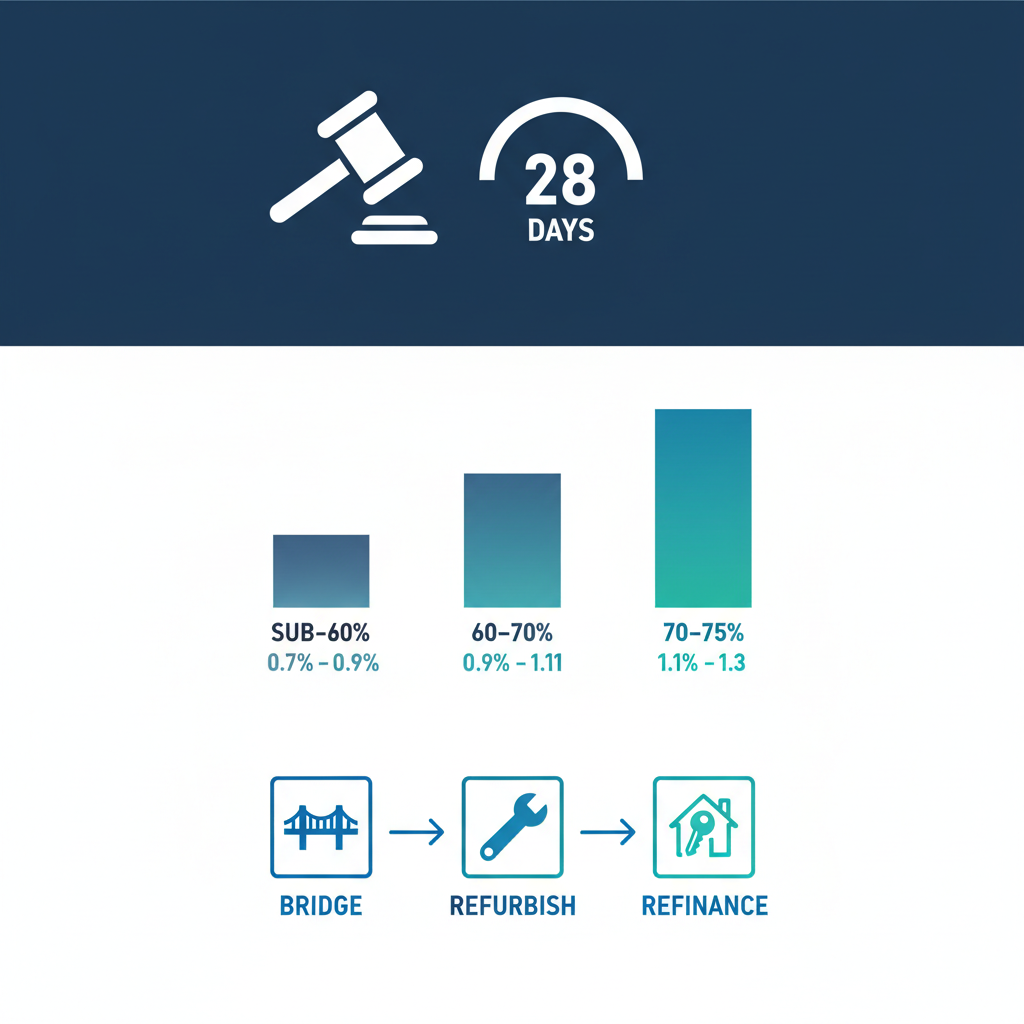
LTV is the single biggest lever. At up to 50% LTV, typical monthly rates run 0.55%–0.75%, rising to 0.85%–1.10% at 70%–75% LTV. Sub-60% LTV unlocks the sharpest pricing, while above 70%–75% moves into specialist territory.
Refurbishment work adds a small but measurable premium. Light refurbishment bridging is currently available at up to 85% LTV from 0.60% per month, and heavy refurbishment at up to 80% LTV from 0.63% per month. Light refurbishment scenarios where the property remains habitable throughout typically price at vanilla bridging rates plus 0.05%–0.10% per month.
For auction purchases, speed is the product. Auction bridging finance pays for the property within the 28-day completion deadline; most auction cases complete in two to three weeks, typically up to 70% of the purchase price. Clean residential investment stock can attract LTVs up to 80% on refurbishment and light works, with rates from about 0.55% per month and completion in 5–14 days.
Fees stack up quickly. Arrangement fees run at 1%–2% of the loan amount; valuation fees typically £300–£2,000; legal fees £800–£2,500 covering both borrower and lender solicitors. An exit fee of historically 1%–2% of the loan is increasingly being waived by lenders competing on headline cost.
United Trust Bank (UTB) is a lender whose product guide merits close reading for bridge-to-let cases. UTB's standard unregulated bridging runs on loans from £100,000 to £1.5 million, with a 2% completion fee on drawdown, a £695 admin fee, a maximum 24-month term, and no early repayment charges — with both rolled-up and serviced interest available. UTB's light refurbishment loans allow maximum works costs of £1 million or 70% of initial value, up to 70% LTGDV including capitalised interest, and a maximum 24-month term. At below 70% LTV, the rate for experienced borrowers is 0.80% per month, rising to 0.90% per month for inexperienced borrowers.
UTB's Bridge to Let product offers a 0.3% discount on BTL rates when the borrower uses the Bridge to Let product — a meaningful incentive to keep the bridge and the exit mortgage with the same lender.
On the exit leg, you can typically borrow up to 70%–75% of the property's day-one value on a bridge to let, with some lenders allowing up to 80% LTV on the exit remortgage, subject to rental affordability. Bridge-to-let lenders are typically specialist UK lenders with integrated BTL products or partnerships, operating outside mainstream high-street banks and focusing on professional landlords and time-sensitive investment.
What This Means for Landlords
The Bridging to Buy-to-Let: Financing Auction and Refurbishment Properties strategy only works cleanly when the exit underwriting is sorted before you draw the bridge. BTL lenders divide your annual rent by a stressed interest rate multiplied by an interest coverage ratio — normally 125% for basic-rate taxpayers and limited companies, and 145% for higher-rate taxpayers. Higher-rate taxpayers are usually tested at 145%, small HMOs at 145%, large HMOs at 160%, and multi-unit blocks at 150%.
UTB's portfolio ICR on its BTL range requires the portfolio ICR to be at least 125% at a mortgage rate of 5%. Run that before you bid at auction. If the rent on a £200,000 loan does not comfortably clear the stress test, the exit mortgage may not cover the bridge, and you are left negotiating an extension — usually at cost.
As of 20 July 2026, UTB made several BTL criteria changes: maximum term extended to 30 years, minimum ownership period removed, landlord experience requirements dropped for HMOs up to 6 beds and MUBs up to 4 units, and exposure limits increased to 10 BTL loans or £3 million per applicant. Those are material changes for a portfolio landlord running multiple refurbishment exits simultaneously.
The BDLA reports that lender feedback points to subdued property transaction activity and protracted completion times, putting pressure on pipelines and sharpening focus on exit strategies. Average LTVs across the market have moved to 57.66%, which tells you where most borrowers are actually transacting — well below the 75% ceiling. Bidding at auction with a 75% bridge when the market is typically clearing at 57.66% LTV is not automatically a problem, but it does place you in a higher-pricing tier with fewer lender options.
The Buy, Refurbish, Refinance (BRR) model suits this route particularly well. Purchase using a bridging loan at 60%–75% LTV, complete planned refurbishment works during the bridge term via stage drawdowns, then refinance onto a BTL mortgage using the new post-works valuation. Interest is typically rolled up rather than serviced during the refurbishment phase, because the borrower is not yet receiving rental income. That rolled interest compounds, so a 12-month bridge at 0.80% per month on a £200,000 loan adds roughly £19,200 to your balance before fees — a number worth modelling before you raise your paddle.
The Bank of England base rate has sat at 3.75% through mid-2026, after being cut from 4% in December 2025. That influences lender funding costs generally, but bridging pricing is driven far more by LTV, exit strategy and property type than by base rate movements alone. Expect rates to be quoted on the specifics of your deal, not the direction of travel on Threadneedle Street.