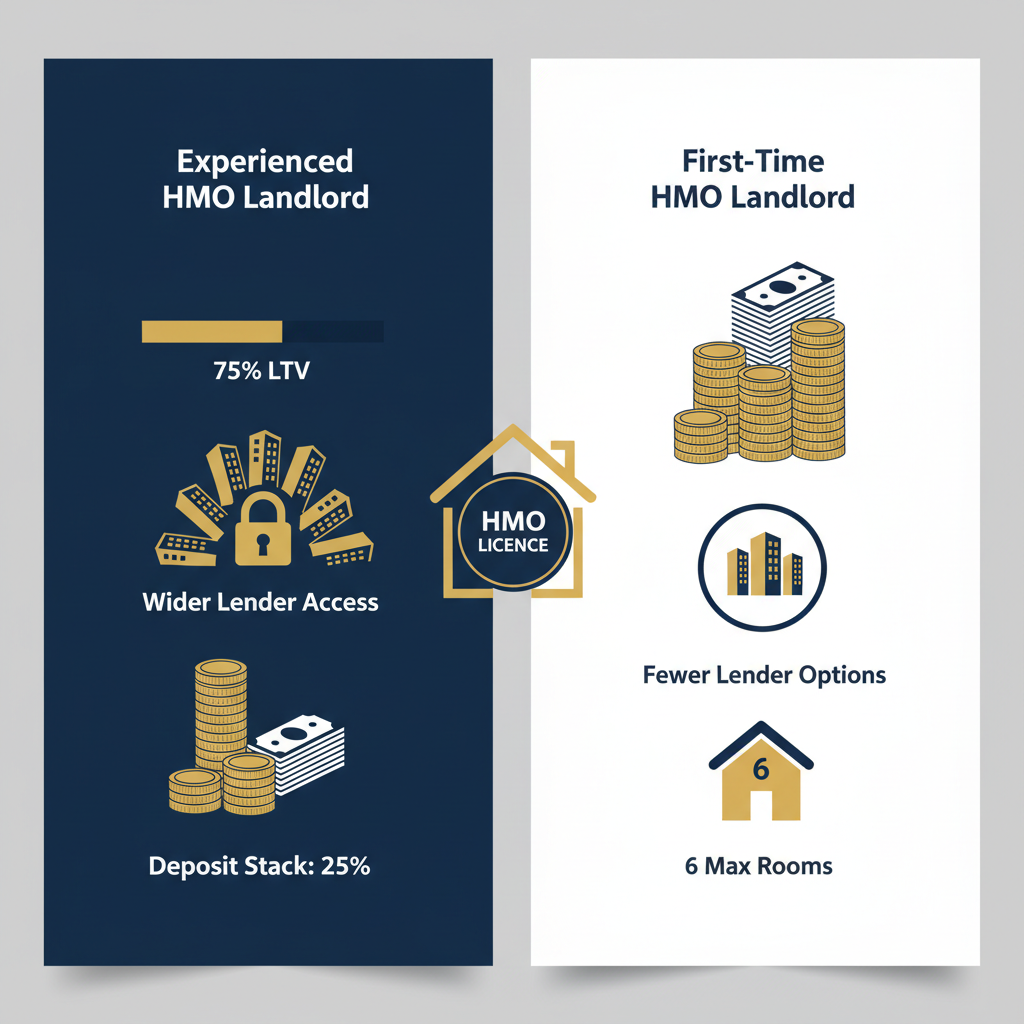
A 30% deposit is where most specialist lenders draw the line for a first-time HMO landlord in 2026. That is not a soft suggestion — it is the structural floor that shapes every other number in the deal. If you are asking whether a first-time HMO landlord: can you get an HMO mortgage with no experience? — the short answer is yes, but the criteria narrow quickly once lenders see a blank landlord track record.
What the Numbers Show
The standard minimum deposit on an HMO mortgage sits at 25% (75% LTV) for personal-name borrowers. For a limited company purchase that typically rises to 30% (70% LTV), and for first-time HMO landlords, a 30% deposit is usually the starting point regardless of ownership structure.
A small number of lenders do accept first-time landlords for HMO mortgages, but these typically cap the property at 4 to 6 rooms and apply lower LTV limits — 65% to 70%. Rates may carry a small premium on top of that.
Most HMO lenders want 12–24 months of prior buy-to-let experience, so a complete first-timer faces a narrower panel. How narrow? The active HMO market in 2026 is led by Paragon, Kent Reliance and Precise (both OSB Group), Shawbrook, Aldermore, Fleet Mortgages, CHL Mortgages, Landbay, Foundation Home Loans and Hampshire Trust Bank. Not all of them will touch a first-timer.
Paragon, for instance, requires a minimum of 2 years' experience as a landlord — which rules it out entirely if this is your first purchase. Kent Reliance, part of the OSB Group, is known for flexible underwriting and does consider first-time landlords — accepting HMO applications for properties with up to six lettable rooms, with a minimum 20% deposit available to help aspiring landlords buy their first HMO. Note that criteria from third-party packager sources differ slightly from each other on the detail; always confirm directly via the lender's intermediary portal before submission.
Keystone is another specialist with strong HMO products, offering up to 80% LTV with no minimum experience required — first-time landlords are explicitly welcome. Keystone's minimum income requirement for first-time landlords is £25,000.
On rates, the market in 2026 has moved materially from the 2023 peak. Current rate ranges on a small HMO (up to 6 rooms) on a 5-year fixed run from 4.77% to 6.88% pay rate, and on a 2-year fixed from 3.55% to 7.34% — with the bottom end of that range reserved for the cleanest cases at the lowest LTVs. First-timers will not access those floor rates. Limited company HMO products typically price 0.2% to 0.5% higher than personal-name equivalents, and sui generis large HMOs of 7 beds or more start from around 5.5%.
Arrangement fees of 2% to 5% apply to the sharpest headline rates, so the true comparison is rate plus fee over the fixed period. Early repayment charges often run at 1–5% of the outstanding balance if you exit a fixed term early, so model your hold period before committing to a 5-year product.
The affordability test is the other gate. The typical interest coverage ratio (ICR) sits at 125–145% at a 5.5% stress rate, with arrangement fees of 1–2% of the loan amount. The Mortgage Works requires an ICR of 175% for all HMO applications, and Leeds Building Society asks for at least 165%. Those are lenders you will not reach as a first-timer anyway, but the stress-test logic applies everywhere.
Here is how to check whether a property passes: multiply the loan amount by the stress rate, then multiply by the ICR, then divide by 12. That gives you the minimum monthly rent required. On a £300,000 loan at a 5.5% stress rate and 145% ICR, the calculation is £300,000 × 5.5% × 1.45 ÷ 12 = £2,006 per month minimum rent. If your projected room-by-room rental income does not clear that figure, the deal does not pass — regardless of your deposit size.
What This Means for Landlords
The first-time HMO landlord: can you get an HMO mortgage with no experience? question has a workable answer, but it demands a realistic starting point. Lenders typically prefer smaller properties — 3 to 5 bedrooms — in good locations as a first HMO investment for new investors. Most mainstream HMO lenders cap at 6–8 rooms; larger sui generis HMOs need niche or commercial lending. Starting with a 5-room C4-use property keeps the lender panel open and the LTV achievable.
For HMOs of 6 units or fewer, lenders offering standard valuation to a first-time investor typically set no minimum personal income, but look for £50,000 of personal income above 6 units. That is a hard cliff edge if you are eyeing a 7-room property with no track record.
A valid HMO licence must be in place before mortgage completion — unlicensed properties may not be eligible. Licence fees are set by individual local authorities and vary considerably, but generally range from £500 to £1,500 for a 5-year licence — budget for that before you count your projected yield.
Some lenders are willing to work with first-time investors if you have a strong personal income or deposit, work with an experienced letting agent or HMO manager, and can demonstrate a clear understanding of HMO responsibilities. Using a professional managing agent is not just good practice — for some lenders it is a formal underwriting requirement that unlocks access to the product at all.
HMOs deliver yields of 8–12%, significantly higher than the 5.7% BTL average. That yield premium is real, and it is why first-time investors push straight into the sector. The criteria are tighter than standard BTL, the deposit requirement starts at 30%, and the lender panel is shorter — but with a 5-bed or 6-bed licensed property, a clean credit file, a £25,000-plus personal income and a professional management agreement in place, there are lenders who will underwrite the case in 2026.