A 5.00% ICR stress rate. That is what Paragon Bank currently applies when calculating affordability on a five-year fixed HMO mortgage, confirmed in its product guide dated 6 November 2026. For HMOs and multi-unit blocks on five-year fixed products, Paragon's ICR calculation rate is the product charging rate or 5.00%, whichever is greater. On shorter terms or trackers, all other products use the product charging rate plus 2%, or 5.50%, whichever is greater. That 50-basis-point swing between stress rates is not academic — it directly changes the maximum loan a property can support, and it is exactly the kind of number most landlords never see until a valuation comes back lower than expected.
What the Numbers Show
HMO Mortgages: How Lenders Value Them and Why It Matters begins with a question most investors skip: how is the property actually being valued, and how does that valuation interact with the ICR?
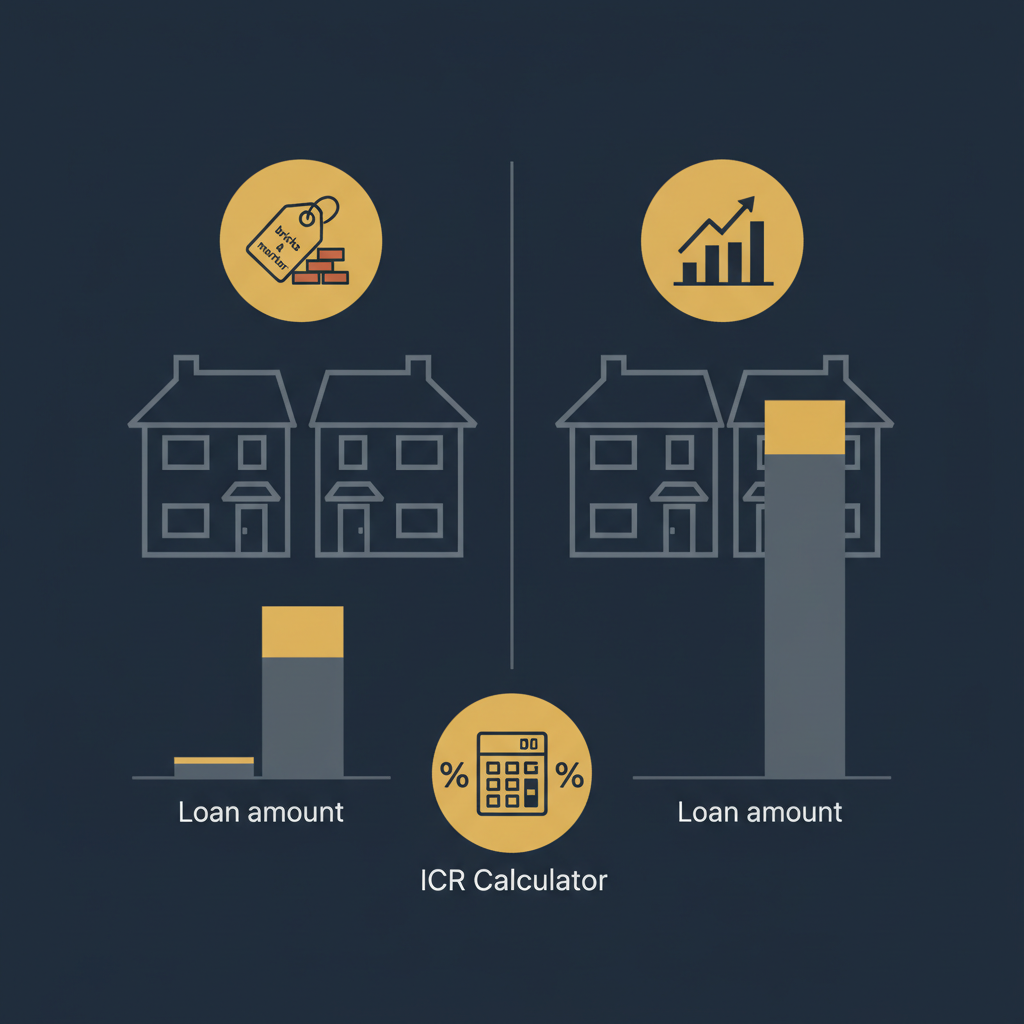
There are two broad valuation methods. Bricks-and-mortar valuation treats the property as if it were a standard residential home, valued on comparable evidence. Commercial or investment valuation values the HMO as an income-producing asset, capitalising the rental income at a yield. The same building, the same postcode, two very different numbers on the valuation report.
At 75% loan-to-value, a yield-based valuation of £400,000 supports a loan of £300,000; the same percentage against a bricks-and-mortar value of £320,000 supports only £240,000. That is a £60,000 difference in borrowing from one surveyor's methodology. Most lenders use bricks-and-mortar for smaller HMOs, so your borrowing is tied to that residential value however strong the rent is.
Bricks and mortar applies for most HMOs; commercial valuation tends to apply for bigger ones, often those with seven bedrooms and above. In Article 4 areas where converting back to a family home is restricted, lenders are sometimes more willing to value on a rental yield basis. If your HMO sits in an Article 4 direction area, the planning constraint that some landlords see as a nuisance can actually unlock a higher valuation basis — provided the licence is in place and the lender agrees.
To capture a higher investment valuation you generally need the HMO licence in place, the planning position clear, the rooms actually let, and a lender who values on investment income rather than bricks-and-mortar. Four conditions. Miss one, and the commercial basis is off the table.
On the ICR side, the numbers differ materially by tax wrapper and lender. Paragon's further advance guide shows basic rate taxpayers at 125% ICR for single self-contained units, rising to 130% for HMOs and multi-unit blocks; higher and additional rate taxpayers face 140% on single lets and 145% on HMOs. That means an HMO held in personal name by a 40% taxpayer has a materially tighter affordability test than the same property inside a limited company, where the 125% threshold typically applies.
Lenders calculate rental income per room and require the total to cover mortgage payments at a stressed interest rate, typically 5.5%. But the room-by-room basis is not universal. Some lenders assess whether rent is calculated room-by-room, or as a single-let equivalent — a distinction that can halve the assessed income on a large property if the wrong lender is chosen.
Maximum LTV is the other hard constraint. Most HMO lenders offer a maximum of 75% LTV, though some will go to 80% or higher for smaller HMOs or strong applicant profiles. For large HMOs with seven or more bedrooms, or student lets, lenders often require a 30% deposit or more regardless of experience. At the top of the market, some lenders cap LTV at 70% once the loan reaches £1.5 million.
Pricing reflects the complexity. Indicative HMO mortgage rates run from around 4.79% on a five- to six-bed personal-name HMO at 75% LTV, with limited company products typically 0.2% to 0.5% higher, and sui generis large HMOs of seven or more beds from around 5.5%. At the specialist end, Hampshire Trust Bank's Specialist BTL, HMO and MUFB range starts from 5.14%, up to 75% LTV, with up to 10% of the loan balance repayable per year without charge.
Hampshire Trust Bank charges a 2% arrangement fee for its ERC Plus and ERC Lite products. That fee structure matters: a 2% fee on a £500,000 loan adds £10,000 to the upfront cost before a single mortgage payment is made. HTB's revert rate is Bank Base Rate plus 5.00%, which at the current BBR of 4.00% (per their product guide) gives a standard variable rate of 9.00% — a strong incentive not to let any fixed deal lapse.
Lender choice is narrower than most landlords realise. Many high-street lenders will not lend on HMOs at all; a specialist broker typically has access to 30 to 50 lenders that consider HMO properties. The high street is largely absent; the market is served by specialist buy-to-let lenders, commonly including Paragon, Kent Reliance, Precise, Foundation, Fleet and Landbay. Birmingham Midshires (part of Lloyds) and The Mortgage Works (part of Nationwide) are the closest to high-street lenders that offer HMO products.
Borrower experience requirements create a further filter. Most HMO lenders want 12 to 24 months of prior buy-to-let experience, but some specialist lenders will consider first-time landlords — typically with a larger deposit of 30 to 35%, a smaller HMO of up to around six rooms, and a lower loan-to-value. The minimum property value with most HMO mortgage providers is £100,000.
What This Means for Landlords
The valuation method your lender uses is not a footnote — it is the ceiling on your borrowing. Two lenders can be presented with the same six-bed, fully let, licensed HMO and reach very different maximum loans because one capitalises the income and the other compares the house to the three-bed semis down the road.
Because borrowing on an HMO mortgage is determined by stress-tested rental income rather than by salary, two lenders can produce very different maximum loans on the same property. Where a property is valued on a bricks-and-mortar basis, borrowing is often limited by the residential value even where rental income is strong.
The ICR and stress rate combination compounds this. A higher rate taxpayer holding a seven-bed HMO in personal name faces an ICR of 145%, stress-tested at a minimum of 5.50% on most products outside five-year fixes. Run those inputs — loan × 5.50% × 145% ÷ 12 — against room rents before you instruct a surveyor, not after. A lower LTV also helps the ICR calculation, because a smaller loan means lower payments relative to your rental income. Dropping from 75% to 65% LTV can be the difference between a deal that passes the stress test and one that does not.
Understanding HMO Mortgages: How Lenders Value Them and Why It Matters ultimately comes down to three decisions made before application: which lender's valuation methodology fits your property, which tax structure gives the most favourable ICR, and whether the property's room-by-room rent — not a single-let equivalent — is what the lender will actually use.