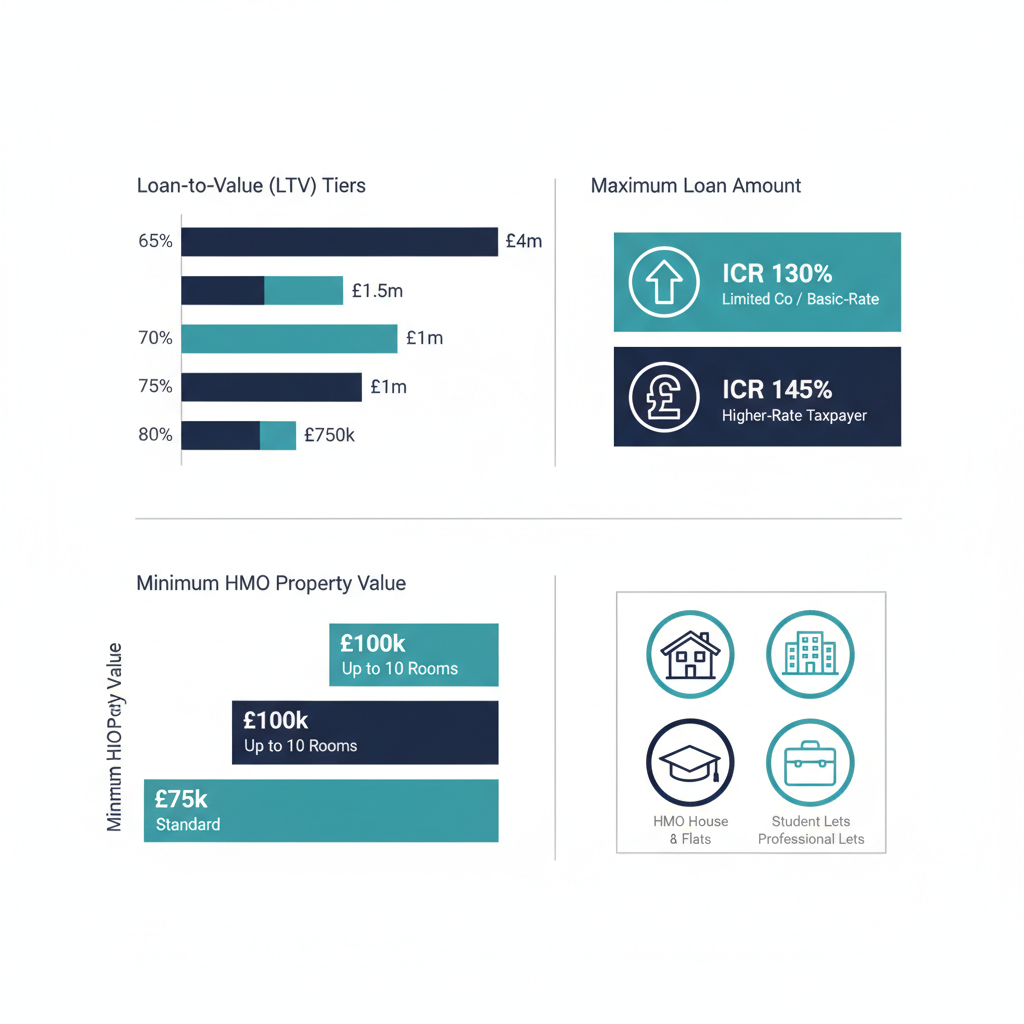
Paragon's maximum loan against a single HMO at 80% LTV is £750,000. That figure alone tells you a great deal about how the lender positions itself: high enough to service serious portfolio landlords, tight enough to signal it is not chasing volume at any risk. If you own or are buying an HMO — a House in Multiple Occupation — or a multi-unit freehold block (MUFB), Paragon is one of the most credible specialist lenders in the UK market. This guide explains exactly what it lends on, who qualifies and how the rental maths works, so you can decide whether Paragon fits your deal before you submit anything.
A quick glossary: An HMO is a property let to three or more unrelated tenants sharing facilities. A MUFB (or multi-unit block, MUB) is a single freehold containing two or more self-contained flats. LTV (loan-to-value) is the loan as a percentage of the property's value. ICR (interest coverage ratio) is the multiple by which your rent must exceed the stressed mortgage interest — the lender's affordability test.
What Paragon Lends On
Paragon's HMO range covers small and large HMOs, student lets, professional sharer houses, and multi-unit blocks (MUBs/MUFBs) under a single freehold. Properties divided into a maximum of 20 units are considered, as are Houses in Multiple Occupation. That 20-room ceiling is firm: anything larger falls outside Paragon's standard criteria and needs to go elsewhere.
A property is classed as an HMO if at least three tenants live in the property, forming more than one household, and sharing a toilet, bathroom or kitchen facility. A property with five or more residents forming more than one household with shared facilities requires a mandatory HMO licence. Paragon accepts student, professional and benefit lets, as well as local authority and housing association nominations, within its HMO range.
On the Refurb-to-Let side, Paragon's Refurb-to-Let product is tailor-made for properties needing modernisation without structural changes, with a 6-month refurbishment period. Light cosmetic work and C3-to-C4 conversions sit within scope; heavy structural conversions or complex change-of-use projects do not.
Who Qualifies
For multi-unit properties and HMOs, landlords must have a minimum of two years' lettings experience. Paragon lowered this minimum experience requirement for HMO and MUB applications from three years to two years, making it easier for landlords to diversify their portfolios. First-time landlords — those with no existing let property — are not accepted on HMO or MUB applications. That is a hard boundary.
Applications for limited companies, limited liability partnerships, HMOs and multi-unit blocks must be submitted through the Paragon portfolio application process, even if the customer is classified as non-portfolio under PRA regulation. Both individual landlords and limited company SPVs (Special Purpose Vehicles) are acceptable borrowing structures, and Paragon lends in England, Scotland and Wales.
Paragon requires a clean credit history with no defaults or CCJs in the last 6 years. Age limits: the minimum age is 21 at the beginning of the mortgage term and the maximum is 85 at the end.
All applications are submitted through a registered intermediary via Paragon's intermediary portal. There is no direct-to-lender route for HMO or portfolio cases.
What the Numbers Show
Loan-to-Value and Loan Caps
Paragon's LTV tiers for portfolio cases are: up to 65% LTV, maximum loan £4,000,000; up to 70% LTV, maximum loan £1,500,000; up to 75% LTV, maximum loan £1,000,000; up to 80% LTV, maximum loan £750,000.
For portfolio landlords, limited companies, and HMO or MUB applications: where total mortgage exposure is £5,000,000 or less, the portfolio LTV cannot exceed 80%. Where total mortgage exposure is above £5,000,000, the portfolio LTV cannot exceed 75%. All new lending where total mortgage exposure is currently above £5,000,000 is subject to a maximum LTV of 70% per property.
The minimum property value for a standard BTL is £75,000. For HMOs: up to 10 rooms, the property value must be at least £100,000; up to 20 rooms, the property value must be at least £150,000.
The maximum aggregate borrowing for portfolio landlords, limited companies and HMO/MUB applications is £10,000,000.
ICR: The Rental Maths
Paragon's ICR table for HMOs and multi-unit blocks is: basic-rate taxpayer (20%) — 130%; limited company — 130%; higher-rate taxpayer (40%) — 145%; additional-rate taxpayer (45%) — 145%.
The stress rate depends on the product. For 5-year fixed products on HMOs and MUBs, the ICR calculation rate is either the product charging rate or 5.00%, whichever is greater. For all other products, the ICR calculation rate is either the product charging rate plus 2% or 5.50%, whichever is greater.
The ICR calculation formula is: Amount of loan × ICR calculation rate × ICR tax band percentage = minimum rental income required.
Worked example — same rent, different borrowing power
Assume a landlord wants to borrow on a 5-year fixed rate HMO mortgage. The stress rate is 5.00%.
Inputs: Maximum loan = annual rent ÷ (ICR × stress rate). Arithmetic checked: £30,000 ÷ (1.30 × 0.05) = £30,000 ÷ 0.065 = £461,538. £30,000 ÷ (1.45 × 0.05) = £30,000 ÷ 0.0725 = £413,793.
On the same rent, a limited company can borrow roughly £47,700 more than a higher-rate taxpayer in personal name. For a portfolio landlord with multiple HMOs, that differential compounds across every property.
Investment Valuations
For HMOs, an occupancy level of five or more tenants will normally require an investment valuation. For multi-unit properties, an investment valuation will be undertaken as a matter of course.
An investment (or yield-based) valuation assesses the property on its income-producing potential rather than its bricks-and-mortar value alone. For a well-let, fully licensed large HMO, this can produce a higher valuation than a standard residential assessment — which in turn supports a larger loan at the same LTV. A specialist broker who regularly commissions investment valuations with Paragon's panel surveyors can often predict the outcome and structure the loan accordingly before the application goes in.
What This Means for Landlords
Licensing and Compliance
A property is classed as an HMO if at least three tenants live in the property, forming more than one household, and sharing a toilet, bathroom or kitchen facility. A property with five or more residents forming more than one household with shared facilities requires a mandatory HMO licence. On purchases, the licence must be obtained after completion — Paragon requires it to be in place before completion where it is already applicable to the property. Properties must have a minimum Energy Performance Certificate rating of E, unless there is an applicable exemption.
The Renters' Rights Act 2026, which is expected to come fully into force in 2026, removes fixed-term tenancies and introduces a periodic-only system. HMO landlords should take specialist advice on how the new framework interacts with their existing ASTs, particularly on multi-room properties where individual tenancies may start on different dates.
Refurb-to-Let: Where the Line Is
Paragon's short-term Refurb-to-Let product bridges light modernisation and C3-to-C4 conversions — for example, converting a standard family home into a 4-bed HMO with shared facilities. The product covers properties needing modernisation without structural changes, with a maximum 6-month refurbishment period. Heavy conversions — such as taking a property from residential to 7+ bed large HMO with significant structural works — are outside scope and require a specialist development or bridging lender.
If Paragon Says No
Paragon is not the right lender for every HMO deal. The most common reasons landlords fall outside its criteria:
Less than 2 years' landlord experience. Some specialist BTL lenders will consider landlords with 12 months' experience or even, in limited circumstances, first-time landlords buying smaller HMOs. These tend to be lenders with a higher risk appetite and pricing to match.
More than 20 rooms. Large sui generis HMOs above 20 rooms require lenders that underwrite on investment value only. A handful of specialist and challenger banks — and some bridging-to-term lenders — will consider these on a bespoke basis.
Heavy conversion or development. A C3 property being gutted and converted to a 10-bed large HMO is a development loan, not a Refurb-to-Let. Specialist development finance lenders and bridging lenders with an HMO exit product cover this space.
LTV above 80%. No mainstream BTL lender in the UK currently offers above 80% on HMOs. If a landlord needs higher LTV, the realistic options are equity release from another property, joint ventures or staged lending structures.
A specialist HMO broker compares Paragon's criteria, pricing and valuation approach against the whole market — including lenders who use investment valuations differently, or who accept lower ICR thresholds — to find which lender produces the highest loan and the most competitive rate for each specific property.
Criteria and rates change without notice. Always check the current Paragon product guide and intermediary criteria pages before submitting. To find out what you could borrow on your HMO or multi-unit block — and how Paragon compares to the broader market on your specific deal — contact BuyToLet4Landlords for an independent whole-of-market assessment.
Your property may be repossessed if you do not keep up repayments on your mortgage. Most buy-to-let mortgages are not regulated by the Financial Conduct Authority.