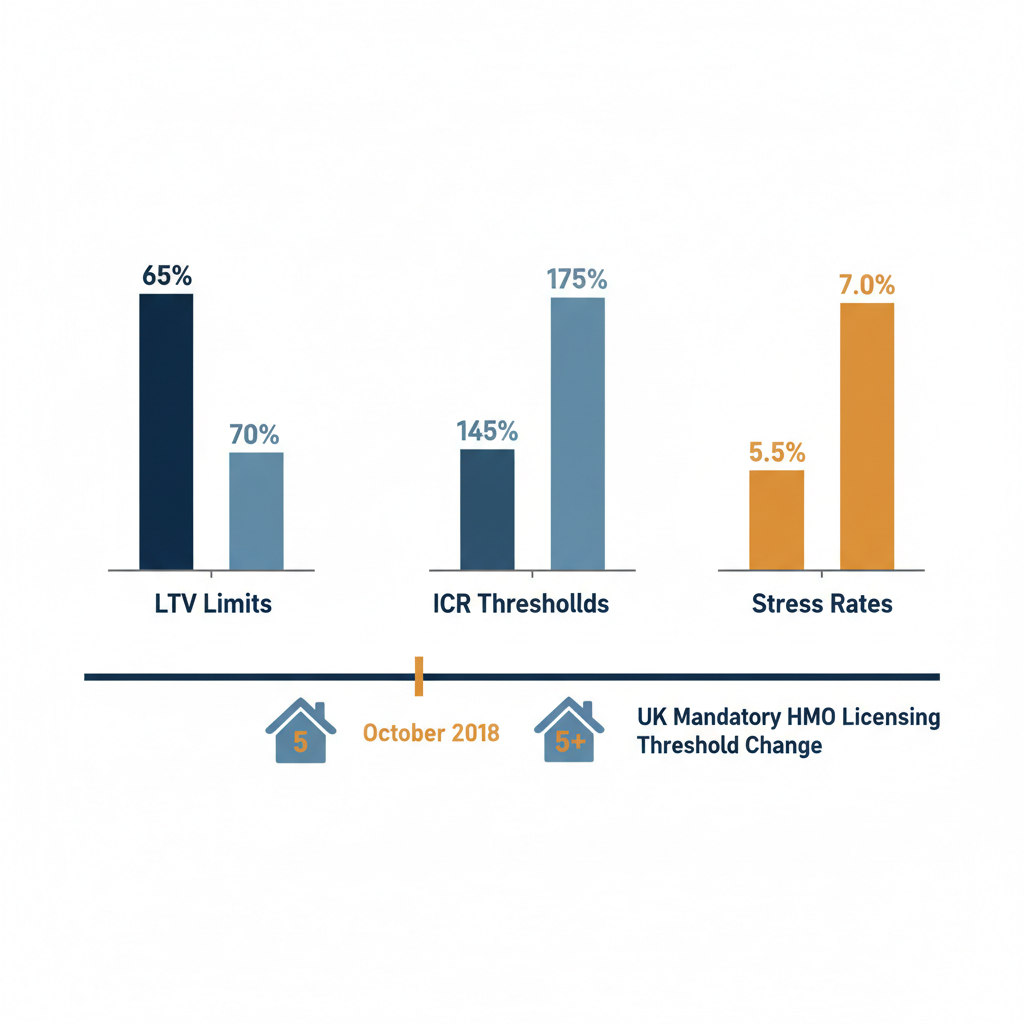
Since 1 October 2018, the mandatory HMO licensing threshold in England has been any property occupied by five or more persons from two or more households — the old three-storey requirement was removed entirely. That single regulatory change is the most important number in the HMO mortgage market. Miss it, and most lenders won't touch you.
This is what understanding HMO licensing and your mortgage: what lenders need before they'll lend actually looks like in practice. Not theory — a read of current product guides, intermediary criteria and lender rate sheets.
What the Numbers Show
Most HMO lenders require a minimum deposit of 25%, giving a maximum loan-to-value of 75%. That is the floor. Large HMOs with seven or more tenants are classified as Sui Generis under planning law and require mandatory licensing. Fewer lenders operate at this end of the market. Deposit requirements typically increase to 25%–35%, and some lenders require 12 to 24 months of HMO-specific experience rather than general landlord experience.
On rates, the spread is wide. Indicative HMO mortgage rates run from around 4.79% on a five- to six-bed personal-name HMO at 75% LTV, with limited company products typically 0.2% to 0.5% higher and sui generis large HMOs (7+ beds) from around 5.5%. Small licensed HMOs price from around 4.5% on a five-year fixed at 75% loan to value, with large sui generis properties and commercial-valuation cases running 5% to 6.5%.
Paragon Bank — one of the deepest specialist lenders in this space — publishes its current HMO criteria openly. Paragon's five-year fixed reference rate is 5.00% for HMOs and multi-unit blocks. The Standard Variable Rate sits at 8.60%, with the Bank Base Rate currently at 3.75%. For five-year fixed HMO products, the ICR calculation rate is either the product charging rate or 5.00%, whichever is greater. For all other products and all property types, the ICR calculation rate is either the product charging rate plus 2% or 5.50%, whichever is greater. Paragon has also extended its maximum loan term from 25 to 35 years and reduced the minimum experience required for HMO and multi-unit block applications from three years to two.
The ICR gap between lenders is significant. The Mortgage Works, as of September 2026, applies an ICR of 125% for basic-rate taxpayers and limited companies, 160% for higher-rate taxpayers, and 175% for all HMO applications. Products under five years are stressed at 5.50% or the pay rate plus 2.00%. That 175% HMO figure from TMW is the tightest standard test in the mainstream market.
Typical market thresholds are 145% at 5.5% stress on a personal-name HMO, and 125% at 5.5% stress on a limited company HMO. The ownership structure you choose changes how much you can borrow from the same lender, on the same property, with the same rent.
Licensing fees are a hard cost that should be in your appraisal from day one. Application fees vary by council — typically £500–£1,500 for five years. Renewal fees typically range from £400–£1,200, with additional charges possible for late applications, inspections and variations.
Licensed HMOs in England must meet national minimum bedroom sizes of 6.51 square metres for a single adult, and licence conditions typically cover maximum occupancy per room, amenity ratios such as bathrooms and cooking facilities per tenant, and management standards. A room that is 6.1 m² fails the standard. That failing room reduces your licensed occupancy, reduces the rent the valuer will certify, and reduces the loan you can borrow.
What This Means for Landlords
Understanding HMO licensing and your mortgage: what lenders need before they'll lend means understanding that the licence is not a box to tick after the mortgage offer. It is a condition of that offer being made at all. HMO licensing status directly affects mortgage eligibility — most lenders require a valid HMO licence or evidence that one is being applied for.
Getting this wrong carries penalties of up to £30,000 per offence, rent repayment orders covering up to 12 months of rent, and the inability to serve valid Section 21 notices. But the mortgage consequence is just as damaging: an unlicensed HMO at completion means a lender can call in or withhold funds, and the property becomes unmortgageable until the licence is in place.
Many councils run additional licensing schemes covering smaller HMOs, and selective licensing schemes covering all rented property in designated areas — so a three-person house-share can need a licence in one street and not in the next. Over 70 councils now operate additional licensing schemes covering smaller HMOs of three to four occupants. Over 60 council areas now have Article 4 restrictions, many covering city-centre wards or areas near universities. Article 4 prevents the conversion of a C3 residential home to a C4 HMO without planning consent — and several lenders require you to confirm Article 4 compliance as part of the application.
The most common minimum experience requirement is 12 months of buy-to-let ownership. This does not need to be an HMO — standard single-let experience qualifies with most lenders. A stricter requirement of 12 months HMO-specific experience applies with some lenders, particularly for larger HMOs of seven or more rooms.
Some lenders also require a minimum annual personal income — often around £25,000 — to ensure the borrower has a stable financial background, in addition to the rental income test.
High-street banks including Santander, NatWest, Barclays and Halifax do not offer dedicated HMO mortgage products. The market is served by specialist lenders such as Paragon, Kent Reliance, Precise, Foundation, Fleet and Landbay. Each has a different appetite for room count, occupancy type, valuation method and licence status.
On early repayment charges, the Paragon product guide dated 13 October 2026 shows a 2-year tracker product with nil early redemption charge and a 5-year fixed product carrying a 3% charge in year three. Paragon has also launched a base-rate tracker range with no early repayment charges, giving landlords the option to switch products at any point during the term without penalty. That flexibility matters if you plan to refinance once licence conditions are fully met and the property value is established.
Shawbrook's buy-to-let business has seen HMOs jump from 27% of its book in 2022–2023 to over a majority of new enquiries — a signal of how fast this end of the market is moving. The lenders are following landlord demand. The question is whether your licence, your rooms and your rent stack up to what the product guides actually require.