Hampshire Trust Bank (HTB) increased its maximum loan-to-value on eligible HMO mortgages to 80% in October 2026 — a move that illustrates exactly how competitive the specialist HMO lending market has become. Most landlords still land at 75% LTV, but knowing which levers actually determine your maximum loan is what separates a well-structured application from a declined one. So here is how much you can borrow on an HMO mortgage, and how to make sure you get the largest loan the numbers genuinely support.
What the Numbers Show
Borrowing on an HMO mortgage is determined by stress-tested rental income rather than salary, so two lenders can produce very different maximum loans on the same property. There are two constraints operating simultaneously: the loan-to-value cap and the interest coverage ratio (ICR) test. Whichever produces the lower number wins.
The LTV constraint
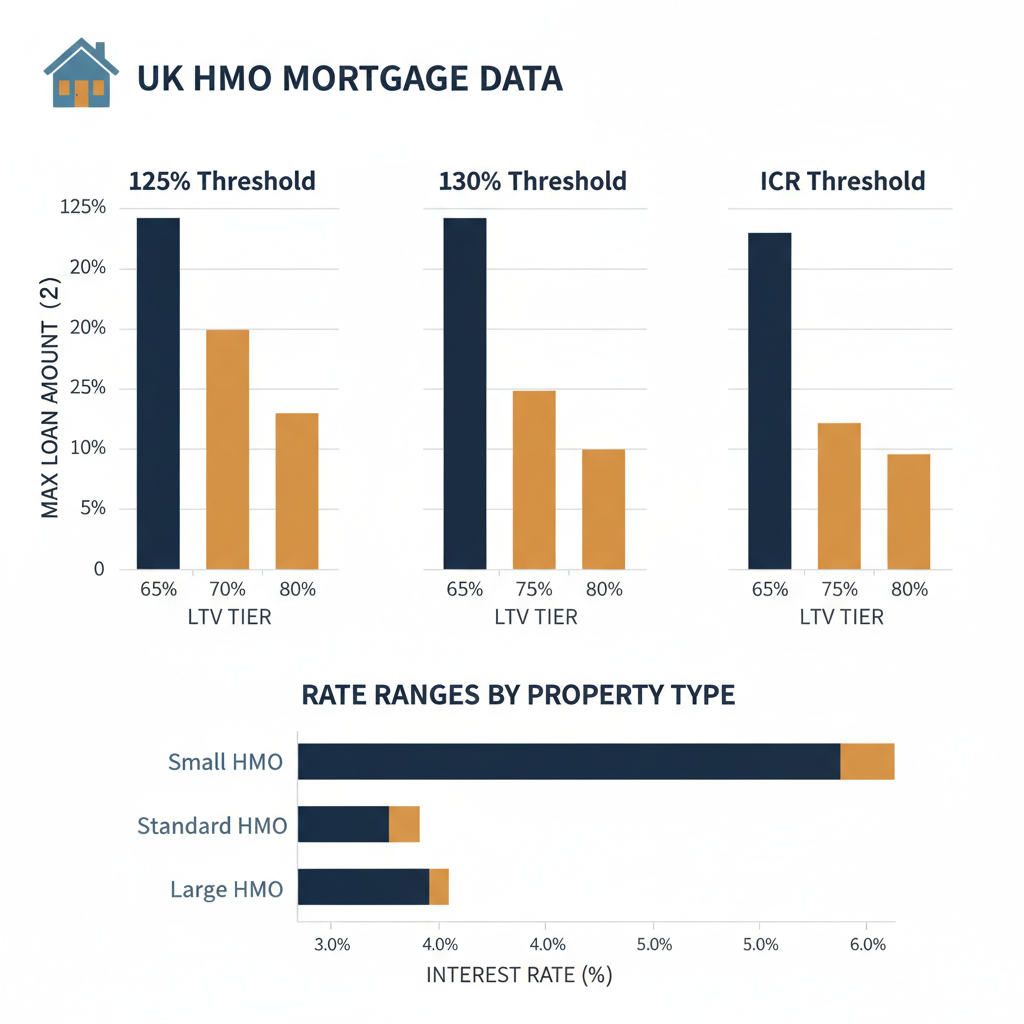
For a small HMO of three to six rooms in a personal name with an experienced landlord, most lenders will go to 75% to 80% LTV. Limited company applicants typically sit at 75%. First-time landlords are generally capped at 65% to 70%, and large HMOs of seven or eight rooms at 70% to 75%. Properties with seven or more bedrooms classified as sui generis are typically assessed on a semi-commercial or commercial basis, where you should expect LTVs of 65% to 75%.
On a £300,000 property, the difference between a 75% and a 65% LTV cap is an additional £30,000 in required deposit — a meaningful cash-flow consideration for portfolio builders.
The ICR constraint
This is where the precise answer to how much can I borrow on an HMO mortgage is actually calculated. Lenders assess HMO rental income per room, based on the valuer's opinion of the market rent achievable for each room. The total projected income must pass the ICR stress test — typically 125% to 145% of the mortgage payment at a stressed interest rate. This differs from standard BTL where a single whole-property rental figure is used.
The formula is: Maximum loan = Annual rent ÷ stress rate ÷ ICR
Take a four-room HMO with four lettable rooms at £550 per month each — £2,200 per month, or £26,400 per year. Stressed at 5.5%, at a 130% ICR the maximum loan is approximately £369,200. At a 145% ICR on the same property, that falls to approximately £331,000.
That £38,000 difference comes purely from the lender's ICR setting — not the property, not the rent, not the borrower's personal income. A lender using a 5.5% stress rate versus one using 7% on the same property can produce a borrowing difference of £40,000 to £60,000. Lender selection, in other words, is not an afterthought.
Current rate context
For a personal-name five-to-six-bed standard HMO, indicative rates currently start from around 4.79% at up to 75% LTV, with a 145% ICR tested at 5.5% for higher-rate taxpayers. Limited company five-to-six-bed HMOs price from around 4.99% to 5.29% at 70% to 75% LTV, tested at 125% ICR at 5.5%. Sui generis large HMOs of seven or more bedrooms start from around 5.5%.
Drop to 65% LTV and you unlock materially lower rates — sometimes 0.3% to 0.5% better than the 75% tier. That rate improvement also feeds back into the ICR calculation, potentially allowing a slightly larger loan at the same rent level.
Arrangement fees and ERCs
Fees are part of the true cost of any HMO mortgage. Arrangement fees typically run from 1% to 2% of the loan amount across the specialist HMO market. Looking at Paragon as a specific example: two-year tracker options for HMOs and MUBs start from BBR plus 1.35% with a 2.00% product fee, and include a free valuation and no early repayment charges. Fixed-rate products from Paragon carry early repayment charges of 3% in each of the first two years, reverting to Paragon's standard variable rate of 7.35% less 1.25%.
Paragon's application fee for HMO and MUB applications is around £299, though this may be waived for multi-property applications.
What This Means for Landlords
The single most important thing a landlord can do before submitting an HMO mortgage application is run the ICR calculation with the correct inputs for each lender under consideration. HMO rental income is typically stress-tested at 125% to 145% interest cover, depending on how you hold the property. Borrow through a limited company and the ICR is often the friendlier 125%. That alone can add tens of thousands of pounds to your available loan compared with a personal-name application using a 145% ICR.
Whether the lender assesses rent room-by-room or uses a single-let equivalent also matters: room-by-room assessment produces higher rental figures and supports larger loans. Some lenders default to single-let equivalent valuations on HMOs — a significant handicap on higher-yielding properties.
How much can I borrow on an HMO mortgage is ultimately a three-variable question: your property value, your room-by-room rental income, and the lender's specific ICR and stress rate. Lenders attach more risk to multi-tenant properties because of the added management complexity, higher tenant turnover, and licensing obligations involved. The exact rate depends on the size and type of HMO, your experience, the loan-to-value, and how the application is packaged.
That packaging is where specialist advice delivers real money. Many high-street lenders will not lend on HMOs at all. The active HMO market in 2026 is led by Paragon, Kent Reliance and Precise (both OSB Group), Shawbrook, Aldermore, Fleet Mortgages, CHL Mortgages, Landbay, Foundation Home Loans and Hampshire Trust Bank. Each applies different stress rates, ICRs, room-count limits and valuation methodologies. Placing the application with the wrong lender can cost you £40,000 to £60,000 in maximum loan size before a single rate comparison is made.
Running your numbers through a whole-of-market HMO mortgage broker before you offer on a property — not after — is the difference between a deal that works and one that ties up your capital in a property the lender will only half-fund.