One BTL lender's mortgage conditions state explicitly: "a condition of the advance is that the mortgaged property is not a House in Multiple Occupation (HMO) and will not be used as an HMO at any time in the future… letting it as an HMO will constitute a breach of the mortgage conditions." That is not unusual small print. It is the standard position across the specialist BTL market. So if you are asking turning your buy to let into an HMO: do you need to tell your lender? — the answer is yes, and you need to do it before a single new tenancy agreement is signed.
What the Numbers Show
A standard buy-to-let mortgage almost never permits HMO use. Letting to three or more unrelated tenants without your lender's consent is a breach of your mortgage terms and can trigger recall of the loan. The tipping point is lower than many landlords assume. A House in Multiple Occupation is a property rented out by at least 3 people who are not from one household and share facilities like a bathroom or kitchen. Your standard BTL deal was not priced or structured for that risk profile, which is why lenders treat conversion as a material change requiring a new decision.
The Housing Act 2004 requires mandatory licensing of certain HMOs. Mandatory licensing is required where the HMO is occupied by five or more persons living in two or more separate households. Licence fees run from approximately £700 to £1,800 for a five-year licence, depending on local authority. The maximum civil penalty for operating an unlicensed HMO is now £40,000 under the Renters' Rights Act 2025. Additional licensing is a discretionary scheme councils can introduce under Section 56 of the Housing Act 2004, extending licensing to smaller HMOs that fall below the mandatory threshold, typically properties with 3 or 4 occupants. Always check with your local authority — you may need a licence well before you hit 5 tenants.
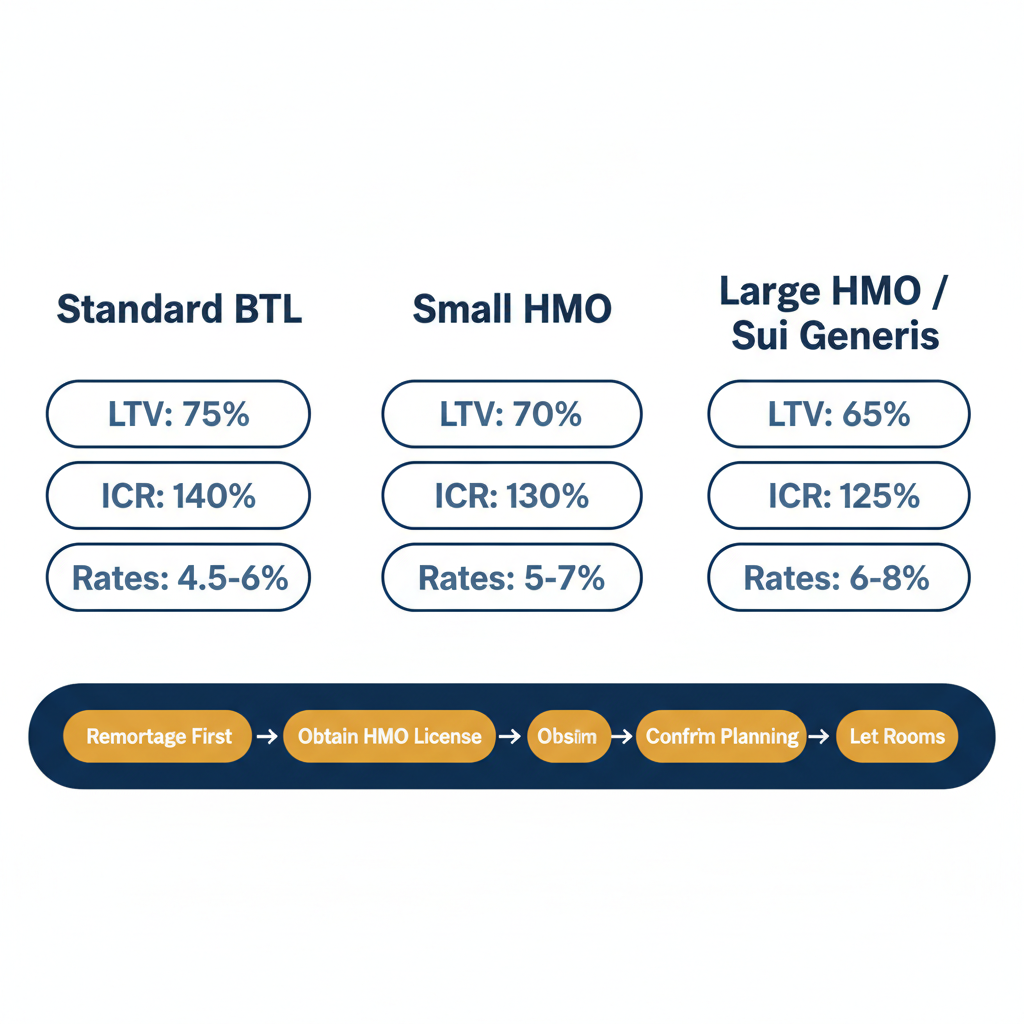
On the mortgage side, the gap between a standard BTL product and an HMO product is measurable. Current pay-rate ranges for small HMOs (up to 6 rooms) on a 5-year fixed run from 4.77% to 6.88%, and on a 2-year fixed from 3.55% to 7.34%. Limited company products typically run 0.2% to 0.5% higher, and sui generis large HMOs (7+ beds) start from around 5.5%. The ICR test is tighter too: lenders assess income on a room-by-room basis and require it to cover the mortgage payment at a stressed interest rate, typically 125% of the mortgage payment for basic-rate taxpayers and 145% for higher-rate taxpayers.
Take a concrete example. A £300,000 HMO mortgage at a 5.5% stress rate with a 145% ICR requires annual rental income of at least £23,925 (£300,000 × 5.5% × 145% = £23,925). The inputs matter: change the ICR to 125% and the minimum annual rent drops to £20,625. If the rental income does not meet the threshold at the stressed rate, the lender will not advance the loan, regardless of the property's value.
LTV limits are also more restrictive than standard BTL. For a small HMO (3–6 rooms) in an experienced landlord's personal name, the typical maximum LTV is 75% to 80%. Limited company small HMOs sit at 75%. First-time landlords are capped at 65% to 70%, and large HMOs (7–8 rooms) run 70% to 75%.
What This Means for Landlords
Turning your buy to let into an HMO: do you need to tell your lender? is really two questions in one: do you need permission, and how do you get the right product in place? The answer to the first is unambiguous. You must either obtain consent to let as an HMO from your existing lender — which is rarely granted on standard BTL products — or remortgage onto a specialist HMO mortgage product before converting.
From a lender's perspective, HMOs are a more specialist lending proposition. If the lender you're currently with for buy-to-let also does HMOs, you can approach them for consent to switch — but if they don't do HMOs, you'll need to change lenders. Paragon, for example, accepts HMOs up to 20 rooms, with a maximum LTV of 75%, minimum landlord experience of three years, ICR of 130%–145% depending on tax status and property type, and minimum property values of £100,000 for up to 10 rooms and £150,000 for up to 20 rooms. Paragon charges a £299 application fee, and HMO valuation fees run from £500 on properties valued up to £100,000 to £1,035 on properties valued between £900,001 and £1,000,000. Fixed-rate products carry an early repayment charge during the fixed period; Bank Base Rate tracker products carry no early repayment charges throughout the full term.
Kent Reliance is another active HMO lender. Its tariff of mortgage charges, effective from 26 March 2026, states that an early repayment charge applies if you switch mortgage product or lender during a special rate period such as a fixed or tracker rate. The mortgage exit fee is £21. ERCs are product-specific and set out in the mortgage offer — check yours before you remortgage, or you could crystallise a charge that wipes out months of enhanced HMO income.
Planning is the other variable. Converting a single home (use class C3) to a small HMO of three to six people (use class C4) is permitted development across most of England, so no planning application is needed — unless the council has removed that right with an Article 4 direction, in which case a full application is required. A large HMO of seven or more people is always sui generis and always needs planning permission.
Many lenders want 12 to 24 months of prior BTL ownership before they will consider an HMO mortgage. Lenders also want to see that you hold the necessary HMO licence and that the property meets all fire safety and housing standards. You'll need at least to prove that you've applied for an HMO licence from your local authority; lenders differ on whether you must actually have one in place or just have applied.
The sequence matters. Remortgage onto the correct HMO product first. Obtain your HMO licence (or confirmation that one is not required). Confirm any planning position in writing. Only then let the rooms. Reversing that order — letting first, sorting the mortgage later — is where landlords create serious problems: a potential breach of mortgage terms, invalidated landlord insurance, and exposure to civil penalties that now reach £40,000 per offence.
Many high-street lenders will not lend on HMOs at all. That narrows the lender pool from the outset and makes it worth establishing your exit route before you begin any conversion work.