6.04%. That is where Keystone Property Finance's holiday let range opens as of 23 September 2026 — at 65% loan-to-value (LTV), verified by The Intermediary's rate reporting. Holiday let rates at Keystone start from 6.04% at 65% LTV following its most recent repricing round. For context, the lender's standard BTL products start from 3.74% at 70% LTV after the same round of cuts. That gap — well over 2 percentage points — tells you everything about how the specialist market prices short-term rental risk in 2026.
What the Numbers Show
Holiday let mortgage rates currently span a typical range of 5.69% to 7.50%, with the market premium over standard BTL sitting at roughly 1% to 2% at the same LTV. Where you land in that range depends almost entirely on three variables: LTV, fix length, and location quality.
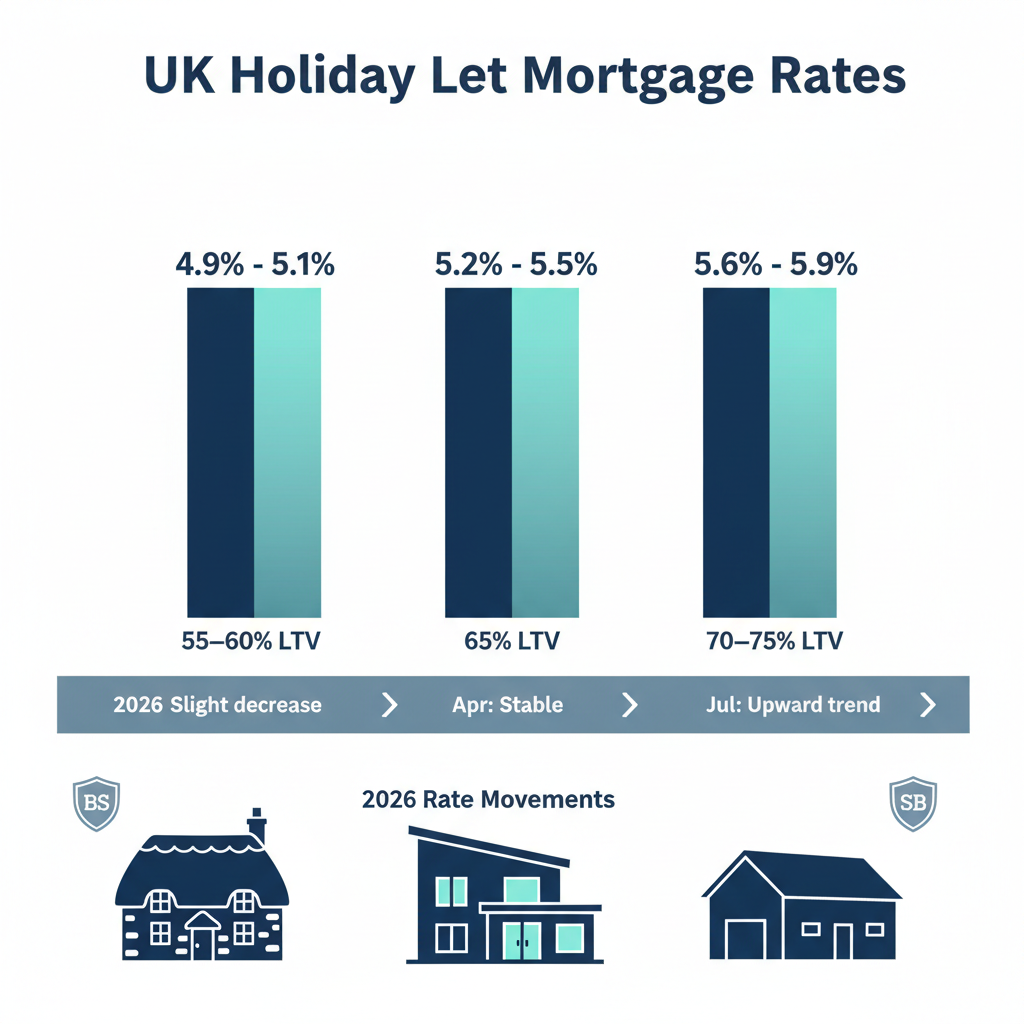
At 55%–60% LTV, two-year fixed rates run from approximately 5.50% to 6.20%. At 65% LTV — the sweet spot for most active lenders — two-year fixed rates sit between 5.69% and 6.50%. Push to 70%–75% LTV and that range widens to 6.20%–7.50%, with fewer lenders willing to participate.
Hodge Bank is one of the few lenders operating at 80% LTV. In March 2026, Hodge increased its maximum holiday let LTV from 75% to 80% and raised its maximum loan size from £1.5 million to £2 million. Its current intermediary rate sheet, updated 20 October 2026, prices accordingly: with updated rates available from 9am on 20 October, Hodge's live holiday let range includes a 2-year fixed at 6.99% with a £995 fee at 75% LTV, a fee-free 2-year fixed at 7.19% at 75% LTV, and a 5-year fixed at 6.75% with a £1,995 fee at 75% LTV. At 80% LTV, the 2-year fixed starts at 6.85% with a £1,995 fee and moves to 7.25% fee-free. Hodge charges early repayment charges (ERCs) of 3% in both year one and year two on its fixed products.
Cumberland Building Society operates at the other end of the risk spectrum. The Cumberland offers what it describes as market-leading holiday let products and has over 30 years' experience lending into this sector. Its maximum LTV sits at 75%, with a minimum property value of £150,000 and a maximum single loan of £2 million. The Cumberland permits personal use of up to 60–90 days per year, outside peak letting periods. Proc fees for new borrowing sit at 0.40% gross.
Fee structure matters as much as headline rate. Keystone's product guide, correct as of 30 September 2026, shows its holiday let 2-year fixed at 65% LTV available with 2.5% and 5.0% arrangement fee tiers, with a reversion rate of 4.99% plus Bank Base Rate. Keystone's most recent repricing round reduced 2-year fixed rates by 0.15% and cut 5-year fixed rates carrying 2.5% and 7% arrangement fees by 0.15%; 5-year products with a 5% fee were reduced by 0.05%.
The ICR test is where most cases live or die. Hodge requires the property to yield a minimum rental income of 140% of interest payments, stressed at the higher of either pay rate plus 2% or 5.5%. Bath Building Society requires rent to cover 125% of stressed mortgage payments for basic-rate taxpayers, or 145% for higher-rate taxpayers, stressed at the product rate plus 2% or 5.5% — whichever is higher — except on 5-year fixed or like-for-like remortgages, where the pay rate is used.
The income figure itself is constructed from seasonal projections. Lenders build a notional income from a holiday letting agency's low, mid, and high season weekly rates, average them, assume around 30 weeks' occupancy, then apply an ICR test. The largest specialists want 140% to 145% coverage whatever your tax band, and some deduct 20% from gross income for letting costs first — which cuts the maximum loan by a fifth before the ICR is even applied.
What This Means for Landlords
The abolition of the Furnished Holiday Letting (FHL) tax regime on 6 April 2025 was the most significant structural change to this sector in a decade. From that date, personal-name holiday let owners became subject to Section 24 mortgage interest restrictions. Lenders have adapted how they underwrite income, but the rate sheet hasn't softened to compensate. Short-term rental income is now assessed case by case, and the old FHL occupancy tests — available 210 days, let 105 days — survive only where an individual lender still uses them as a letting-viability benchmark.
For the arithmetic to stack, you need strong gross income relative to your loan. Take a verified worked example: a £42,000 gross annual rental income against a £318,750 loan at 5.69% on a 5-year fixed rate produces an ICR comfortably above a lender's 125% coverage requirement at a 5.5% stress rate for a limited company application. That property — a Cotswolds cottage — cleared the affordability hurdle, but only because the letting history was strong and the LTV was conservative.
Most lenders in 2026 are using an ICR of 125% to 145%, with limited company applications typically at the lower end of that range. That distinction is worth noting: borrowing through a special-purpose vehicle (SPV) can produce a more generous maximum loan from lenders that price limited company risk more leniently than personal-name exposure.
The typical maximum LTV is 75%, with select lenders going to 80% on strong cases; minimum loan sizes start from £50,000 and maximum loan sizes reach £2 million with most lenders; terms run from 5 to 25 years on either repayment or interest-only bases.
Keystone's holiday let criteria require the property to be available for letting for at least 210 days a year, borrowers must have a minimum personal income of £25,000 (excluding holiday let rent), and must own at least one existing BTL property or two holiday lets already. That last rule eliminates a large swathe of first-time investors from Keystone's panel — but not from the market. Cumberland lends to first-time holiday let investors, and Hodge explicitly accepts first-time buyers and first-time landlords with no minimum personal income requirement.
Properties in premium holiday let locations — the Lake District, Cornwall, and Edinburgh — attract the best rates; urban or non-premium locations carry a premium of 0.3% to 0.8% on top of standard pricing. Location is a lever you cannot pull after completion. Choose it carefully at the outset. Most holiday let mortgage lenders require a minimum deposit of 25%–30%, equating to a maximum LTV of 70%–75%; some specialist lenders cap at 65% LTV, requiring a 35% deposit. Every percentage point of additional equity you put in at purchase has a direct, compounding effect on both the rate tier you access and the ICR headroom your income needs to provide.