The Single Factor That Decides Everything
Holiday Let vs. Long-Term Let: Which Mortgage and Tax Setup Works Better? The answer used to involve a detailed tax calculation. It no longer does. The Furnished Holiday Lettings regime was abolished from 6 April 2025 for income tax and capital gains tax, and from 1 April 2025 for corporation tax. From that date, the tax treatment of a Cornish cottage let through Airbnb and a terraced house in Leeds let on a periodic tenancy became identical — both subject to Section 24, both taxed as standard UK property income. The decision now hinges on one number: whether your net yield after operating costs clears the higher mortgage rate and heavier management burden of short-term letting.
That is the framework. Everything else follows from it.
When Holiday Let Makes Sense
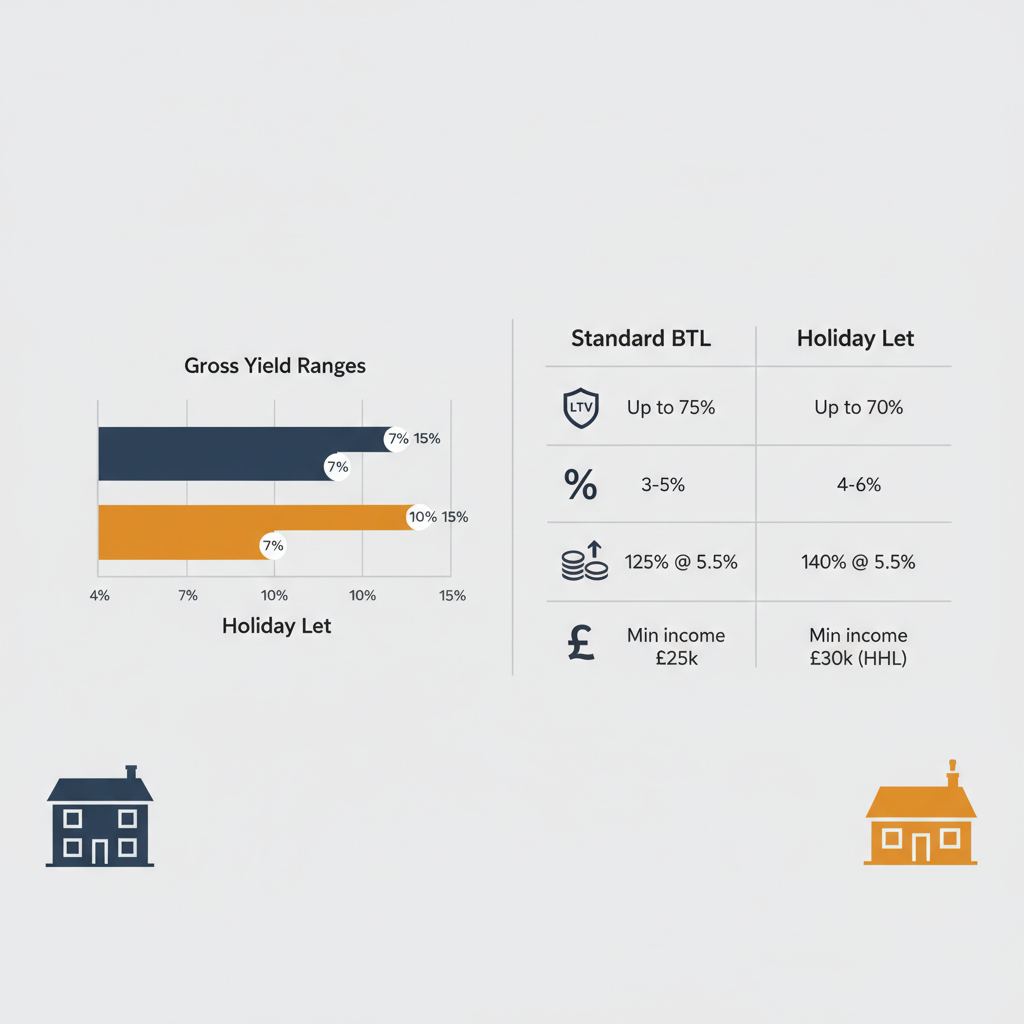
The gross income case for holiday letting remains real. A well-managed holiday let in a prime UK tourist hotspot can achieve gross yields between 8% and 12%, compared with an average gross yield of around 6% nationally for standard buy-to-let, rising to 7.5%+ in the North East and Scotland. In prime coastal locations the gap is wider still: Cornwall achieves peak nightly rates of £250–£450 with annual occupancy of 55–70% and gross yields of 8–12%; the Lake District runs £200–£500 per night, 60–75% occupancy and yields of 8–14%.
The mortgage product, however, costs more and demands more equity. Rates from 5.5% on 5-year fixed terms as of April 2026, with the top of the market running to 7%. Maximum LTV is 75%, with select lenders going to 80% on strong cases. The lender applies an ICR at pay rate or stressed rate depending on the product; most lenders in 2026 use an ICR of 125% to 145%. Critically, lenders assess affordability on projected occupancy reports from a recognised letting agent — not on a single guaranteed rent figure. That subjectivity means your approval can depend heavily on which agent signs off the forecast.
Holiday letting still makes sense in three specific scenarios: a proven, high-demand tourist location with documented occupancy above 60%; an investor who can absorb seasonal void periods without relying on rental income to service the mortgage; and a limited company structure, where properties owned within a limited company are tested against an ICR of 125%, while personally held properties remain subject to 145%. The company route costs roughly 0.3–0.7% more in rate but unlocks a tighter ICR — worth modelling on larger loans.
When Long-Term Let Makes Sense
The standard buy-to-let mortgage is cheaper, simpler and more widely available. The average 5-year fixed BTL rate at 75% LTV is currently 5.7% (with a £2,000 fee), with the lowest available deals at 5.03% at the same LTV. Molo cut all 2- and 5-year fixed rates across its standard BTL range on 11 November 2026 — 2-year fixed rates to 3.60% and 5-year rates to 5.30%, both at up to 75% LTV. Barclays currently offers a 5-year fixed BTL at 5.30% with a £899 fee at 75% LTV.
Affordability stress-testing is also more predictable. Basic-rate taxpayer BTL applicants are tested at 125% ICR with a stress rate of 5.5–8%; higher-rate taxpayers at 160% ICR at the same stress rate; limited company applicants at 125%. Those are firm, documented inputs — not dependent on a letting agent's occupancy projection.
Long-term let management fees typically sit between 8–12% of monthly rent, compared with specialist holiday let management that commonly runs to 20–25%. Voids on a long-term tenancy are measured in days, not months. For investors with smaller equity positions, properties in non-tourist areas, or portfolios requiring predictable monthly cash flow, the long-term let wins on every operational metric except gross headline yield.
The Calculation That Decides It
Run both models on the same property before you commit to a structure. Use these verified inputs.
Standard BTL worked example — £300,000 property at 75% LTV (£225,000 loan)
- Stress rate: 5.5% (PRA SS13/16 floor, standard across most lenders)
- ICR for a higher-rate taxpayer (personal name): 145%
- Minimum annual rent required: £225,000 × 5.5% × 145% ÷ 100 = £17,944
- That is £1,495/month — the floor to pass the stress test
To find maximum loan from rent: divide annual rent by the stress rate, then divide by the ICR. Example: £14,400 annual rent ÷ 5.50% stress rate ÷ 125% ICR = a maximum loan of £209,455.
Holiday let worked example — same £300,000 property, 75% LTV, rate 5.5%
- ICR: 145% (personal name, post-April 2025)
- Minimum annual projected rent from letting agent report: £225,000 × 5.5% × 145% ÷ 100 = £17,944
- But the property also needs to cover an interest rate 0.3–0.7% above standard BTL, plus management fees of 20–25% and cleaning costs — stripping back the gross income advantage significantly
The break-even question is simple: does the holiday let's additional gross income (after platform fees of roughly 3%, cleaning at £80–£120 per changeover, and a management fee nearer 20–25%) exceed what a long-term let would net after an 8–12% management fee and typical void allowance of 2–4 weeks per year? The cost differential between the two models is significant and often underestimated by landlords who focus only on the gross income comparison.
The tax position is now equal. From 6 April 2025, personal-name holiday let owners are subject to Section 24 restrictions, meaning mortgage interest is relieved only as a 20% basic-rate tax credit — identical to a standard BTL. A gain on disposal of a former holiday let is now standard residential CGT: 18% within the basic-rate band and 24% above it, for 2025/26. Holiday let profit no longer counts as relevant UK earnings from April 2025, so it cannot support tax-relieved pension contributions on its own.
The only remaining structural advantage of holiday letting is gross income. Confirm that advantage is real — not just a headline nightly rate on a letting agent's optimistic forecast — before paying the premium mortgage rate to access it.