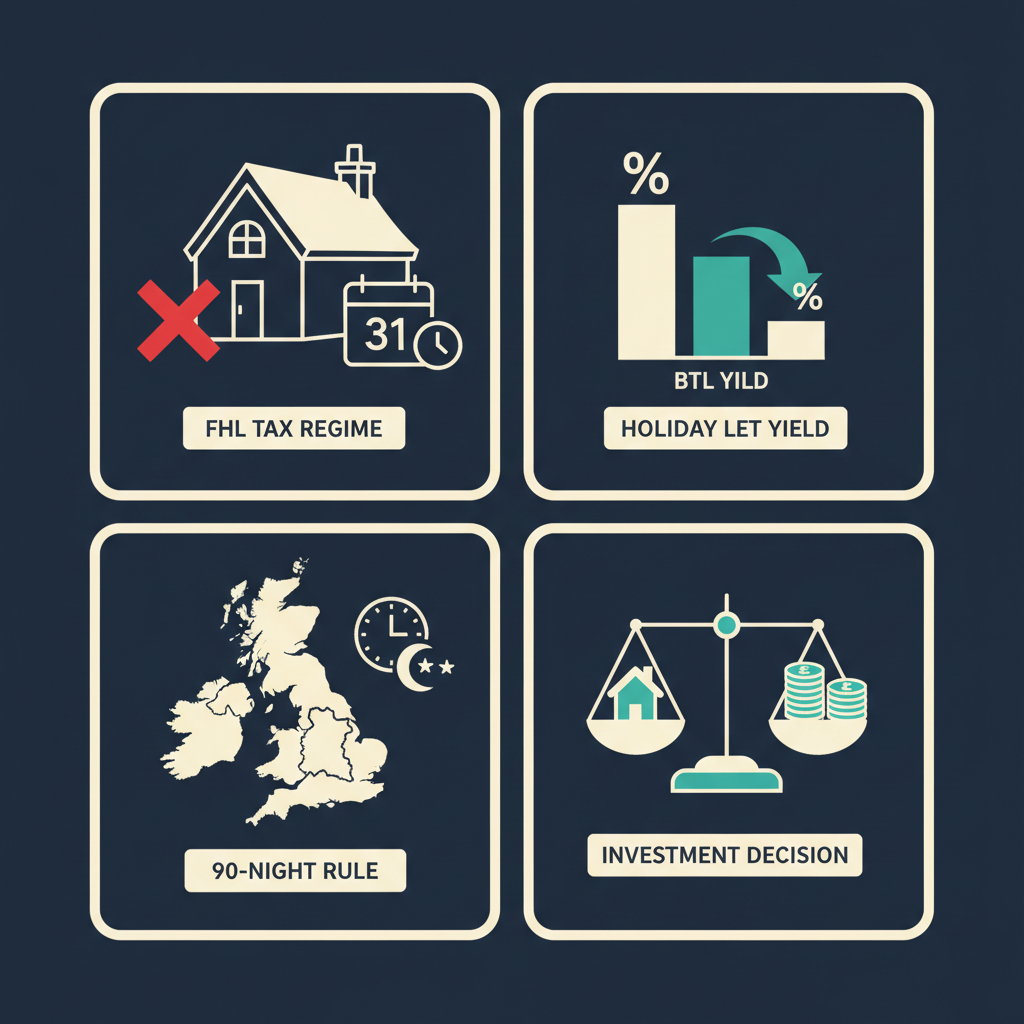
The furnished holiday letting tax regime ended at 6 April 2025 — with no transitional provisions and no grace period. There were no transitional provisions; the change took effect immediately from 6 April 2025, the start of the 2025/26 tax year. For a sector that had enjoyed preferential treatment since 1984, that is a significant reset. The question now is whether the numbers still work.
What the Numbers Show
The furnished holiday lettings regime was abolished from 6 April 2025, and your cottage, lodge or seaside flat is now taxed like any other rental. The change took effect from 6 April 2025 for income tax and capital gains tax, and from 1 April 2025 for companies within corporation tax.
Four specific advantages disappeared on that date. First, capital allowances. FHL properties could previously claim capital allowances on furniture, fittings, and equipment — sofas, beds, kitchen appliances, TVs. Standard buy-to-let cannot claim capital allowances; it uses the replacement of domestic items relief instead, which only covers replacements, not original purchases. Second, full mortgage interest relief. Until April 2025, FHLs were exempt from Section 24 restrictions. Holiday let owners now face the same Section 24 restrictions as residential landlords, meaning mortgage interest is no longer deducted pound-for-pound from rental profits. Only a 20% basic-rate tax credit remains. For a higher-rate taxpayer carrying a £300,000 interest-only mortgage at 5.5%, the effective tax cost of that restriction is material.
Third, the CGT position changed sharply. FHL properties previously qualified for Business Asset Disposal Relief, taxing gains at 10% rather than 18%/24%. They could also qualify for Gift Relief (holdover relief) and Business Asset Rollover Relief. These CGT advantages are now lost. Standard residential CGT rates of 18% (basic rate) and 24% (higher and additional rate) now apply, after the £3,000 annual exempt amount.
Fourth, pension planning. From 6 April 2025, holiday let profits no longer count as relevant UK earnings — the figure that sets how much you can pay into a pension with tax relief. For a higher earner who was using FHL profits to maximise pension contributions, that is a structural planning loss.
One small beneficial transitional provision is worth knowing. FHL losses brought forward at 5 April 2025 can be offset against any UK property income — not just FHL income — in 2025–26 and later years.
On the gross yield side, holiday lets still outperform long-term rentals in the right location. A well-managed holiday let in a prime UK tourist hotspot can achieve gross yields between 8% and 12%. In 2025, the Cumbria and Lake District region averaged £28,400 in annual gross turnover, and Cornwall averaged £24,600. By contrast, the average gross rental yield in the UK for standard buy-to-let stood at approximately 6% to 7% in late 2025. The gross gap is real. The critical question is what happens to it after costs, vacancies, Section 24, and management fees.
Holiday lets have significantly higher running costs than standard buy-to-let — cleaning, utilities, furnishing, and platform fees all reduce the net figure. Airbnb charges its own platform fee. Professional management typically runs at 20–25% of gross income. When you layer Section 24 on top for a mortgaged, higher-rate taxpayer in a personal name, the effective net yield after the Section 24 impact at 40% tax may be 1–2% in a scenario where the property is heavily financed.
What This Means for Landlords
The mortgage market has not closed its doors. The FHL abolition changed tax treatment rather than directly changing the existence of holiday let mortgage products. Lenders still offer holiday let mortgages, still assess projected rental income, and still apply deposit and affordability criteria.
The lender pool is specialist and smaller than standard BTL. Specialist BTL lenders with holiday let permission include Shawbrook, Paragon, Hodge, Landbay, West One and Precise. Leeds Building Society offers a holiday let range up to 70% LTV for first-time landlords, and Vida has a holiday buy-to-let range. The Mortgage Works does not accept holiday lets.
On deposit requirements, you'll normally need at least 25% of the value of the property. Holiday let mortgages are considered riskier for lenders, and whilst 25% is the common minimum, some lenders may require 30–40% depending on the property type, location and borrower profile. On income assessment, holiday let lenders typically test at 125–150% ICR against a stress rate of 5–5.5%, meaning the projected annual income must exceed the stressed mortgage interest by the required factor. That is a tougher hurdle than some standard BTL products.
Most lenders require a minimum personal income of £25,000 to £40,000 per year alongside the projected rental income, to ensure mortgage payments can be maintained during low-occupancy periods. Rates price a premium over standard BTL: interest rates are typically 0.3–0.7% above standard BTL rates, and lenders tend to favour properties in established tourism markets.
Company ownership is the structural question that the post-FHL world has sharpened. Holiday lets held through a UK limited company still get full mortgage interest deduction against company profits, as limited companies are outside Section 24. For a higher-rate taxpayer with a meaningful mortgage and strong gross income, the corporation tax route can recover a significant part of what Section 24 removes. The trade-off is extraction costs, complexity, and the need to hold existing properties personally if they were already purchased that way.
On planning and local restrictions, the picture varies considerably by location. As things stand, there is no general requirement for planning permission to let a property short-term in most of England, and no dedicated short-term let use class is yet in force. However, the practical lever councils use is the Article 4 direction, which lets a local authority in a high-pressure area remove permitted-development rights and require planning permission for a change to short-term letting. Outside London the rule is: usually no permission needed now, but check your local authority, because hotspots are increasingly using Article 4 powers, and a dedicated use class has been proposed — though its timing, and even its final form, remain uncertain.
London is the clear outlier. Under the Deregulation Act 2015, a whole property in Greater London cannot be let on a short-term basis for more than 90 nights in a calendar year without planning permission for change of use. Platforms like Airbnb automatically block listings once they hit 90 nights.
The business rates threshold also remains relevant. In England, a holiday let is assessed for business rates instead of council tax if it was available to let for at least 140 nights in the last 12 months, actually let for at least 70 nights, and will be available for at least 140 nights in the next 12 months. With the FHL regime gone, owners should review whether their occupancy levels still meet the business rates threshold, as council tax may now be higher than business rates for some properties.
The arithmetic is tighter than it was before April 2025. A holiday let in Cornwall or the Lake District, owned in a limited company, with strong occupancy, low leverage and active management, can still deliver a net yield that outperforms a standard long-term let in the same postcode. The same property, held personally, heavily mortgaged, and relying on off-peak bookings to hit 70 nights, is a harder case to make. You simply need to ensure the deal stacks up on yield alone without relying on tax benefits.