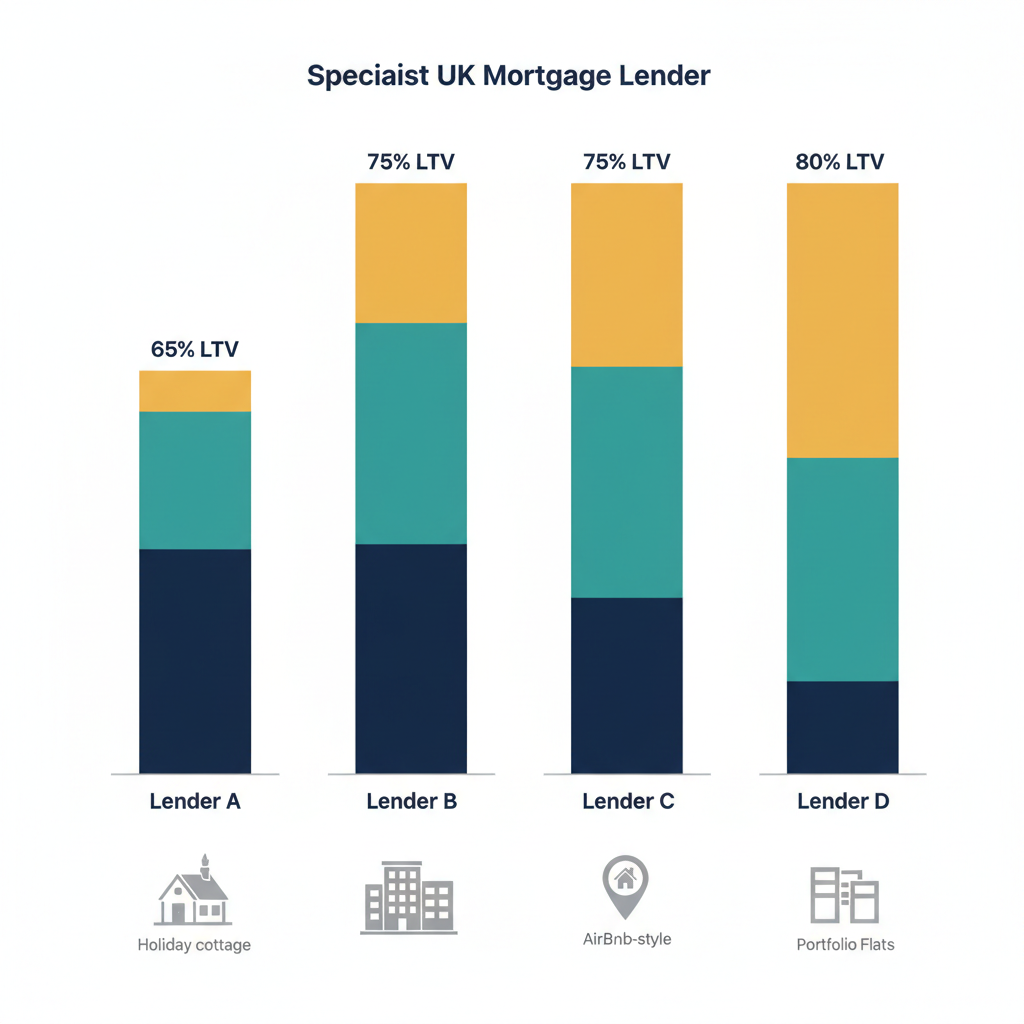
Hodge Bank increased its maximum loan-to-value for holiday let mortgages from 75% to 80% in March 2026, making it the most aggressive lender on deposit requirement in the short-term let space. That single shift matters enormously for landlords who want to preserve capital while entering the serviced accommodation and Airbnb mortgage market. This article audits what the active lenders are actually offering right now on serviced accommodation and Airbnb mortgages: which lenders will lend on short-term lets, how they assess income, and where the hard limits sit.
What the Numbers Show
A serviced accommodation mortgage is a specialist buy-to-let or commercial mortgage for a property let on a short-term basis to business travellers, contractors, or tourists. High street lenders will not fund serviced accommodation. The market is entirely specialist, and criteria vary sharply between lenders.
CHL Mortgages runs the most transparent published rate sheet in this sector. Its short-term let range, suitable for holiday lets and serviced apartments, offers 2-year fixed rates from 3.81% at 65% LTV with a 7% fee, up to 7.21% at 65% LTV with no fee, and at 75% LTV from 3.91% with a 7% fee. Its 2-year fixed early repayment charges are 3% in year one and 2% in year two. Its ICR is stressed at the highest of 5.50% or the initial pay rate plus 2%. CHL also offers 5-year fixed products at 75% LTV from 5.65% with a 7% fee, with ERCs of 5/5/3/3/3, and stresses those at the pay rate only. Critically, CHL also offers 80% LTV products on its short-term let range, with a 2-year fixed available from 4.94% with a 5% fee.
Shawbrook Bank expanded its serviced accommodation criteria in June 2025. It now lends on portfolios and larger blocks of flats operated as serviced accommodation. For portfolios with 10 or fewer units, no additional evidence is required. The maximum loan amount is based on market rent under an AST, confirmed by valuation, up to 75% LTV across its buy-to-let product range. For portfolios exceeding 10 units, either two years' accounts for established assets or a cashflow forecast for new assets is required. Shawbrook requires a minimum of 12 months' experience as a buy-to-let landlord.
Hodge Bank is the most permissive on LTV. Hodge lends at 80% LTV up to £2 million property value for holiday lets, imposes no minimum personal income requirement, and caps the portfolio at 4 mortgaged properties excluding the primary residence. The ICR requirement is 145% of interest payments stressed at 5.5%. Hodge calculates rental income using an average of projected low, medium and high season weekly rental yield based on 30 weeks' occupancy. Hodge also explicitly permits Airbnb lettings on its holiday let mortgage.
The lender tier structure for Airbnb income is distinct from standard serviced accommodation. Shawbrook, Paragon and Hodge sit in the tier that accepts direct trading income from Airbnb, used for remortgages and trading-property purchases. A second tier — including Cumberland Building Society, Furness Building Society, Leeds Building Society and Harpenden Building Society — uses AST comparable rent at 145% ICR as the primary test, accepting Airbnb history as supporting evidence only. A third tier accepts a written projection from an ARLA-qualified or RICS-registered agent in place of trading history, useful on a purchase where the property has no platform history — Shawbrook, Hodge and Suffolk Building Society operate in this space on the right cases.
Foundation Home Loans also accepts short-term and holiday let properties within its BTL range. Foundation confirms that properties may be let on an Assured Periodic Tenancy, short-term or holiday let basis. Its short-term let products are positioned for portfolio and non-portfolio landlords at up to 75% LTV, with 2-year fixed ERCs of 3% in year one and 2% in year two.
On income assessment, lenders split into two approaches. The majority use the AST equivalent rent — what the property would achieve on a standard 12-month tenancy, confirmed by a RICS valuer — stressed at typically 5.5% or above, with an ICR of 125% for basic-rate taxpayers and 145% for higher-rate taxpayers. The minority, including Shawbrook and Hodge, will consider actual trading income from platforms, though Airbnb statements show gross booking value before cleaning fees, platform fees and VAT — typically 18% to 24% of the headline figure — and most lenders want at least 12 months of trading before placing weight on the number. A small number want 24 months.
On borrower eligibility: most specialist holiday let lenders require a minimum personal income of £20,000 to £40,000, a clean credit profile, prior property ownership in many cases, and a deposit of 25% to 35% depending on the lender and the property's location. Hodge is the notable outlier, requiring no minimum personal income at all.
One critical regulatory point for leasehold properties: for leasehold properties, confirm the lease permits short-term letting. In London, confirm whether the 90-day rule affects the intended operation. A solicitor should advise on this before exchange.
What This Means for Landlords
On serviced accommodation and Airbnb mortgages, which lenders will lend on short-term lets comes down to three questions: how they measure income, what LTV they'll go to, and whether they require trading history. Lenders who will lend against proven short-term let income typically require a track record of at least 12 months, with clear evidence of occupancy rates, nightly rates and operating expenses.
The FHL (Furnished Holiday Let) tax regime was abolished from April 2025, removing a material tax incentive. The FHL rules were abolished in April 2025. That changes the economics but not the mortgage structure: lenders price and underwrite short-term let mortgages on the property's income, not its tax classification.
Shawbrook enhanced its criteria for serviced accommodation responding to increased interest from professional landlords — its internal data showed a 14% rise in MUFB investments throughout 2024, with momentum continuing into 2025. That is the clearest public signal that specialist lender appetite for this sector is growing, not contracting.
Alongside the LTV increase to 80%, Hodge Bank also removed its six-bedroom property restriction, which is significant for landlords targeting group-stay or large holiday property strategies where income per unit is highest.
The ICR maths deserve attention on any specific deal. If a lender stresses at 5.5% and requires 145% coverage, the minimum monthly rent on a £300,000 loan is: £300,000 × 5.5% × 145% ÷ 12 = £2,006 per month. Run that calculation against the RICS-assessed AST equivalent rent, not the Airbnb headline rate, before committing to a purchase price.
The active lenders in 2026 — CHL, Shawbrook, Hodge, Foundation, and the building societies operating on AST fallback — represent a functioning, if narrow, market. Criteria move frequently. Always request a current product guide from any lender before relying on published figures.