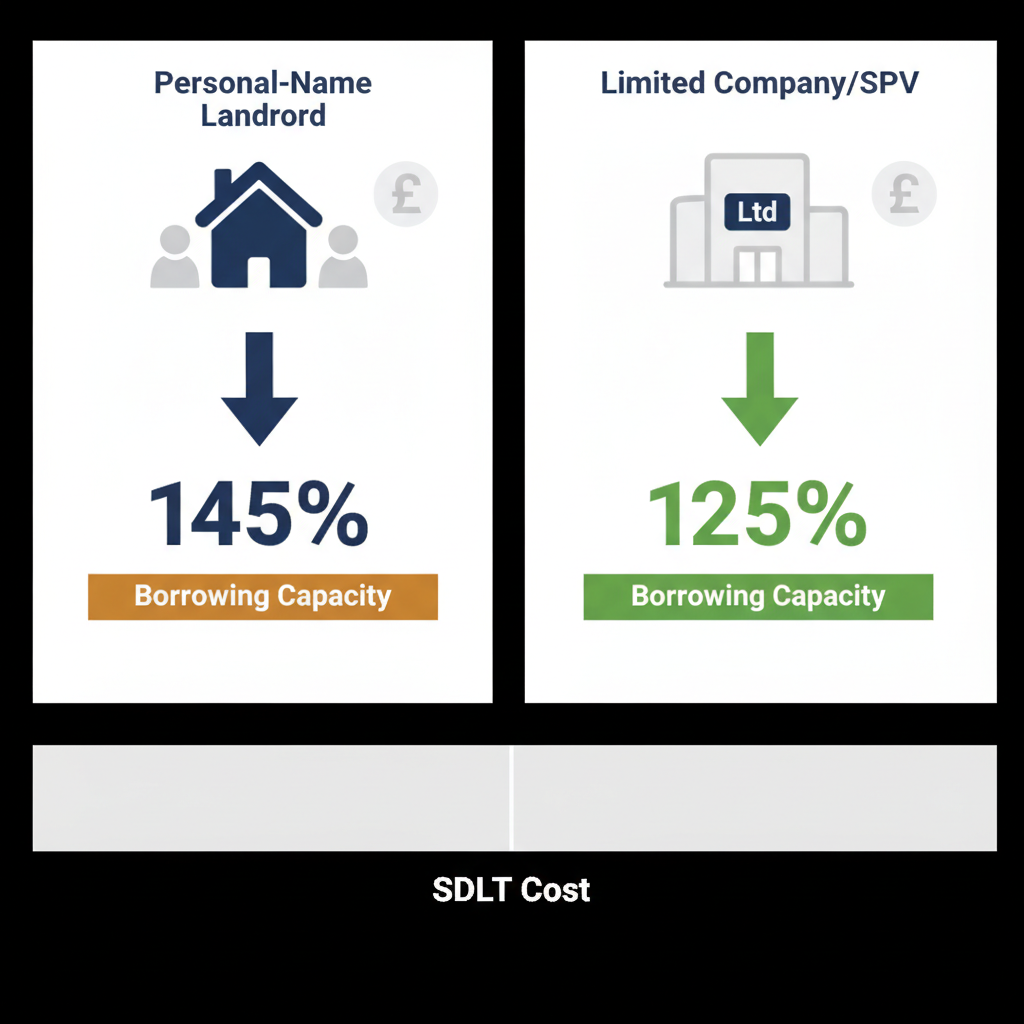
The one factor that decides the structure
Buy-to-let lenders size the loan using an interest coverage ratio (ICR): the rent must cover the mortgage interest at a stressed rate by a set margin. Because companies are not caught by Section 24, most lenders apply 125% to limited companies, while higher-rate taxpayers borrowing personally typically face 145%. That single difference — 125% versus 145% — is the fulcrum on which the entire joint-ownership decision turns. Everything else, rates, setup costs, tax treatment, is secondary to it.
Buying a buy to let with friends or a business partner (a joint SPV) exploits that gap deliberately. You incorporate a Special Purpose Vehicle — a clean, non-trading limited company — before you apply. Both partners are directors and shareholders. The mortgage goes in the company's name. The rent is assessed at 125% ICR rather than 145%, and the tax treatment shifts from income tax to corporation tax.
With rent of £1,500 a month (£18,000 a year) and a stress rate of 5.5%, a higher-rate taxpayer borrowing personally at 145% ICR can borrow a maximum of roughly £225,705. The same rent through a limited company at 125% ICR supports a maximum loan of approximately £261,818. That is a difference of £36,113 on unchanged rent from an unchanged property — before you have even looked at mortgage rates or tax.
When a personal-name joint mortgage makes sense
Personal buy-to-let works best for basic-rate taxpayers with modest rental income. A limited company (SPV) is usually more tax-efficient for higher and additional-rate taxpayers, and for landlords planning to build a portfolio. If both co-investors are basic-rate taxpayers and plan to hold just one or two properties, the friction of running a company — annual accounts, corporation tax filing and the cost of extracting profits — may outweigh the structural benefit.
Arrangement fees on company mortgages typically run 1.5%–3% of the loan. Annual accounts and corporation tax filing cost £500–£1,500. On a £150,000 loan, a 2% arrangement fee is £3,000 before you start. That upfront cost needs a meaningful ongoing tax saving to justify itself. If neither partner pays 40% income tax, the saving is small.
A 25% deposit is the standard minimum for buy-to-let mortgages, whether joint or single. Personal-name joint applications pull from a wider lender panel and typically price slightly keener than SPV products, which matters if cash flow is tight in the early years. Some lenders — Barclays, for example — accept applications in combinations of private names, including one in a sole name and a partner's name, and can also accommodate a client in both their private name and in an SPV limited company.
When a joint SPV makes sense
For many higher-rate and additional-rate taxpayers buying a new leveraged buy-to-let in 2026, a limited company (SPV) can be the more tax-efficient structure, depending on how profits are used. The maths changes substantially the moment either co-investor crosses the 40% income tax threshold.
Inside a company, mortgage interest is deducted as a full business expense before corporation tax is applied. Corporation tax sits at 19% on company profits up to £50,000 — the band most SPV landlords sit comfortably inside when they begin. Compare that to a higher-rate taxpayer who receives only a 20% basic-rate credit on mortgage interest under Section 24, while rental income is taxed at 40%.
Joint investors — two to four partners — can incorporate an SPV together. Up to four directors and shareholders are permitted, who must be the same people, and the company must be a non-trading SPV holding residential property only. Both partners give personal guarantees, which are mandatory, and all guarantors must seek independent legal advice before signing the Deed of Guarantee.
Most buy-to-let SPV mortgage lenders require SIC code 68100 (buying and selling of own real estate) or 68209 (other letting and operating of own or leased real estate). Register the SPV with the correct SIC code the day you incorporate; using a trading company SIC code significantly reduces, and in many cases eliminates, lender options. Aldermore, Paragon and Landbay are among lenders that accept day-one SPVs, so you do not need 12 months of company history to get started.
Profits can be retained in the company without triggering dividend tax until you take them out. For co-investors who want to recycle rental surpluses into the next deposit rather than draw income, that retention advantage compounds over a portfolio.
The calculation that decides it
Three numbers determine whether a joint SPV beats a personal-name joint mortgage: the tax saving per year, the cost of the rate premium, and the break-even point.
Step 1 — Verify the ICR. The ICR of 125% and the circa 5.5% stress rate are the standard limited-company buy-to-let assumptions drawn from the Prudential Regulation Authority's supervisory statement SS13/16; both are lender-specific and worth checking at the time you apply.
Step 2 — Calculate maximum borrowing. Maximum loan = annual rent ÷ (ICR × stress rate). On £14,400 annual rent, a company borrowing at 125% ICR and a 5.5% stress rate can borrow a maximum of £209,454. The same rent at 145% ICR permits only £180,604. That is £28,850 of extra headroom inside the same property and the same rent — without touching the rate.
Step 3 — Price the rate premium. The rate premium for an SPV is currently 0.2–0.5% above personal-name equivalents. The gap has closed sharply from the 0.5–1.0% it sat at in 2021–2023. The best five-year fixed SPV rate at 75% LTV is currently around 4.79%, with a typical range of 5.19%–6.09%. On a £200,000 loan, a 0.4% premium costs £800 a year in additional interest.
Step 4 — Calculate the annual tax saving. On a typical mortgaged property, a higher-rate taxpayer saves approximately £4,290 a year through a company structure. Against an £800 annual rate premium, the break-even is under three months. Higher-rate landlords typically recover the premium inside two years on the tax saving alone.
Step 5 — Factor SDLT. For a buy-to-let, a company and an individual who already owns a home pay the same SDLT: standard rates plus the 5% surcharge. The surcharge has been 5% since 31 October 2024 (Finance Act 2025, ss.50–51). On a £250,000 purchase, that is £15,000 in SDLT alone — identical whether you buy personally or through an SPV, so the structure does not move that bill.
Step 6 — Add running costs. Budget £500–£1,500 per year for accountancy. If the annual tax saving exceeds £2,000, the company structure is almost always the right answer for a higher-rate co-investor pair. If the combined annual saving is under £500 after all costs, stay in personal names.
Transferring an existing personally-held property into an SPV is expensive: HMRC treats it as a market-value sale, triggering full SDLT and potentially Capital Gains Tax, so SPVs work best for new purchases rather than moving an existing portfolio. If buying a buy to let with friends or a business partner (a joint SPV) is the plan, register the company before you make an offer — not after.