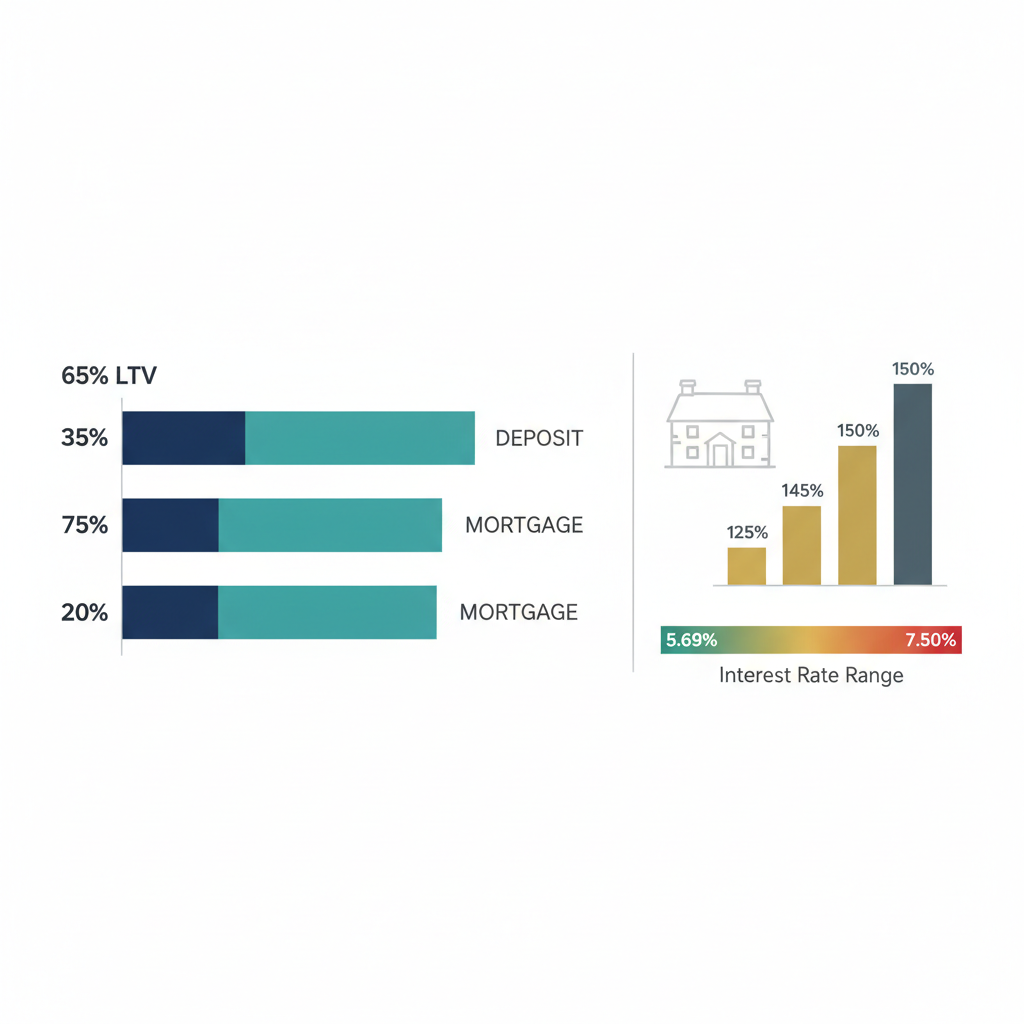
On 27 March 2026, Hodge Bank raised its holiday let mortgage LTV ceiling from 75% to 80%, and simultaneously lifted its maximum loan size from £1.5m to £2m. That single criteria change is the most significant shift in holiday let deposit requirements this market has seen in years — and it reshapes the maths for investors who previously faced a hard 25% floor.
What the Numbers Show
For a holiday let mortgage, most lenders require a minimum deposit of at least 25%, meaning the standard borrowing ceiling sits at 75% LTV. Lenders impose a larger deposit than on standard buy-to-let because holiday lets are considered higher risk, given fluctuating rental income and seasonal demand. That 25% baseline is real and consistent across the mainstream specialist panel. Leeds Building Society, for example, requires at least a 25% deposit for holiday let applications, compared with 20% for standard buy-to-let.
Holiday let mortgage rates in 2026 start from 5.69% from Keystone Property Finance at 65% LTV, verified 1 October 2026. At 70–75% LTV, two-year fix rates run from 6.20% to 7.50%. Holiday let mortgage rates are generally 1 to 2 percentage points higher than equivalent buy-to-let rates, and that premium does not disappear just because you bring a larger deposit — it narrows, but it stays.
Hodge Bank's holiday let product summary shows early repayment charges (ERCs) of 3% in year one and 3% in year two on its fixed-rate range. Hodge also offers fee-free options on both two- and five-year holiday let fixes. On a £400,000 loan, a 3% ERC in year one equals £12,000 — worth pricing into your exit before you commit.
The ICR test is where most cases actually get constrained, not the LTV cap. Hodge's calculator uses a 145% ICR, with a five-year-plus fix tested at the pay rate or 5.5%, whichever is higher; a sub-five-year fix is stressed at the pay rate plus 2%, again with a 5.5% floor. The lender builds its income figure by averaging low, mid and high weekly rents, then multiplying by 35 assumed weeks of occupancy.
Leeds Building Society stress-tests holiday let income at 7% and requires a 145% ICR for all holiday let applicants, regardless of tax band. That is notably tighter than its standard buy-to-let treatment, where basic-rate taxpayers now qualify at 125%. The 145% holiday let ICR at 7% stress effectively means the assessable annual rent must equal at least 10.15% of the loan value (0.07 × 1.45 = 0.1015). On a £300,000 loan, that demands £30,450 of projected annual holiday rental income before a penny is lent.
Some lenders — including Cumberland, Leeds and Furness — assess income using the open-market 12-month AST comparable rent at 145% ICR and a 5.5% stress rate for personal-name borrowers. Others, including Shawbrook, Paragon and Hodge, use a written projection from an ARLA-qualified or RICS-registered letting agent showing low, mid and high-season weekly rates, weighted across approximately 30 weeks for voids and owner use. Which method your lender uses matters enormously: in a strong tourist location, the agent projection typically produces a higher assessable income figure and therefore a larger maximum loan.
Most holiday let lenders require minimum personal income of between £20,000 and £40,000, evidenced separately, to cover voids and ongoing costs. Mansfield Building Society sits at the upper end, requiring a minimum income of £35,000 to qualify for its holiday let range. Hodge Bank is the notable exception — it sets no minimum personal income requirement for its holiday let mortgages, underwriting each case on its merits.
What This Means for Landlords
The 80% LTV product from Hodge changes the deposit conversation but does not eliminate it. A smaller deposit only helps if the projected rent can support the bigger loan. Run the numbers carefully. At 80% LTV on a £350,000 Cornish cottage, the loan is £280,000. At Hodge's 145% ICR and a 5.5% stress rate on a five-year fix, the minimum annual rental income required is £280,000 × 0.055 × 1.45 = £22,330. That is achievable in a strong tourist location — but the valuer's income projection, not your ambition, is what the lender uses.
The Furnished Holiday Let tax regime was abolished on 6 April 2025, removing tax advantages that many investors had relied on. For individual owners, mortgage interest relief is now restricted to a 20% basic-rate tax credit, broadly in line with standard buy-to-let. That shift makes the structure of ownership — personal name versus limited company — a live question. Limited company holiday let products are available but from a narrower panel.
The UK government is also introducing a mandatory national registration scheme for short-term lets in England, which as at May 2026 is not yet in force but is expected to begin in 2026. The register is expected to be administered at local authority level and is likely to require basic safety documentation, including gas safety certificates, electrical installation condition reports, and evidence of appropriate insurance. Some lenders may require proof of registration once the scheme is live — check the product guide before you apply.
Most holiday let lenders currently set a maximum LTV of 75%, with select lenders going to 80% on strong cases, minimum loan sizes from £50,000, and maximum loans up to £2m with most lenders. Portfolio landlords should note that Hodge caps its holiday let exposure at four mortgaged properties per borrower, excluding the primary residence.
The holiday let mortgages deposit requirement of 25% remains the correct planning figure for most borrowers. Budget it as the floor, treat 80% LTV as a ceiling available only when income projections fully support the loan, and price the SDLT — holiday lets carry the additional-property SDLT surcharge on top of the standard rates — before you agree heads of terms.