The Mortgage Works cut selected limited company buy-to-let two and five-year fixed rates by up to 0.20% in February 2026, bringing its two-year fixed rate to 3.74% with a 3% fee. That number matters because it represents the sharpest entry point from a mainstream lender in this sector right now. If you are assessing whether a limited company buy to let mortgage works for your next acquisition, start with that figure and work backwards from it.
What the Numbers Show
The Mortgage Works (TMW) two-year fix sits at 3.74% with a 3% fee, and its five-year fix came in at 4.97% fee-free, both available for purchase, remortgage and further advance up to 75% LTV with a free valuation. A percentage-based fee versus a flat fee is a meaningful distinction at typical landlord loan sizes. On a £100,000 loan, a product with a £1,500 fee beats a higher-rate deal below approximately 5.37%; on £300,000, the break-even shifts to around 5.87%. Always run the true cost over the fixed term, not just the headline rate.
TMW made a further round of cuts in June 2026, reducing a two-year fixed limited company buy-to-let product by 0.26% to 4.98% with a £3,995 fee, available up to 75% LTV for purchase, remortgage and further advance with a free valuation.
Limited company mortgage rates usually sit a fraction of a percent above personal buy-to-let pricing at the same loan-to-value. Moneyfacts put the average two-year company fix at 5.04% in October 2025, down from 6.53% two years earlier. Across all buy-to-let mortgages, Moneyfacts put the average two-year fix at 5.32% and the five-year fix at 5.70% on 8 September 2026.
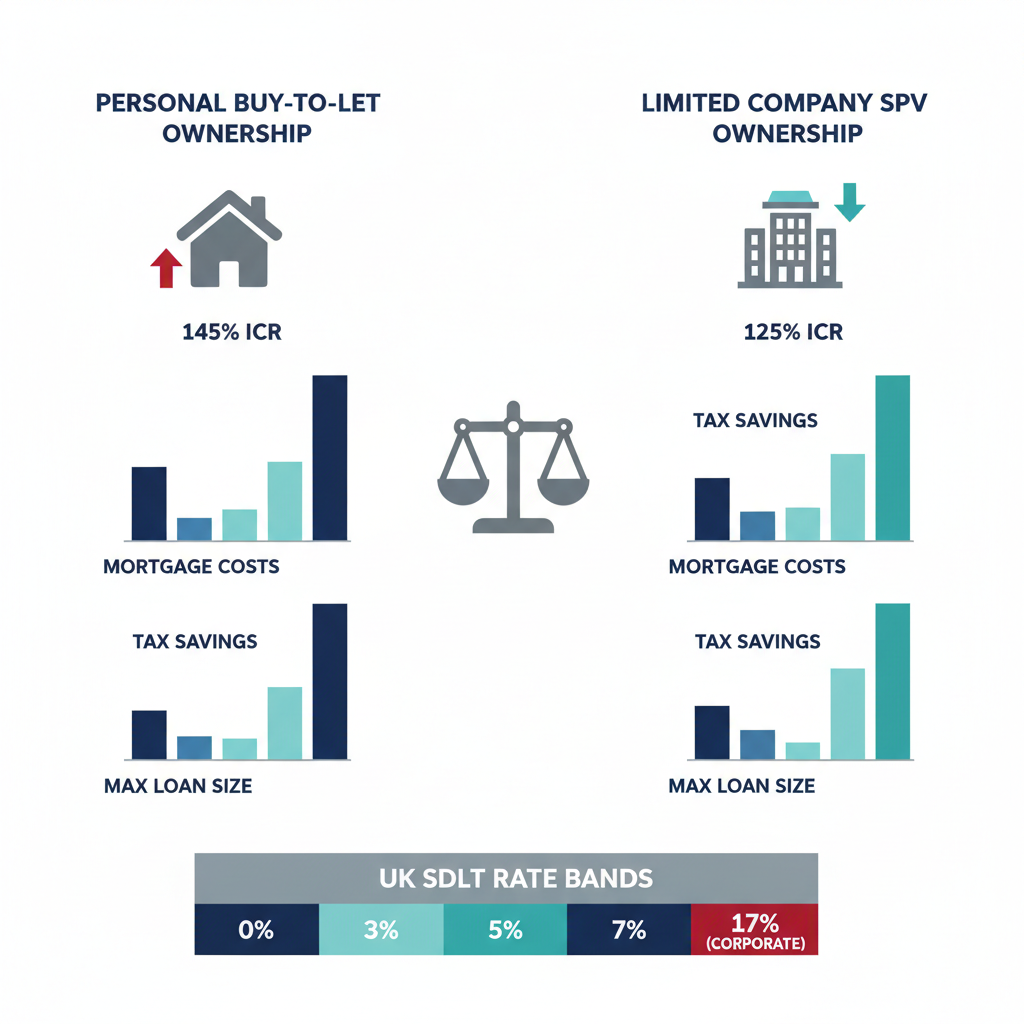
The ICR test is where limited company structures deliver genuine borrowing power. Buy-to-let lenders size the loan with an interest coverage ratio: the rent must cover mortgage interest at a stressed rate by a set margin. Because companies are not caught by Section 24, most lenders apply 125% to limited companies, while higher-rate taxpayers borrowing personally typically face 145%.
Coventry for Intermediaries, for example, requires rent of 125% of the monthly interest at the higher of 5.5% or the product rate plus 2% for limited company buy-to-let. The PRA framework underpins this: the Prudential Regulation Authority describes 125% as the industry standard minimum, and expects lenders to allow for a rate rise of at least 2 percentage points and to assume a borrower rate of at least 5.5%, unless the rate is fixed for five years or more.
Here is how that 20-percentage-point ICR gap plays out in practice. On a property producing £18,000 annual rent with a 5.5% stress rate: a higher-rate taxpayer borrowing personally at 145% ICR can support a maximum loan of £225,705, while a limited company at 125% ICR can support £261,818. That is £36,113 more borrowing capacity from the same rent — before any tax benefit is considered.
For five-year fixes, the stress test is softer. A 5.5% stress rate is typical for two-year and shorter-fix products; five-year fixes often qualify at the pay rate plus 1%, or sometimes just the pay rate, under the PRA SS13/16 carve-out.
Leeds Building Society, for limited company buy-to-let, requires monthly rental income to cover mortgage payments on an ICR of 125% at 5.75%. Its maximum LTV for limited company buy-to-let is 80% — one of the more generous thresholds available in the market.
On maximum LTV: 75% is the standard ceiling on SPV products, rising to 80% with selected specialist lenders for strong cases.
What This Means for Landlords
The demand for a limited company buy to let mortgage has not plateaued. In 2025, 66,587 new buy-to-let companies were established in the UK, an 8% increase from 2024 and a 363% rise over the past decade. Limited companies accounted for 43% of mortgaged buy-to-let house purchases in 2025, up from 35% in 2024. The shift is structural, not cyclical.
The engine driving it is Section 24. Section 24 of the Finance (No. 2) Act 2015, fully in force since April 2020, removed the ability for personal landlords to deduct mortgage interest as a business expense. Instead they receive only a 20% basic-rate tax credit on mortgage interest, regardless of their actual tax band. Limited companies can still deduct 100% of mortgage interest as a business expense and pay corporation tax at 19–25%, rather than income tax at up to 45%.
A 40% taxpayer with £20,000 rental income and £12,000 mortgage interest pays corporation tax on profit of £8,000 at the 19% small profits rate — just £1,520 per year — versus a materially higher income tax bill in personal name under Section 24. The annual corporation tax saving can accumulate and exceed setup costs, the higher mortgage rates, and accountancy fees of £1,200–£2,500 per year.
Stamp duty is a cost that catches some investors out. A company purchasing residential property pays the standard SDLT bands plus the 5% surcharge: 5% on the portion up to £125,000, 7% on £125,001–£250,000, 10% on £250,001–£925,000, 15% on £925,001–£1.5m, and 17% above £1.5m. Properties over £500,000 bought by an SPV may pay the 17% corporate rate where no relief applies. Run those numbers before any purchase decision.
Transferring existing personally held property into a company triggers SDLT at market value and may crystallise capital gains tax. Capital gains tax is charged on the gain at 18% or 24%, and incorporation relief can defer it, but only where the letting is a genuine business transferred as a whole.
SPV structure matters to lenders. Lenders typically require an SPV registered with property SIC codes — usually 68100 (buying and selling own real estate) or 68209 (letting and operating own real estate). Many lenders will lend to newly incorporated SPVs with no trading history, because they assess the rent, the property and the directors, who give personal guarantees.
Basic-rate taxpayers with income comfortably under £50,270 should note that the 20% mortgage-interest credit covers the tax due, so Section 24's impact is neutral — personal name is simpler and cheaper to operate for that cohort. The SPV case is also weaker for anyone who needs to draw all rental income as personal income each year, because extraction via salary or dividend adds a layer of personal tax.
For higher-rate taxpayers with growing portfolios, the arithmetic increasingly favours incorporation from the first purchase. Among landlords aged 25–34, 57% of properties are already held in limited companies — a cohort that has never known any other way to own rental property.