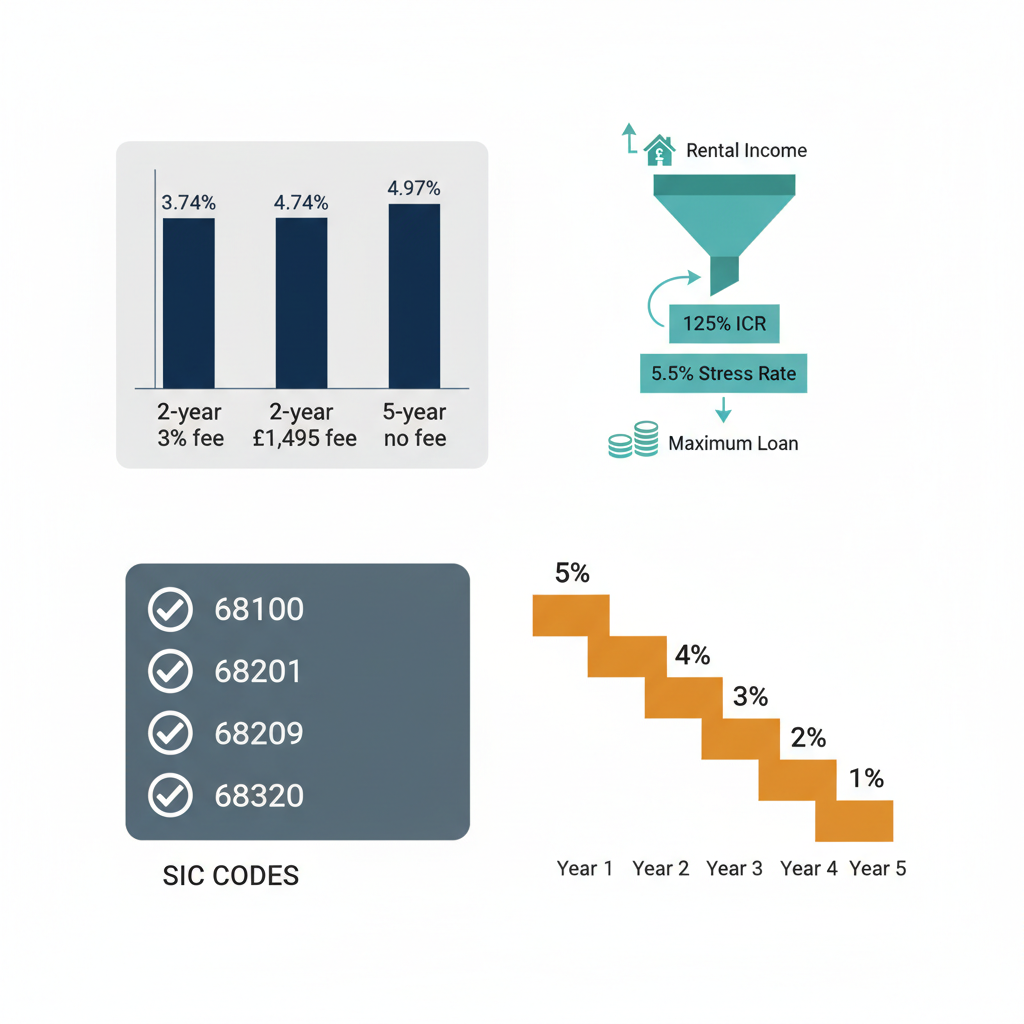
A 2-year fixed rate at 3.74% with a 3% product fee. That is where The Mortgage Works limited company buy-to-let range sits right now, available up to 75% LTV for purchase, remortgage and further advance, with a free valuation included. The rate was cut by 0.20% to reach 3.74%, with the product available for purchase, remortgage and further advance at up to 75% LTV with a free valuation. For portfolio landlords who have been watching this lender's pricing over the last 12 months, the trajectory is clear: multiple cuts, narrowing premium over standard BTL, and a product range that has grown meaningfully wider.
The Mortgage Works has been supporting the limited company buy-to-let market since 2018, and the lender continues to focus on offering limited company landlords a competitive range of products. That longevity matters. Criteria beds in. Brokers know how to package cases. The underwriting team understand SPV structures. It shows in the pricing.
What the Numbers Show
In its new business range, 2-year fixed rates sit at 3.74% with a 3% fee and 4.74% with a £1,495 fee. A 5-year fix is available at 4.97% with no fee. All products are available for purchase, remortgage and further advance up to 75% LTV with a free valuation.
Those three products give you three cost structures: a high-fee, low-rate option that works well at larger loan sizes; a mid-fee option at £1,495 that starts to win at sub-£300,000 loans; and a no-fee 5-year fix for borrowers who want certainty without upfront outlay. The cross-over point between the 3% fee product and the £1,495 fee product sits at approximately £50,000 — below that loan size, the flat fee is cheaper on a true cost basis. Do the maths on your specific loan before defaulting to the headline rate.
For existing limited company borrowers using the rate-switcher range, 2-year fixed rates sit at 3.74% with a 3% fee and 5.29% fee-free, with a 5-year fix at 4.79% with a £1,495 fee. All switcher products are available up to 75% LTV. The switcher 2-year fix matching the new business headline rate is notable — existing customers are not being penalised on price to the degree that was common two years ago.
On early repayment charges: the 2-year fixed rate products carry an ERC of 2% until 30 November 2027, then 1% until 30 November 2028. The 5-year fixed rate products carry an ERC of 5% until 30 November 2028, then 4% until 30 November 2029, then 3% until 30 November 2030, then 1% until 30 November 2031. These are standard tiered structures, but on a £500,000 loan, 5% in year one equates to £25,000 — material enough to warrant running the numbers before committing to a 5-year fix on a property you may want to sell or refinance within the term.
Borrowers can make lump sum or regular overpayments of up to 10% of the initial mortgage balance in each 12-month period from the anniversary of completion without incurring an early repayment charge. That 10% annual allowance gives active portfolio managers a useful lever, particularly on capital repayment arrangements.
Maximum LTV for limited company products sits at 75% across the standard range. Buy-to-let products within the limited company range carry a maximum loan of £2,000,000, and the 125% Interest Cover Ratio applies to limited company buy-to-let applications.
The 125% ICR applies to all limited company applications, except houses in multiple occupation. HMO applications attract a 175% ICR, regardless of tax status, and are capped at 75% LTV with a minimum property value of £100,000.
On stress rates — these determine the minimum rent required and are the number that actually constrains the loan, not the pay rate. For purchase, remortgage with capital raising, or further advance on a 1- or 2-year fixed rate product at any LTV, the stress rate is 5.50% or the pay rate plus 2.00% — whichever is higher. On a 5-year fixed rate at 65% LTV or below, the stress rate drops to 4.00% or the pay rate, whichever is higher. This means that on a 2-year fix at the current 3.74% rate, the ICR test runs at 5.50%. Minimum monthly rent on a £300,000 loan would be: £300,000 × 5.50% × 125% ÷ 12 = £1,719. A 5-year fix at 65% LTV uses the 4.00% stress rate, dropping the equivalent minimum rent to £1,250 per month on the same loan. Term choice has a direct effect on borrowing capacity.
What This Means for Landlords
To qualify for a limited company mortgage, the company must be set up with the sole purpose of buying, letting and selling properties — known as Special Purpose Vehicles (SPVs). Only SPVs with one or more of the following SIC codes are accepted: 68100, 68201, 68209, 68320. Partnerships and LLPs are not accepted.
TMW criteria require that all directors must be applicants. Personal guarantees are required from all directors, and anyone with more than 20% of the shareholding or who is a person of significant control must be party to the mortgage. A maximum of two directors and shareholders can be on the mortgage. A floating charge over assets of the company is not required, but personal guarantees are needed from all beneficial owners in all cases.
SPVs that have associated commercial property or assets are not accepted, and directors may only have one limited company financed with The Mortgage Works. That one-SPV-per-director rule is the most common case-killer. Landlords with multiple SPVs across a portfolio need to ensure other lenders — not TMW — hold the remaining vehicles.
TMW now accepts limited company purchase applications for buy-to-let where the company is purchasing a property that is currently owned and lived in by one of its directors. That is a meaningful expansion of the criteria — it effectively creates a limited company let-to-buy pathway for incorporated landlords who want to retain their former home rather than sell.
There is no minimum income requirement for applicants. Lending is assessed on rental coverage, not personal salary. The minimum mortgage term is 5 years and the maximum is 35 years, with a minimum loan of £25,001.
The lender is available through mortgage brokers only — direct applications are not accepted. Given the SPV structuring requirements, director guarantee rules and stress rate complexity, broker submission is not just a gatekeeping formality. Getting the case packaged correctly from the outset avoids the most common reasons TMW limited company applications are declined.
The Mortgage Works limited company mortgages are a credible first call for a higher-rate taxpayer structuring a growing portfolio through an SPV. The 3.74% new business 2-year fix at 75% LTV, the £2,000,000 maximum loan, and the 125% ICR combine to make the numbers work on a wider set of properties than many competing lenders at the same LTV tier.