The Mortgage Works published a 3.74% two-year fixed rate for limited company buy-to-let at 75% LTV in February 2026, carrying a 3% product fee. That 3.74% rate applies to purchase, remortgage and further advance at 75% LTV, with a free valuation included. It is the sharpest rate on their intermediary-only limited company range and the number that portfolio landlords keep quoting to justify moving property into a structure. The rate matters. But it is the cost of getting there that most landlords underestimate.
What the Numbers Show
A record 66,587 new buy-to-let companies were formed during 2025 as landlords continued to exit personal ownership in favour of limited company structures. The arithmetic behind that trend is straightforward: a higher-rate taxpayer in personal name gets only a 20% tax credit on mortgage interest under Section 24. Inside a company, the full deduction is preserved against corporation tax — meaning a landlord at the 40% marginal rate, where personal-name ownership produces an effective relief of only 20%, recovers the full deduction inside the company.
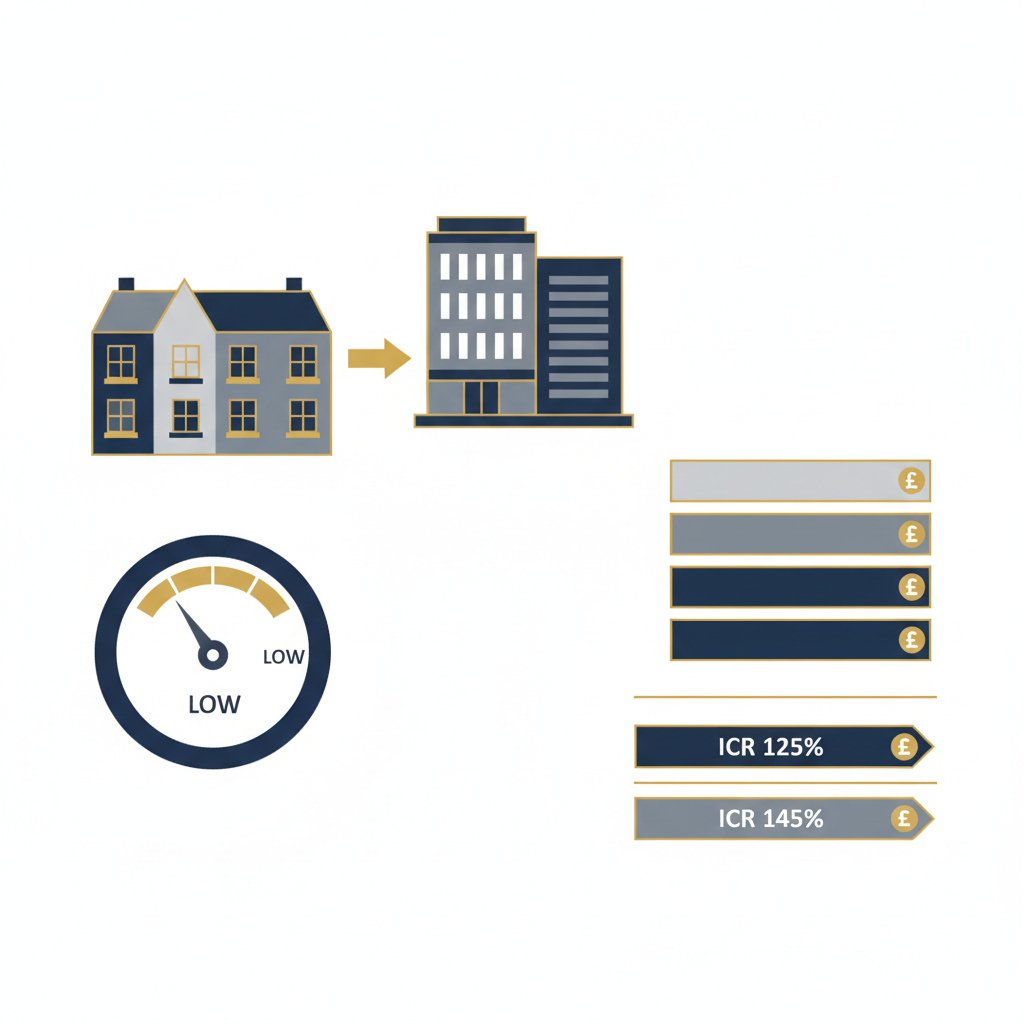
The mortgage terms inside a company are different from personal-name lending, and the difference favours the borrower at the ICR stage. The Mortgage Works offers products up to 80% LTV for limited companies, with a 125% Interest Cover Ratio for buy-to-let. That 125% ICR for limited companies compares with 145% for higher-rate individual borrowers. On a £250,000 loan at a 5.5% stress rate, the 125% ICR requires annual rent of £17,188 — compared with £19,938 at 145%. That 20% gap in required rent can be the difference between a deal passing affordability and a decline.
Most lenders require company rent to cover the mortgage interest by 125% at a stressed rate, often 5.5% on fixes shorter than five years. On £1,500 a month of rent that supports a loan of about £261,800. Five-year fixed products are frequently stress-tested at the pay rate rather than a loaded rate, which can push the maximum supportable loan higher still. For a five-year fixed, the stress rate for most SPV lenders is the pay rate; for a two-year fixed, it is the pay rate plus 2%.
On rates available through The Mortgage Works right now: the two-year fixed rate for purchase, remortgage and further advance at 75% LTV with a £1,495 fee is 4.74%. The five-year fixed rate for purchase, remortgage and further advance at 75% LTV with a free valuation is 4.97%. Landlords who want the lowest headline rate pay more upfront: a 5-year fixed of 4.02% is available for purchase, remortgage and further advance at 70% LTV, carrying a 5% fee with free valuation. On a £243,750 loan, a 5% fee costs £12,188 — worth running against the monthly interest saving before committing.
Early repayment charges matter if you are planning to remortgage within the fixed term. On The Mortgage Works' limited company BTL five-year fixed, the ERC structure is 5% until the end of year one, 4% until the end of year two, 3% until the end of year three, 2% until the end of year four, and 1% until the end of year five. On a two-year fixed, the ERC is 2% in year one, then 1% in year two.
What This Means for Landlords
The transfer buy to let to limited company mortgage decision starts long before the mortgage application. Structurally, moving an existing personally held property into a limited company is treated by HMRC as a sale at open market value, regardless of what actually changes hands. When you move a rental property into your own limited company, SDLT is charged on the property's open market value at the date of transfer, and the company pays it as if buying an additional residential property on the open market.
The additional-dwelling surcharge was raised from 3% to 5% on 31 October 2024. Because a company has no main residence, the first £125,000 is taxed at 5%, not 0%. The combined SDLT rates a company faces are: 5% up to £125,000; 7% from £125,001 to £250,000; 10% from £250,001 to £925,000; 15% from £925,001 to £1,500,000; and 17% above £1,500,000. On a £300,000 property, the SDLT bill is £20,000 — £6,250 on the first £125,000 at 5%, plus £8,750 on the next £125,000 at 7%, plus £5,000 on the remaining £50,000 at 10%.
Capital gains tax lands at the same time. Residential property has its own CGT rates: 18% applies to any slice of the gain that falls inside the unused basic-rate income tax band, and 24% applies to the rest. For 2026/27 the annual exempt amount is £3,000, and UK residents disposing of property where CGT is due must file a return and pay within 60 days of completion. Run those numbers on a property bought for £180,000 and now worth £300,000: the £120,000 gain, less the £3,000 exempt amount, produces a CGT liability of roughly £28,080 at 24% for a higher-rate taxpayer — before a single stamp duty pound is counted.
There are limited circumstances where the SDLT partnership rules may reduce the SDLT charge, potentially to nil, particularly where a genuine property partnership is incorporated. However, this is not a general SDLT incorporation relief and does not apply simply because a landlord transfers property into a company. Similarly, Section 162 incorporation relief can defer CGT where the transfer constitutes a whole-business disposal, but Section 162 relieves the CGT but does nothing for the SDLT. The company still pays SDLT on market value. A transfer can therefore be fully CGT-deferred and still carry a substantial SDLT charge.
For landlords buying new property directly into a limited company — rather than transferring — the equation changes. The SDLT is unavoidable, but there is no personal-name CGT to defer, and the transfer buy to let to limited company mortgage sits on cleaner ground from day one. A UK company, almost always an SPV registered under SIC code 68100 or 68209, can hold a limited company buy-to-let mortgage in its own name: the company borrows, the directors give personal guarantees, and the rent services the loan. Foundation Home Loans and Kent Reliance are among the lenders offering 80% LTV for SPV cases. The rate premium at 80% LTV versus 75% LTV typically runs at around 0.4% to 0.7%, which may be worth carrying to preserve more cash for further acquisitions.
The payback period on incorporation costs is usually the deciding calculation. A higher-rate landlord with four or more properties, meaningful mortgage debt and a long hold period will often find the numbers eventually stack up. One with two unencumbered properties sitting on minimal gains may find the upfront SDLT bill alone takes more than a decade to recover through tax savings.