The lowest two-year limited company buy-to-let fix was 3.62% at 60% and 75% loan-to-value on 6 October 2026, carrying a 5% arrangement fee. That is the opening number worth pinning to your spreadsheet, because everything else flows from it. Strip out the fee on a £200,000 loan and that headline rate costs you £10,000 upfront. Whether it's worth it depends on how long you hold the product — and at what rate you're comparing it against.
What the Numbers Show
The lowest five-year fix for limited company buy-to-let sat at 4.55% at 60% LTV. The market average stood at 5.79% at the start of October, so the gap between the keenest pricing and the average is wide. That spread matters. On a £100,000 loan, a deal with a £1,500 fee wins where the rate is below approximately 5.37%. On a £300,000 loan, the break-even point rises to around 5.87%. Always run the true cost over the fixed term, not just the headline rate.
Five-year fixed limited company BTL products at 75% LTV are available from around 5.06% fee-free, or 5.11% with a £1,499 arrangement fee. At 75% LTV, some lenders are offering five-year fixes from 4.67% with a 3% fee, or 4.72% also with a 3% fee. The three-percent-fee products are typically the ones worth forensically stress-testing on total cost across the deal period.
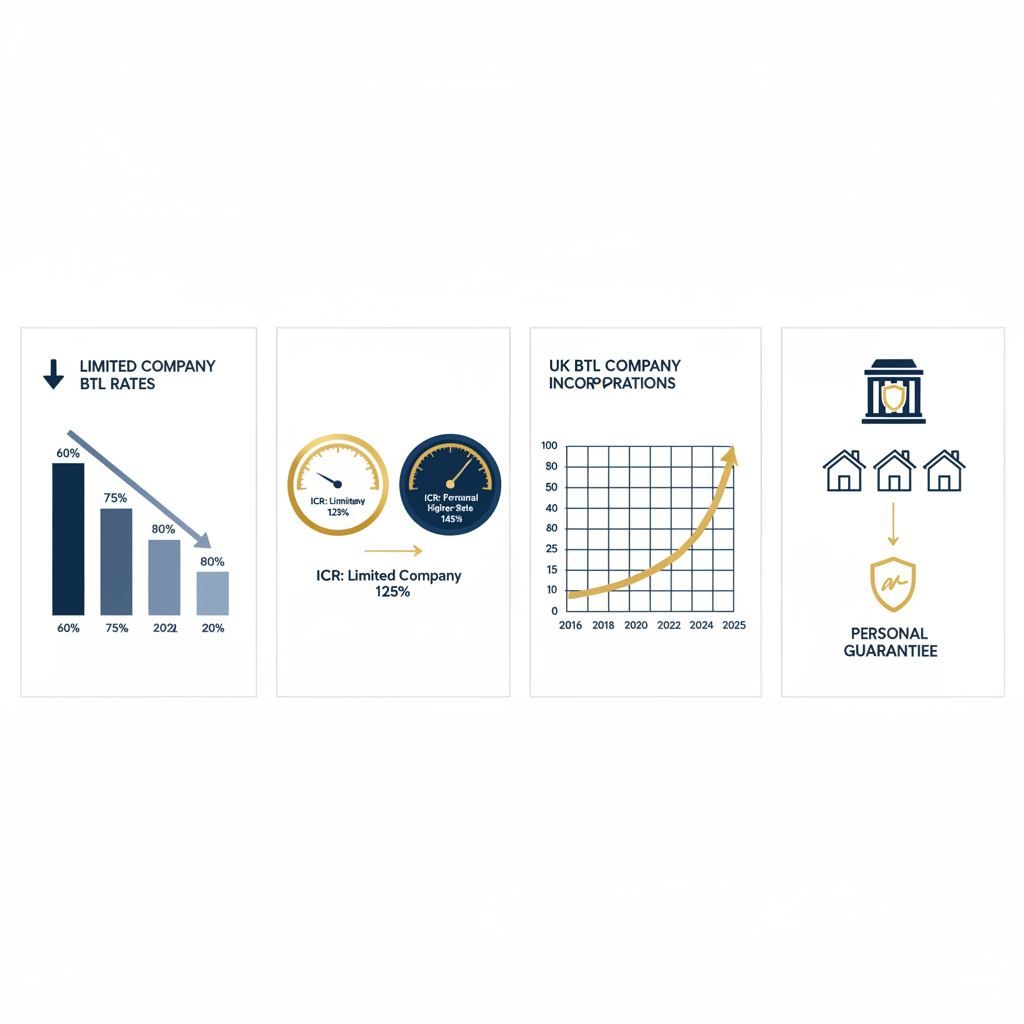
The ICR calculation is where limited company structures earn their structural advantage. The standard requirements in 2026 are a 125% ICR for limited company borrowers, versus 145% for higher-rate taxpayers owning property in a personal name. The floor stress rate is typically 5.5% across mainstream and specialist BTL lenders in 2026. Run the maths: maximum loan = (annual rent) ÷ (ICR × stress rate). On £1,500 per month rent — £18,000 per year — at 125% ICR and a 5.5% stress rate, the maximum loan is £18,000 ÷ (1.25 × 0.055) = £261,818. Push that same rent through a 145% ICR test and the maximum loan drops to £18,000 ÷ (1.45 × 0.055) = £225,564. On £1,500 of monthly rent, the difference between a 125% company test and a 145% personal test is approximately £261,800 versus £225,700 at a 5.5% stress rate.
On five-year fixed products, some lenders soften the stress test further. 5.5% is the typical stress rate for two-year and shorter-fix products. Five-year fixes often qualify for a softer stress at the pay rate plus 1% — sometimes just the pay rate — under the PRA SS13/16 carve-out. Leeds Building Society's criteria, effective from 24 August 2026, confirm this: for purchases and capital raising under five years, the ICR is 125% at a stress rate of product rate plus 2% (minimum 5.50%). For remortgages like-for-like over five years, it's product rate with a minimum of 5.00%.
On LTV, most of the market sits at 75% for SPV structures. The Mortgage Works makes products available up to 80% LTV with a maximum loan of £2,000,000 for buy-to-let. Leeds Building Society caps loans at £500,000 with a maximum LTV of 80% for purchase or remortgage, reduced to 75% for first-time landlords. At 80% LTV, expect a rate premium. 80% LTV SPV products are available from a smaller panel including Foundation and Kent Reliance, carrying a rate premium of approximately 0.4–0.7% versus 75% LTV.
Product fees across the market range. Buy-to-let mortgages carry completion fees of up to £1,999 for loans under £500,000, or 1% of the loan amount for loans above £500,000. Arrangement fees typically range from £999 to £1,999, or 1–2% of the loan amount. Beyond the product fee, budget for valuation (£150–£1,500), legal costs (£800–£2,000), and company formation at Companies House for £50.
What This Means for Landlords
The upward trend in incorporations has been building since 2016, when full mortgage interest relief began to be phased out for higher-rate taxpayers. In 2025, 66,587 new companies were established to hold buy-to-let property — an 8% increase from 2024 and a 363% rise over the past decade. Today, around three-quarters of new buy-to-let purchases are made through limited companies, with rising numbers also reflecting landlords transferring existing portfolios out of personal ownership.
The lender panel for Limited Company Mortgages is clear on structure. To qualify with The Mortgage Works, the company must be set up with the sole purpose of buying, letting and selling properties — what lenders call a Special Purpose Vehicle (SPV). Only SPVs with SIC codes 68100, 68201, 68209 or 68320 are considered by The Mortgage Works. Some lenders, including Aldermore, Paragon and Landbay, are comfortable with day-one SPVs; others require 12–24 months of trading history.
Personal guarantees are non-negotiable at most lenders. Most lenders require the director to sign a personal guarantee on a limited company buy-to-let mortgage, which means personal assets remain at risk if the company cannot service the debt. Lenders need to see that directors can stand behind the company, with most wanting £25,000 or more in personal income from salary, dividends, employment or pension.
Limited companies pay SDLT at the standard residential rates plus the additional dwellings surcharge of 5%, raised from 3% in October 2024. On a £300,000 purchase, that additional 5% means £15,000 more in stamp duty compared to the pre-October 2024 position. For landlords incorporating an existing portfolio, the SDLT cost on transfer is a critical calculation before any mortgage rate advantage is assessed.
Corporation tax, typically between 19% and 25%, applies to company profits — instead of the 40–45% income tax rates faced by higher-earning landlords holding property personally. For a landlord running a six-property portfolio generating £60,000 of net profit, the difference between 25% corporation tax and 40% income tax is £9,000 per year. That is the annual saving against which mortgage costs, accountancy fees and SDLT exposure must be measured.
The momentum has carried into 2026, with 5,922 new buy-to-let limited companies set up in January 2026 — 11% more than the same month last year. The structural shift is not slowing. For portfolio landlords paying higher-rate tax, the 125% ICR advantage alone can unlock £30,000–£40,000 more borrowing per property compared with an equivalent personal application — before any tax efficiency is factored in. Check each lender's current product guide for up-to-date rates, fees and stress-rate floors before committing.