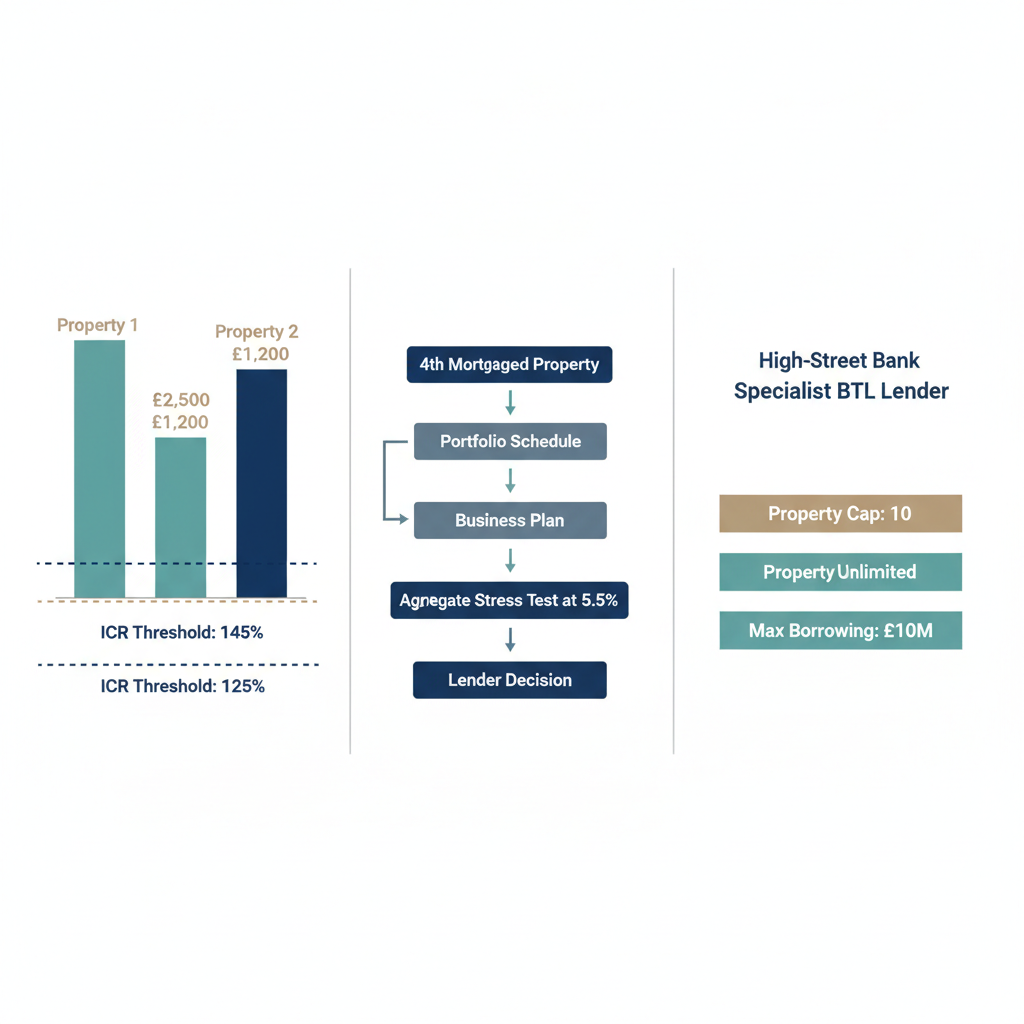
Since September 2017, the Prudential Regulation Authority has required lenders to apply enhanced underwriting standards to portfolio landlords — those with four or more distinct mortgaged buy-to-let properties. That rule, set out in PRA Supervisory Statement SS13/16, changed the game permanently. A £90,000 flat bought by a ten-property landlord triggers the same full portfolio review as a £1.5 million block purchase. The new loan almost doesn't matter. It's the existing portfolio that gets put under the microscope.
What the Numbers Show
Under PRA standards, a borrower with four or more distinctly mortgaged buy-to-let properties is a portfolio landlord, and lenders must underwrite the whole portfolio on every new application — aggregate rental cover, total gearing, a property schedule, and often a business plan and cash flow.
The interest coverage ratio (ICR) is the number that controls everything. For properties held in personal names, most lenders require an ICR of 125% at the stress test rate for basic-rate taxpayers and 145% for higher-rate taxpayers. The stress rate most lenders use is 5.5%, or the product charging rate plus 2%, whichever is the greater — though for five-year fixed rate products, the ICR calculation rate is either the product charging rate or 5.00%, whichever is the greater.
The NRLA's worked example makes the arithmetic concrete. For each £100,000 of background portfolio mortgage debt, interest at 5.5% equals £458 per month. At a 145% ICR, minimum rent must be £664 per month per £100,000 of debt. Run that across a portfolio carrying £600,000 of mortgage debt and you need aggregate rent of at least £3,984 per month before the background test passes. Get one property on a cheap deal that masks a wider shortfall and the whole application can stall.
The aggregate loan-to-value cap matters too. As a general rule, the overall portfolio LTV should not exceed 75%. Virgin Money requires the background BTL portfolio to have an aggregate maximum LTV of 75% and cover mortgage payments by 135% at a stressed interest rate of 5%. Virgin Money also caps total BTL exposure across all lenders, including the property being mortgaged, at 10 properties — with a maximum of five properties with the Virgin Money group and total group mortgage balances not exceeding £3,000,000.
Paragon Bank operates a tiered LTV-to-loan-size structure worth knowing before you approach them. Up to 65% LTV, the maximum individual loan is £4,000,000. Up to 70% LTV, the maximum drops to £1,500,000. Up to 75% LTV, it falls to £1,000,000. Up to 80% LTV, the ceiling is £750,000. The applicant must have a minimum of two years' lettings experience as a landlord. Their reference rate used in ICR calculations is 5.50%, and their current standard variable rate sits at 9.60%.
For personal name applications, Fleet Mortgages stress-tests rental income against a notional rate of 5.5% at 145% ICR. Fleet applies its own ICR calculation — 145% at 5.5% for personal name, 125% at 5.5% for SPV — across the borrower's entire declared portfolio, including properties with other lenders.
Property type also affects the calculation before the ICR is even applied. Some lenders apply a vacancy discount of 10% to 20% on HMO rental income before running the ICR test. That means a six-bed HMO producing £3,000 per month could be tested at only £2,400 to £2,700, narrowing the headroom significantly.
What This Means for Landlords
The documentation burden at portfolio level is categorically different from a standard BTL application. Lenders assess the landlord's whole portfolio, including every property and mortgage, assets and liabilities, a business plan and cash flows, as well as the new loan. Lenders may ask for every property and mortgage, the landlord's assets and liabilities including tax, a business plan and the cash flows of all the properties, so that a weak part of the portfolio does not put the new loan at risk.
Lenders typically require a full property schedule covering every property in the portfolio — address, type, current value, outstanding mortgage, lender, rental income, and term — evidence of rental income, and, depending on structure, certified company accounts or SA302 tax calculations. Specialist lenders commonly also require three years of SA302 tax returns, or company accounts for SPV portfolios, to demonstrate a track record of rental income management.
The business plan is not optional at most lenders. Applicants must provide a property portfolio schedule and a business plan. Lenders review these documents to understand the landlord's strategy and the portfolio's financial projections. The business plan does not need to be elaborate — two to three pages covering your investment goals, target areas and growth plans is sufficient — but it must be there, and it must be coherent.
Some lenders aggregate the entire portfolio, meaning a single legacy property that falls short of the 145% ICR threshold can be offset by a high-yielding HMO generating surplus income. However, stricter lenders stress-test every single background property in total isolation. Knowing which approach your target lender takes before submitting is not a minor detail — it can be the difference between a clean approval and a declined case.
Lender type is arguably the single biggest variable for landlords with larger portfolios. Most high-street lenders cap portfolio landlords at 6–10 properties or £2–3 million total portfolio debt. That ceiling is absolute at many banks. Once you hit it, the application simply won't progress regardless of how strong the numbers are. Specialist lenders are built differently. The Mortgage Works defines a portfolio landlord as a borrower with four or more distinct mortgaged BTL properties and imposes no limit on the number of properties, with total borrowing up to £10 million. TMW separately identifies a large portfolio landlord as someone with 11 or more distinct mortgaged BTL properties, applying a further layer of review at that threshold. Paragon accepts unlimited background properties with any lender on its portfolio range and lends to limited companies and limited liability partnerships — an important distinction for landlords who have moved into SPV structures for tax efficiency.
Some lenders permit earned income to supplement rental income when the ICR falls slightly short of requirements — a mechanism known as top-slicing. Not every lender offers it, and those that do apply their own rules around how much personal income can be used and at what deficit threshold. If your portfolio is cashflow-positive in aggregate but one recently acquired property is dragging the ICR calculation slightly below threshold, top-slicing at the right lender could make the application work without requiring you to restructure anything.
Since the affordability tightening cycle of 2023–2025, many lenders refined how they interpret the PRA rules. Stress rates have remained elevated, ICR requirements have become more structured, and background portfolio analysis has grown more granular. Portfolio landlord mortgages reward landlords who run their portfolios with precision — clean schedules, consistent documentation, and a clear understanding of where each property sits against its individual ICR threshold, not just the aggregate.