The Single Factor That Changes Everything at Four Properties
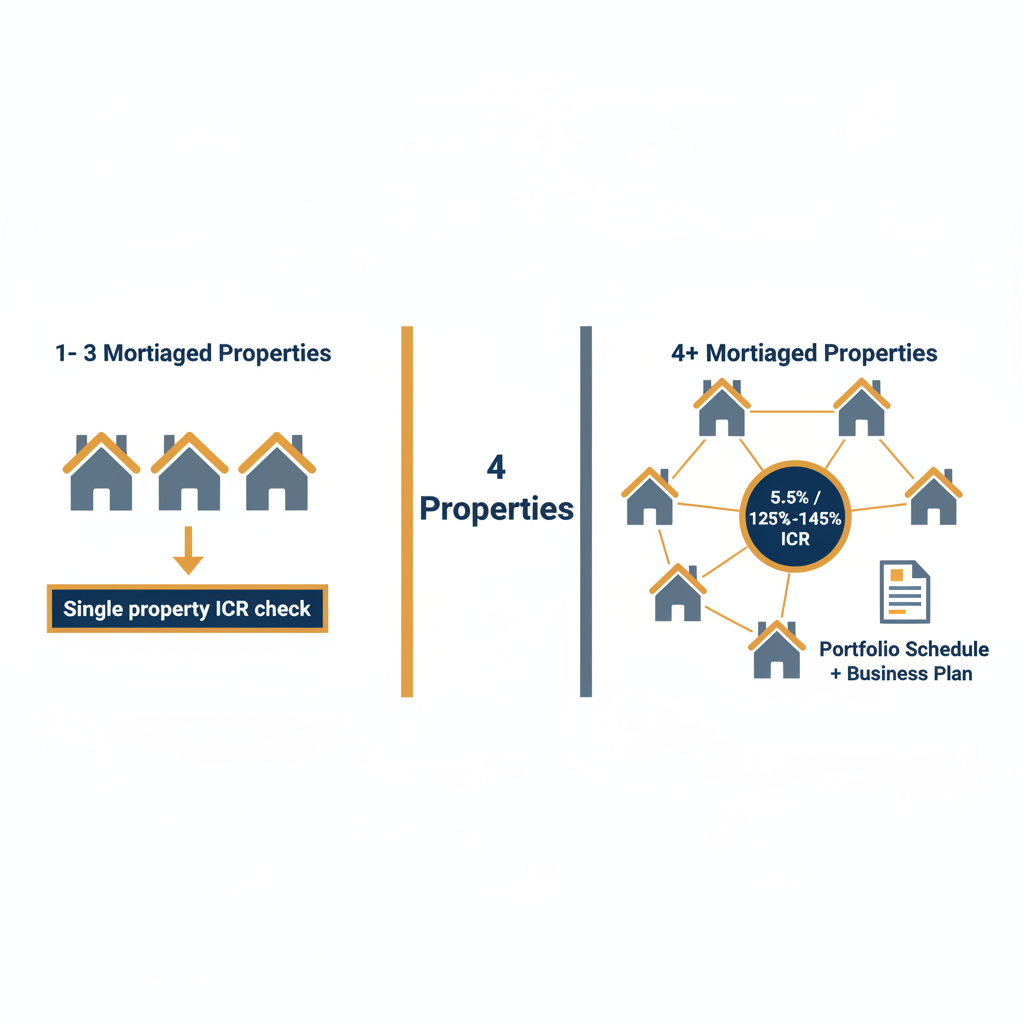
The PRA set the definition in its supervisory standards for buy-to-let underwriting, effective 30 September 2017: a portfolio landlord is any borrower with four or more mortgaged buy-to-let properties across all lenders combined. That is the number. Not four with one lender — four in total. Properties held through a limited company count alongside personal-name properties, so if you hold two mortgaged properties in your own name and two in a company, you are a portfolio landlord.
Properties owned outright do not count towards the four-property threshold, though lenders still consider them when assessing your overall portfolio. And the count is taken at completion, not at application. If you currently own three properties financed by buy-to-let mortgages and are applying to buy one more, your total at completion would be four mortgaged properties and you would be categorised as a portfolio landlord.
This matters because the underwriting model changes completely. Lenders must apply enhanced underwriting at portfolio level rather than assessing each property in isolation. Below the threshold, each buy-to-let stands largely on its own merits. Above it, every application — including a straightforward product transfer — pulls the whole portfolio into scope.
When Staying Below Four Makes Sense
Three mortgaged buy-to-lets keeps you in standard BTL underwriting. Each property is assessed on its own rental income, its own valuation and its own stress test. The process is lighter, lender choice is wider, and documentation stays manageable.
The position matters most if one of your existing properties has a weak rental yield or sits at a high loan-to-value. If properties in your background portfolio are currently on product end dates or have reverted to standard variable rates, the lender will calculate the ICR on those properties at the current stressed rate. A portfolio where every property has a live product and is covered at stress rate is significantly easier to mortgage against than one with several properties on reversion rates or with ICR issues.
If your three current properties are leveraged at 80% LTV each and generating modest yields, adding a fourth before you have improved that position can close doors with every lender that runs an aggregate LTV cap. Specialist lenders typically cap the maximum allowable aggregate LTV at 75% across the entire asset base, regardless of how profitable the individual new purchase might be. Consolidate equity before you cross the line and the fourth purchase becomes structurally cleaner.
When Crossing Four Makes Sense
Portfolio landlord rules: what changes when you own four or more mortgaged properties is not just an underwriting question — it is a proposition question. Some lenders actively want portfolio clients because they represent professional, repeat business.
Paragon Bank has increased maximum buy-to-let loan sizes and removed minimum income requirements for portfolio landlords as part of its evolving proposition. The updated limits mean landlords can now borrow up to £800,000 at 80% LTV, £1.2m at 75% LTV, and £1.7m at 70% LTV. For landlords with four or more mortgaged properties, limited companies and applicants for HMOs or multi-unit blocks, the £4m maximum at 65% LTV remains unchanged. Paragon has also removed the £25,000 minimum income requirement for portfolio landlords, enhancing access for professional investors.
Specialist lenders also offer access to more property types at scale. Specialist lenders in this space include Paragon Bank, The Mortgage Works (Nationwide's BTL arm), Kent Reliance (OneSavings Bank), Fleet Mortgages and Foundation Home Loans. These lenders have dedicated portfolio teams, purpose-built questionnaires and faster processing for landlords who arrive prepared.
The requirement for a business plan is not a hurdle — it is a filter. Lenders view portfolio landlords as operating a professional business, not just making a passive investment. The application process requires professional documentation such as a detailed business plan, cash flow forecasts and a comprehensive property schedule, and lenders are evaluating the landlord's capability as a business owner. If you have that discipline already, the rules simply formalise what you are already doing.
The Calculation That Decides It
The ICR stress test is the number that determines whether a portfolio landlord application proceeds. Most lenders stress-test portfolio landlord applications at 5.5%, regardless of the actual product rate offered. Every property in your portfolio must demonstrate that its rental income covers the mortgage payment calculated at the stress test rate, multiplied by the interest coverage ratio.
For properties held in personal names, most lenders require an ICR of 125% for basic-rate taxpayers and 145% for higher-rate taxpayers. Limited company borrowers typically sit at 125%. The ICR is applied across the whole portfolio, not just the subject property.
Here is the arithmetic. The formula is: minimum monthly rent = (loan × stress rate × ICR) ÷ 12.
For a personal-name higher-rate taxpayer on a £200,000 interest-only loan at 145% ICR and a 5.5% stress rate:
£200,000 × 5.5% × 1.45 ÷ 12 = £1,329 minimum monthly rent required
The same loan for a limited company at 125% ICR and 5.5% stress rate:
£200,000 × 5.5% × 1.25 ÷ 12 = £1,146 minimum monthly rent required
The difference is £183 per month per property. Across a ten-property portfolio, that is a material gap in qualifying rental income. Fleet Mortgages applies 145% at 5.5% for personal name and 125% at 5.5% for SPV, across the borrower's entire declared portfolio including properties with other lenders. The Mortgage Works uses 145% ICR at a 5.25% stress rate for personally owned portfolios and 125% at 5.25% for limited company borrowers, with a maximum aggregate LTV of 75% in both cases.
Accord Mortgages requires all background portfolio properties to collectively meet a minimum interest coverage ratio of 145% at a stressed rate of 5.0%.
The portfolio questionnaire required by lenders covers all mortgaged properties — address, value, balance, rent, rate, lender and expiry — alongside aggregate portfolio LTV, aggregate ICR, void periods and business plan. Run those numbers before submission, not after. A single low-yielding property can drag the aggregate ICR below threshold and kill an otherwise clean application.
The structure decision — personal name versus limited company SPV — changes the qualifying rent by roughly 14% on the same loan at the same stress rate. That alone can determine whether your existing portfolio passes aggregate ICR. If the spread is marginal and you are approaching the fourth property, it is worth modelling both structures before you buy, not before you apply.
---ARTICLE END---