Buy for Uni Mortgage: Bath vs Loughborough
The single factor that determines which buy for uni mortgage is right for your client is not the headline rate — it is the loan-to-value they can support without triggering a parental collateral charge. Get that threshold wrong and the deal either collapses or drags a parent's unencumbered home into the security structure against their will.
Both active lenders in this market — Bath Building Society and The Loughborough Building Society (trading as "The Loughborough") — operate on a Joint Borrower Sole Proprietor (JBSP) basis. The student is the sole proprietor; the parent joins as borrower for affordability. That structure keeps the parent off the title deeds, which means no 3% Stamp Duty Land Tax surcharge for a second property. For a £250,000 purchase, that saves the family £7,500 in SDLT compared with a standard joint purchase.
Both lenders restrict the product to mainland England and Wales, require the property to be within 10 miles of the attended university, and assess affordability using projected room rental income plus parental income.
When Bath Building Society Makes Sense
Bath Building Society is the stronger call when the family cannot assemble a 20% deposit but parents own a home they are willing to charge.
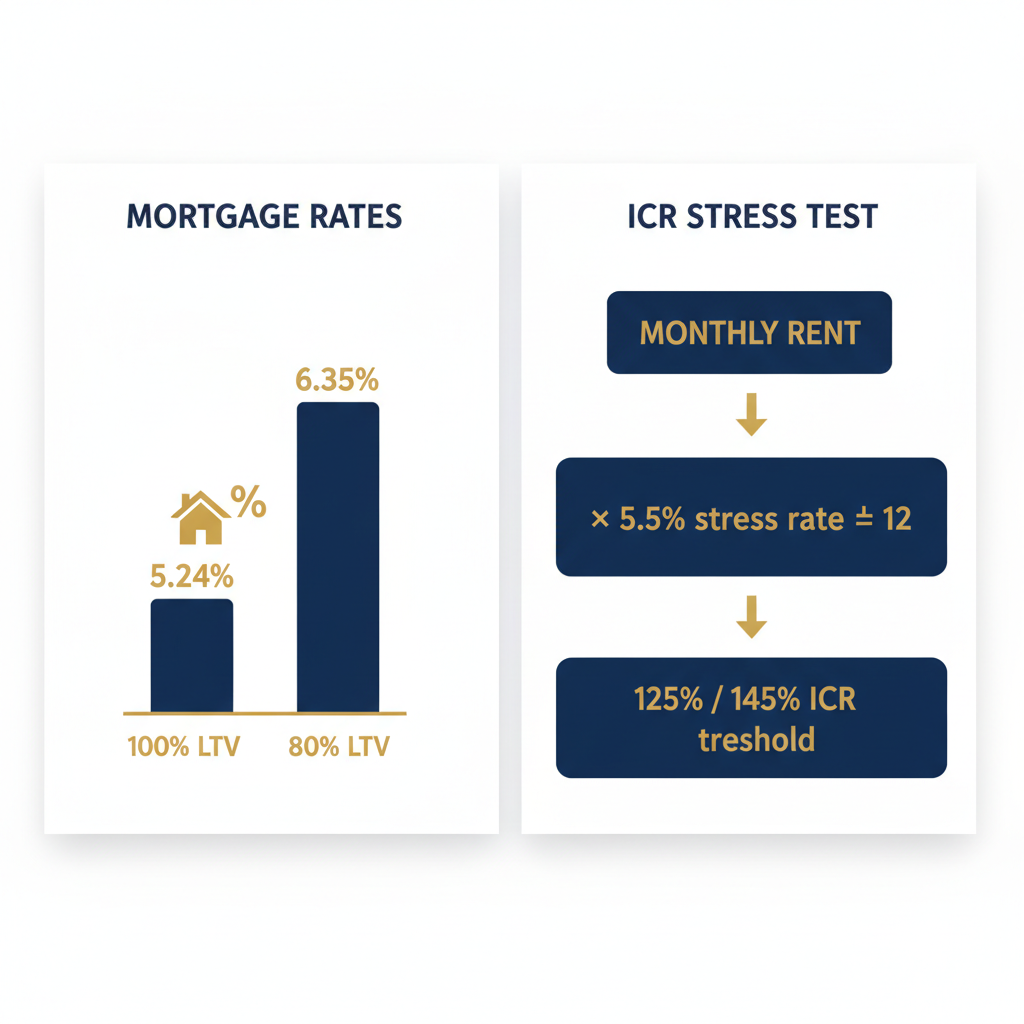
At 80% LTV, Bath prices at 5.04% — a 2.20% discount from its current SVR of 7.24%. At 100% LTV the rate steps up to 5.24%, a 2.00% discount. Neither product carries a product fee. There is a closing administration fee of £100, and a free valuation applies in most cases. The ERC structure is clean: 3% of the outstanding balance only in year 1, then 0% for years 2 through 5. That matters if the student graduates early or the family wants to sell.
Bath lends up to £500,000, with a minimum loan of £75,000 on properties valued at least £100,000. The term runs from 5 to 40 years. Overpayments of up to 20% of the capital balance are allowed in year 1; unlimited from year 2 onwards. The maximum joint borrower age is 85.
Above 80% LTV, Bath requires additional security — either a collateral charge on the parent's residential property or a cash pledge held with the Society. The amount is determined at application. If parents are retired, a 30% deposit may be required instead.
Bath operates manual underwriting with no automated credit scoring, which is useful where income is non-standard — for example, a parent on a variable self-employed income or one close to retirement age. Applications are referred to Bath directly; intermediaries earn a 0.225% gross proc fee on completion.
When The Loughborough Makes Sense
The Loughborough makes sense when the family values rate certainty over rate level, or when Bath's security requirements cannot be met and the family can bring a 20% deposit.
Its current Buy for Uni term discount rate is 6.35% at 100% LTV and 6.04% at 80% LTV. Both are discounts from its SVR, currently 7.89%, with an interest rate floor of 3.50%. The product fee is £499 on both LTV tiers. Crucially, The Loughborough charges no early repayment charge on full repayment, and unlimited partial repayments are permitted at any time — useful for a family planning to sell once the student graduates.
The Loughborough caps its maximum loan at £400,000 and requires at least 12 months of the course to remain. Properties must be in England or Wales, typically within 10 miles of the university, with a maximum of 3 rooms and 3 occupants including the student. Purchase up to one year before the course starts is permitted with proof of acceptance. The Society pays for the standard mortgage valuation, including where a parental property is used as collateral. Intermediaries earn a 0.40% gross proc fee.
The Loughborough's rate is higher than Bath's, but the absence of any ERC removes one structural risk that Bath's 3%-in-year-1 charge creates.
The Calculation That Decides It
The affordability engine on a buy for uni mortgage is room rental income, not the student's income. Both lenders use projected rent from rooms let to fellow students, plus parental income, in their assessment. The stress test framework lenders apply to assess that income is an ICR calculation — the same framework used in mainstream BTL lending.
At a 5.5% stress rate and 125% ICR (applicable to a basic-rate taxpayer), the minimum monthly rent required to support a £200,000 loan is:
£200,000 × 5.5% × 125% ÷ 12 = £1,146/month
If the parent is a higher-rate taxpayer the ICR rises to 145%, pushing the required rent to:
£200,000 × 5.5% × 145% ÷ 12 = £1,329/month
A three-bedroom property within commuting distance of a university town where two spare rooms each achieve £600/month in rent generates £1,200/month — enough to pass the 125% test but short of the 145% threshold. That gap is where parental income makes up the difference.
The LTV decision sits on top of this. At 80% on a £250,000 property, the loan is £200,000 and parents need either a 20% deposit (£50,000) or no deposit at all if using Bath's collateral charge route. No deposit means Bath's 100% product at 5.24% with a parental property charge. A £50,000 deposit available means Bath at 5.04% or The Loughborough at 6.04%, with the ERC profile and term structure driving the final call.
On a £200,000 loan, the monthly interest at Bath's 5.24% is £873. At The Loughborough's 6.35% it is £1,058 — a difference of £185/month, or £2,220/year. Over a typical four-year degree term that is £8,880 in gross interest. Weighed against no product fee (Bath) versus a £499 product fee (The Loughborough), and no ERC on full repayment at The Loughborough, the maths favours Bath if the parents can support the collateral charge and the family is confident the property will not be exited in the first year.
If the family sells in year 1 before the ERC drops to 0% at Bath, the 3% charge on £200,000 costs £6,000. That reverses the comparison entirely.