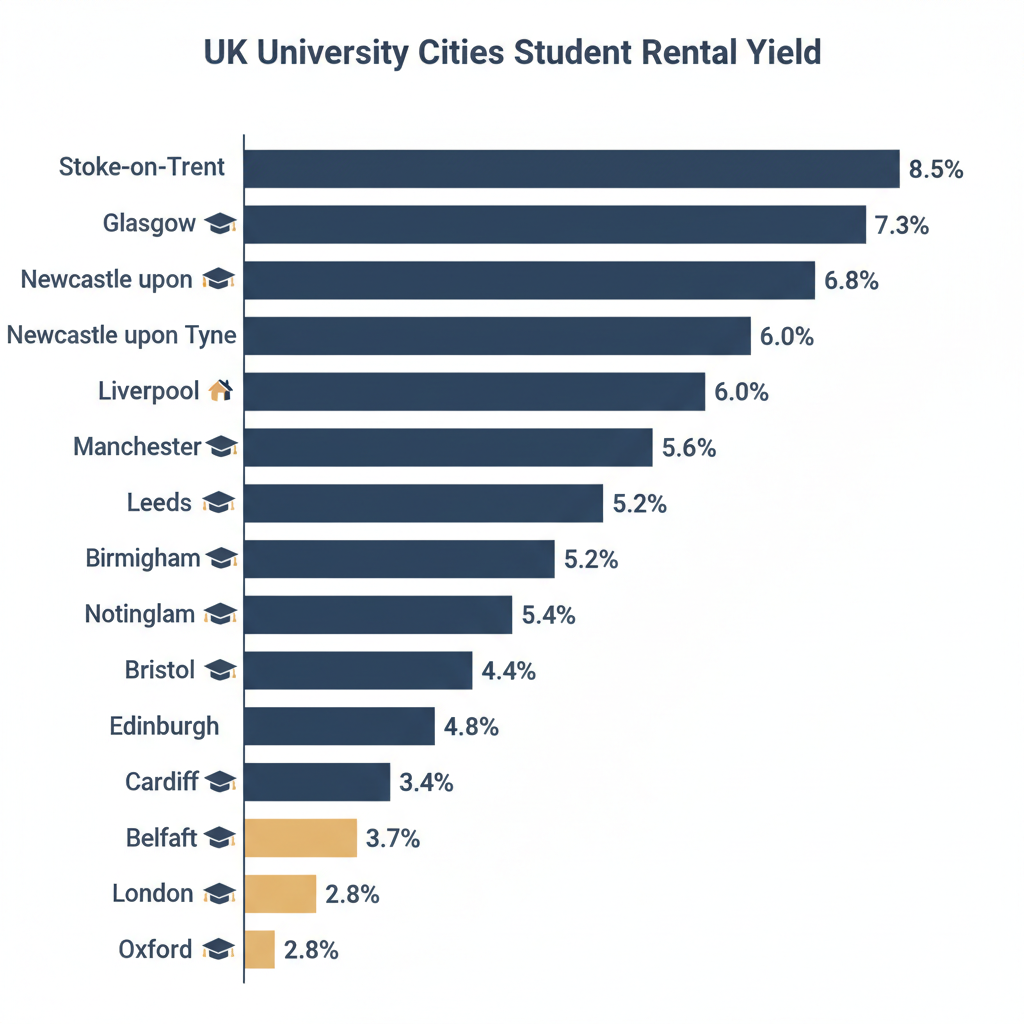
A student property in Stoke-on-Trent is currently generating an average yield of 9.42% — the highest of any university city in Paragon Bank's latest analysis of its own buy-to-let mortgage applications.
What the Numbers Show
Stoke-on-Trent sits at the top of the table on the back of average annual rental income of £14,222 against an average property valuation of £150,982. Those are modest absolute numbers compared with many university cities, but that accessible entry point is precisely what drives the yield. The city serves both the University of Staffordshire and nearby Keele University, giving landlords two student populations drawing on a relatively compact property market.
Plymouth takes second place at 9.27%. The numbers there look very different in scale — average annual rental income of £35,224 against an average valuation of £379,881 — yet the yield still clears 9%. That gap between Stoke and Plymouth in absolute property values is striking: Plymouth's average valuation is £228,899 higher, yet the yield difference is only 15 basis points.
Liverpool completes the top three at 8.86%, produced from annual rental income of £26,399 and an average property valuation of £297,951. The city is home to both the University of Liverpool and Liverpool John Moores, and the dual-institution dynamic clearly sustains robust rental demand.
Portsmouth and Cardiff follow at 8.31% and 8.27% respectively, with Portsmouth's average annual rental income reaching £39,215 against a valuation of £472,121, and Cardiff delivering £32,344 in annual income against an average valuation of £390,983.
Edinburgh came in at 8.23%, while Coventry, York and Leeds all cleared 8% — at 8.16%, 8.12% and 8.01% respectively. York's average valuation of £484,958 and Leeds's £485,464 are among the higher property values in the top ten, yet both cities still push yields above 8%.
Further down the table, Nottingham returned 7.97% from an average annual income of £30,702 and an average valuation of £385,185. Loughborough — not a Russell Group city — came in at 7.86%, ahead of Sheffield at 7.84%. Durham, Exeter and Southampton rounded out the top 15 at 7.81%, 7.71% and 7.67% respectively. Exeter's average valuation of £579,036 is the highest in the full table, yet still delivers a 7.71% yield from annual rental income of £44,659.
Ten of the fifteen locations — Liverpool, Cardiff, Edinburgh, York, Leeds, Nottingham, Sheffield, Durham, Exeter and Southampton — carry Russell Group university credentials. That said, the two highest-yielding locations, Stoke-on-Trent and Plymouth, are not Russell Group cities, which puts a dent in any assumption that the strongest student returns sit exclusively in those markets.
What This Means for Landlords
Paragon Bank's analysis of mortgage applications in known student postcodes shows that those postcodes produce an average yield of 7.32%, compared with 6.86% for non-student postcodes. That 46-basis-point premium is not trivial when compounded across a portfolio of properties.
The yield premium makes intuitive sense. Student rentals typically involve multiple occupants — meaning HMO structures in many cases — and landlords can charge on a per-room basis rather than a whole-property basis. That drives income higher relative to the asset value. But the 7.32% average also means roughly half the student locations in the table are beating the benchmark, while some are well above it.
The spread across the top 15 is wide. At one end, Stoke-on-Trent at 9.42% with a £150,982 average valuation; at the other, Southampton at 7.67% with a £380,648 average valuation. A landlord targeting yield rather than capital growth has a genuinely different shortlist from one targeting asset value appreciation in a larger city.
Louisa Sedgwick, Managing Director of Mortgages at Paragon Bank, makes the operational point clearly: student property is a specialist market. Landlords need to understand local demand, what kind and quality of accommodation students require, and the responsibilities that come with managing shared homes. The figures in this table are averages drawn from Paragon's application data — individual properties and streets will vary, and local vacancy rates, licensing requirements for shared houses and management costs all affect net returns.
The two non-Russell Group leaders — Stoke-on-Trent at 9.42% and Plymouth at 9.27% — demonstrate that the strongest gross yields tend to emerge where student demand is solid but property prices have not been bid up to the levels seen in London or the South East. For portfolio landlords already holding assets in higher-value cities, these locations represent a different risk and return profile worth modelling out carefully.
The full top 15 covers a wide geography — from Durham at £474,942 average valuation in the north to Exeter at £579,036 in the south-west — confirming that student rental demand, and the yields it generates, is not concentrated in any single region of England, Scotland or Wales.