A 5.10% opening rate. That is where Paragon Bank's five-year fixed student accommodation mortgage sits for houses in multiple occupation (HMOs) and multi-unit blocks (MUBs) as of its August 2026 product guide — reduced by 15 basis points from where it stood earlier this year.
What the Numbers Show
For HMOs and MUBs, Paragon's rates now start from 5.1%. That compares with a floor of 4.95% on its green-rated single self-contained units, so the HMO premium — which includes most student accommodation — is currently 15 basis points. Paragon's five-year fixed reference rate for HMOs and multi-unit blocks sits at 5.00%, meaning ICR calculations default to the product rate or 5.00%, whichever is greater.
The product fee structure at Paragon matters as much as the headline rate. The 2-year fixed HMO product at 4.45% carries a 3.00% product fee and a £150 application fee, with early repayment charges of 3% in year one and 3% in year two. If you are borrowing £300,000, that 3% fee costs £9,000 upfront — make sure you run the true cost of borrowing, not just the rate.
For landlords who want rate flexibility, Paragon's BBR tracker products are not subject to early repayment charges, with HMO and MUB tracker rates starting from 5.45% (BBR plus 1.70%). The Track to Fix feature lets existing customers switch to a fixed-rate Paragon product during their tracker term without paying an ERC, as long as they meet eligibility requirements at the time of application.
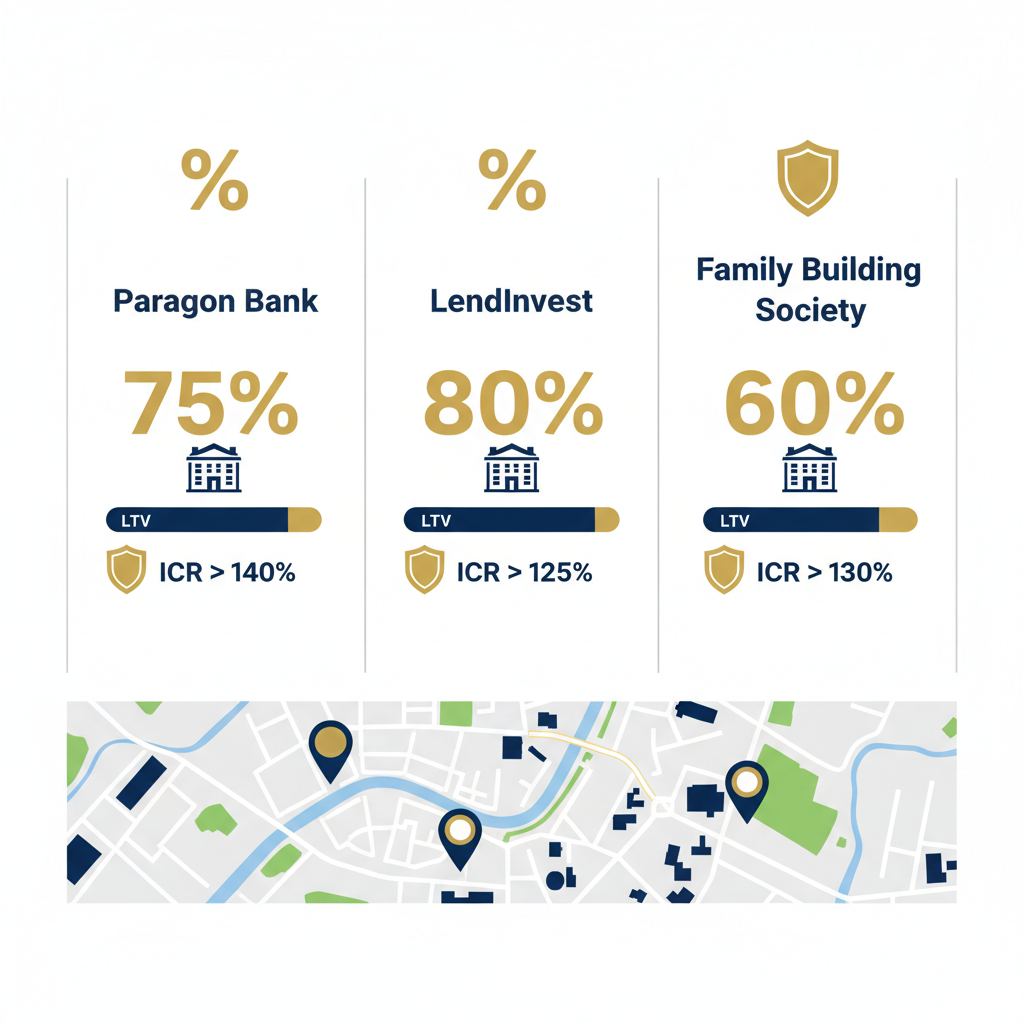
LendInvest is the other specialist worth putting on the comparison sheet. Four two-year fixed small HMO rates at 75% LTV were reduced by 30 basis points in June 2026, with rates ranging from 4.59% with a 3% fee to 5.59% with no fee. LendInvest accepts HMOs let to students of up to 10 rooms, which makes it a credible option for larger student houses operating below the sui generis threshold. LendInvest typically lends up to 80% LTV on standard properties and 75% on HMOs or MUFBs.
On the ICR, LendInvest splits by tax status. For basic-rate taxpayers and limited companies, the ICR requirement is 125% for both single properties and HMOs. For higher-rate and additional-rate taxpayers, the ICR rises to 145% on HMO and MUFB applications. That difference is significant: on £2,000 per month of gross rent, a 145% ICR at a 5.10% stress rate caps your loan at roughly £331,000 versus £385,000 at 125%. Running your purchase through a limited company collapses that gap immediately.
Family Building Society now accepts student lets under its HMO criteria in nine approved cities. Family accepts student let properties under their HMO criteria where the property is located in one of their approved areas: Birmingham, Cambridge, Cardiff, Leeds, London, Manchester, Newcastle, Oxford and York. The criteria permits up to 6 bedrooms, up to 6 tenants, and a maximum LTV of 75%, available to both personal and limited company landlords.
What This Means for Landlords
The deposit requirement is the first hurdle. A minimum deposit of 25% is usually required for a student BTL mortgage, though a small number of specialist lenders may consider 15%. For purpose-built student accommodation (PBSA), which lenders treat as a distinct asset class, the typical deposit rises to 30–35%.
Experience requirements have eased at several lenders. Paragon extended its maximum loan term from 25 to 35 years, while reducing the minimum experience required for HMO and MUB applications from three years to two. That shift opens the door for landlords who started building their portfolio during the 2022–2023 rate spike, many of whom hit the two-year mark during 2024 and 2025.
ICR stress testing on student HMOs is materially tighter than on single lets. Small HMOs are typically tested at 145% ICR, while large HMOs are assessed at 160%, reflecting additional management risk. Typical thresholds in practice are 145% at 5.5% on a personal name HMO and 125% at 5.5% on a limited company HMO. That makes the ownership structure decision one of the most impactful choices in your whole application — not a box-ticking exercise.
The investment case holds up under the stress test pressure. Student buy-to-let regularly delivers gross yields of 7–12% in the right cities, well above the national average for standard single-let properties. In 2024, occupancy rates exceeded 95% in major student cities like Manchester and Nottingham, significantly outperforming traditional BTL properties, which can face 3–4 weeks of vacancy between tenants.
The annual void risk is manageable but must be budgeted. On a property generating £2,000 per month, a 10-week annual void costs approximately £4,615 in lost income — around 18% of annual gross rent. Structure your ICR calculation on 46 weeks of rent rather than 52, and you will arrive at a figure that a lender's underwriter would not dispute.
PBSA financing operates on different terms entirely. PBSA financing involves options such as development finance, mezzanine funding, or joint ventures, often covering up to 90% of loan-to-cost (LTC) or 75% of loan-to-gross development value (LTGDV). The Buy to Let Broker quotes ICR coverage of 125% for limited company and 140% for personal ownership, with flexible terms available up to 10 years and loans from £3m to £35m.
The student accommodation mortgage market has sharpened considerably since the start of 2026. Paragon has cut rates twice, LendInvest cut by up to 40 basis points across its HMO range in June, and Family Building Society expanded its geographic footprint for student lets. The direction of travel is clear. The landlords who will make the most of it are those who have the ownership structure in place, the minimum two years' experience documented, and the rental income figures ready to defend at underwriting.