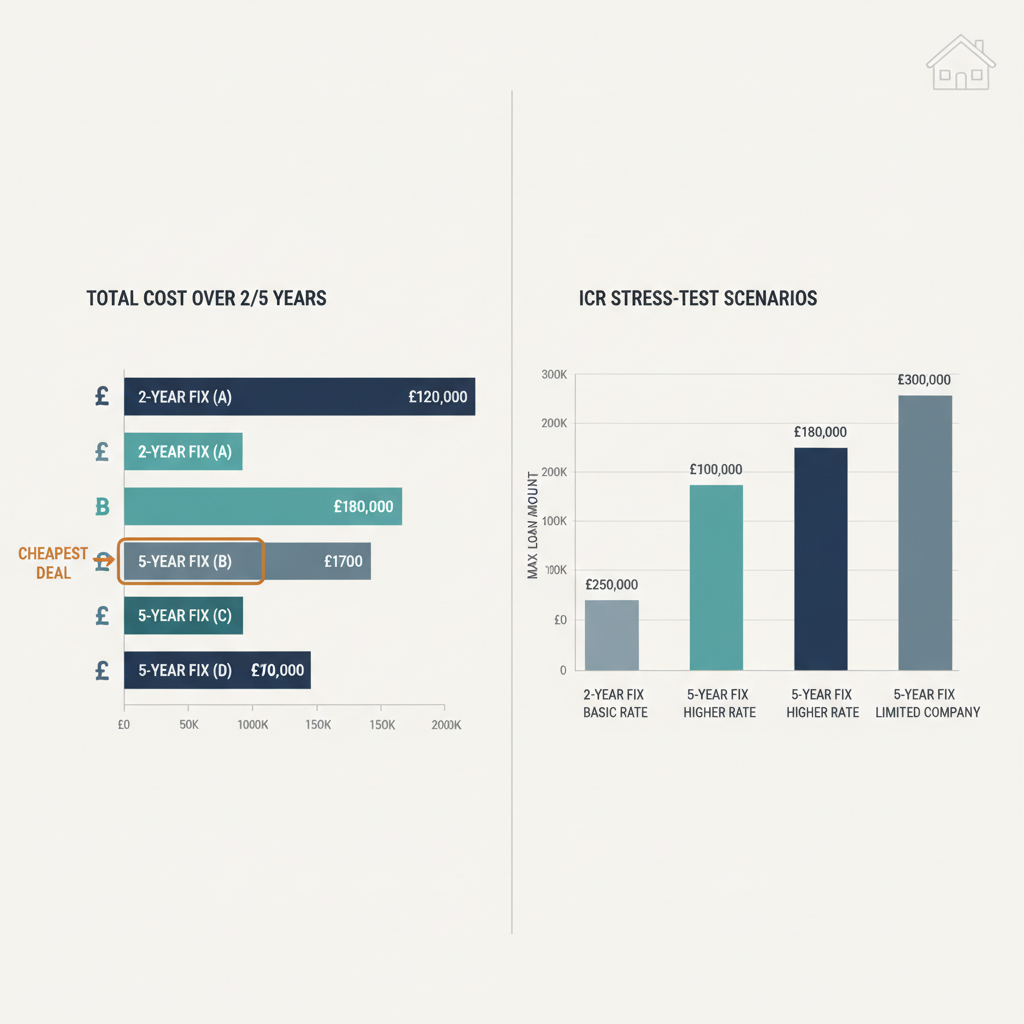
A product fee of £1,999 sitting on a 4.90% rate can end up costing almost exactly the same as a no-fee deal at 5.40%, over a two-year fix on a £200,000 loan. That single fact shows why any buy to let mortgage comparison that ranks by headline rate alone is working with the wrong number.
This guide works through the full picture: true cost, maximum borrowing, and the checklist items that change which deal actually wins.
Why Comparison Sites Mislead Landlords
Most online comparison tools sort by initial rate. That is not irrational — rate is a real cost — but it is incomplete in three important ways.
First, buy-to-let product fees are frequently charged as a percentage of the loan, not a flat amount. Percentage fees routinely reach 3%, 5% or 7%. On a £300,000 loan, a 3% fee is £9,000. No comparison table that shows only the rate is capturing that.
Second, comparison sites show only lenders who list their products publicly. A large portion of the specialist BTL market — portfolio lenders, limited company specialists, and lenders serving more complex properties — operates exclusively through brokers. Those products never appear on a price-comparison website.
Third, and most importantly for landlords who need to borrow a specific amount: comparison sites cannot tell you whether a lender's criteria will accept your property, your tax position or your portfolio. A deal ranked second by rate might be the only one that actually lends you enough. Seeing 500 products means nothing if 480 of them reject your application.
What the Numbers Show
True cost: low rate vs low fee
The examples below are illustrative. Rates and fees change daily; always verify current figures before applying.
On a £200,000 interest-only buy to let mortgage, 2-year fix
- Deal A: 5.40% rate, £0 fee. Monthly payment: £900. Total over 24 months: £21,600.
- Deal B: 4.90% rate, £1,999 fee paid upfront. Monthly payment: £817. Total over 24 months (payments + fee): £21,607.
The difference is £7 — the rate advantage has been almost entirely consumed by the fee. If the fee is added to the loan instead, Deal B's loan becomes £201,999, making the monthly payment £824 and the 24-month repayment cost approximately £21,772: more expensive than the no-fee deal.
The break-even point where a £1,999 fee on a 2-year fix starts saving money (against a deal with a 0.50% higher rate) is a loan of around £200,000. Below that, the no-fee deal is usually cheaper. Above it, the lower rate pulls ahead.
Over a 5-year fix on the same £200,000 loan, the picture changes materially
- Deal C: 5.50% rate, £0 fee. Monthly payment: £917. Total over 60 months: £55,020.
- Deal D: 5.10% rate, £1,999 fee paid upfront. Monthly payment: £850. Total over 60 months (payments + fee): £52,999.
Deal D saves £2,021 — the fee has paid for itself with money to spare. The longer the fixed term, the more time a lower rate has to recover the upfront cost. This is why a buy to let mortgage comparison that covers only 2-year products against each other, or 5-year against 5-year, is at least asking the right question. Comparing a 2-year against a 5-year on rate alone is not.
On 2 September 2026, the leading two-year fixed buy-to-let rate on the open market was 3.09% at 75% LTV, carrying total fees above £13,000. Sub-3.5% headline rates exist but almost always carry percentage fees of 5% or more, which usually makes them more expensive overall on loans under about £400,000.
Comparing by how much you can borrow
The rate is only half the story. For many landlords — particularly those remortgaging to release equity or buying their next property — the question that actually matters is: how much will the lender let me borrow?
The answer depends on three things:
- ICR (interest coverage ratio): the minimum multiple by which your rent must cover the stressed interest payment. The ICR test requires the rent to cover a stressed mortgage payment by a multiple that varies: 125% for limited companies and basic-rate individuals, 145% for higher-rate taxpayers, and up to 175% for some HMO lenders.
- Stress rate: the notional interest rate used in the ICR calculation — not the actual product rate. Two-year fixes get the toughest test: most lenders use the higher of 5.5% or the pay rate plus 2%, roughly 6–7.5% at current two-year pay rates. Most lenders tested two-year fixes at roughly 6–7.5% and five-year fixes at about 4.5–6%.
- LTV (loan-to-value): your loan as a percentage of the property's value. Most lenders cap buy-to-let at 75% LTV, though some go to 80%.
The formula is: Maximum loan = Annual rent ÷ (ICR × stress rate).
Here is what that produces at £1,200/month rent (£14,400/year), using illustrative stress rates from the ranges above:
The same rent. The same property. The difference between the worst-case row and the best is over £67,000 of borrowing capacity — purely because of the product type, the ownership structure, and the lender's stress rate.
A 2-year fix at 5.0% might look better than a 5-year at 5.3%, but the 5-year gets stressed at 5.3% while the 2-year gets stressed at 7–8%+. The 5-year lets you borrow significantly more despite the slightly higher rate.
For portfolio landlords with a background stress test applied across all properties, this borrowing differential compounds significantly. You can read more about how lenders assess portfolio landlord background stress tests and what that means for your maximum borrowing across a portfolio.
What This Means for Landlords
The full comparison checklist
Rate and fee get most of the attention. These items do not — but they affect real money:
Maximum LTV. Most mainstream lenders top out at 75% LTV. Some specialist lenders will go to 80%, which on a £300,000 property is the difference between needing a £60,000 deposit and a £75,000 one.
Early repayment charges (ERCs). Most UK ERCs follow a sliding 1%–5% scale on a 5-year fix, or 1–2% on a 2-year fix. On a £200,000 mortgage, a 3% ERC would be £6,000. Always check the ERC schedule before fixing, particularly if there is any chance you will sell or refinance early.
Portability. A portable mortgage can move with you to a new property without triggering an ERC — useful if you plan to sell and buy within the fixed term.
Overpayment allowance. Most lenders allow overpayments of up to 10% of the outstanding balance per year without penalty. Beyond that, the ERC applies.
Valuation and legal fee incentives. Many lenders offer free valuations and free standard legal work on remortgages. On a £200,000 remortgage, free legals can save £300–£600 in solicitor fees.
Cashback. Some lenders offer cashback of £250–£1,000 on completion. This is a genuine cost offset, not a marketing gimmick — it should appear in your total cost calculation.
Limited company vs personal name. A limited company structure often improves your chances of passing a stress test by offering more favourable ICR thresholds. Lenders typically apply a 125% ICR for properties held within an SPV, whereas individual higher-rate taxpayers often face a stricter 145% requirement. However, the tax and legal costs of holding in a company are substantial. If you are considering transferring an existing property into a company, read our guide to what a buy-to-let to limited company transfer costs before committing.
Offer validity. Some lenders hold a mortgage offer for only 90 days on a purchase; others allow 180 days. For slower-moving chains or new-build completions, this matters.
Fixed vs tracker
The current Bank of England base rate is 3.75%, held at the November 2026 MPC meeting. Tracker mortgages typically price at Bank of England base rate plus 2.5%–3.5%, meaning current tracker pay rates sit roughly in the 6.25%–7.25% range — above average fixed rates. Tracker mortgages carry no ERCs, so you can remortgage freely if rates fall.
A tracker makes sense if you believe rates will fall materially within 12–18 months and want flexibility without paying an ERC to exit. A 5-year fix makes sense if you want payment certainty, need to maximise borrowing (via the softer stress test), or have a portfolio where predictable costs matter. For landlords with a large portfolio who rely on top-slicing to pass affordability, the stress rate on the product type is critical — a tracker may actually stress worse than a 5-year fix at some lenders.
Remortgage vs product transfer
A product transfer is switching to a new rate with your existing lender — no solicitor, no valuation, no new application. A product transfer is faster, requires no valuation or legal work, and can often be completed online. Many borrowers do not realise that switching to a new deal with their existing lender often avoids ERCs entirely, even before the current deal ends.
The limitation is that your lender's product transfer rate may not be the best available. On larger balances (£200,000 and above), a remortgage with a lower rate often saves more even after arrangement fees. On smaller balances, a fee-free product transfer can be cheaper overall.
Both options should always be priced. Some lenders allow you to lock in a product transfer rate up to six months early, protecting against rate rises while you decide. If you need to complete a remortgage quickly, a same-day completion remortgage is available from certain lenders via specialist solicitors.
A note on broker fees and whole-of-market access
A broker who charges a £500–£1,500 fee effectively adds that to your total mortgage cost. On a 2-year fix where a lower-rate deal saves £600 over the term, a £995 broker fee turns a saving into a loss. That arithmetic is worth running before you engage anyone.
BuyToLet4Landlords charges no broker fees and pays cashback on every mortgage arranged, including product switches. The service covers the whole market, including broker-only specialist lenders not visible on comparison sites — the same lenders that often carry better criteria for portfolio landlords, limited company structures, HMOs and multi-unit blocks. If you want a whole-of-market buy to let mortgage comparison run against your specific property, rent, tax position and portfolio, get in touch for a free comparison.
Your property may be repossessed if you do not keep up repayments on your mortgage. Most buy-to-let mortgages are not regulated by the Financial Conduct Authority. All rates and criteria quoted in this article are illustrative only and subject to change. Always verify current figures with a lender's current product guide before making a decision.