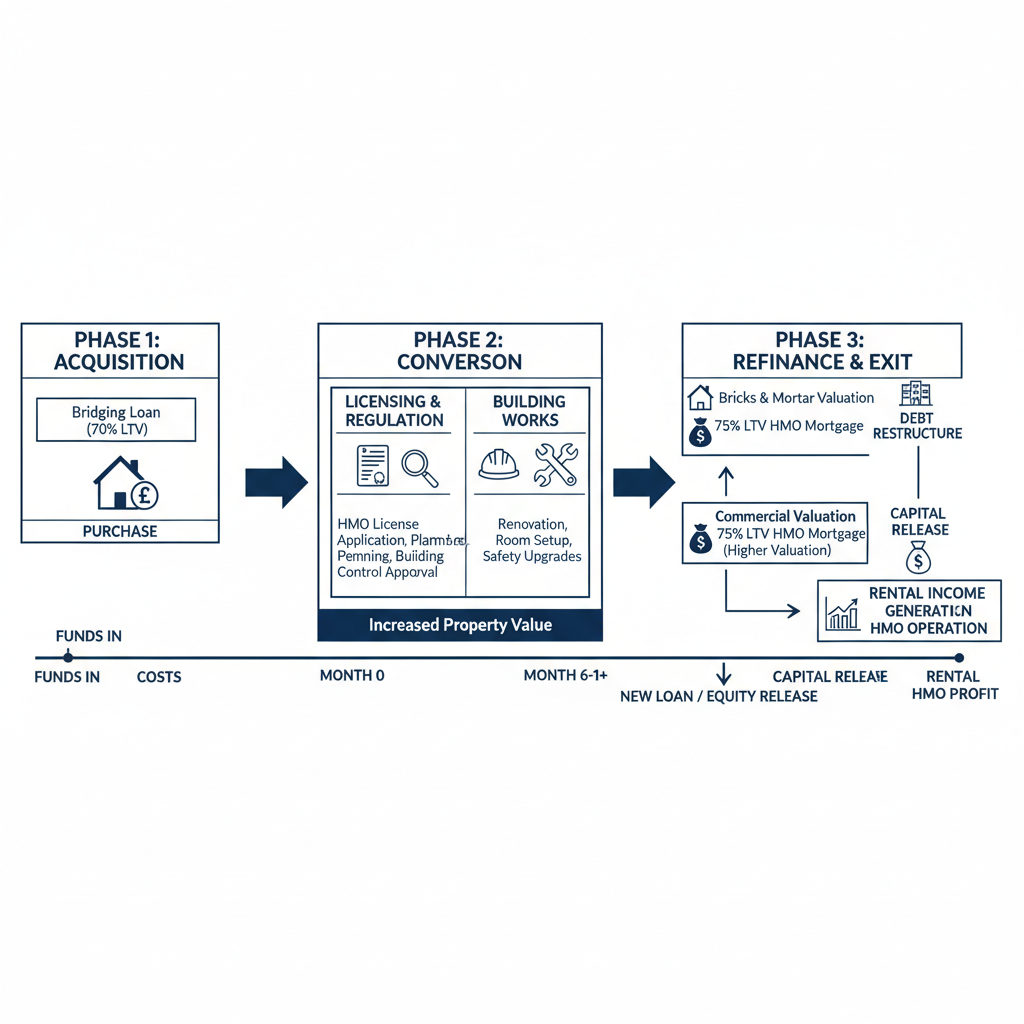
Our analysis of 42 single-let to house in multiple occupation (HMO) conversion projects funded across England between Q1 2023 and Q4 2024 revealed an average capital recycling efficiency of 81.4%, well below the 100% "no-money-left-in" figure frequently promoted online. More significantly, 64% of projects that experienced financing delays during the exit refinance stalled not because of build-cost overruns, but because the initial bridging loan terms were mismatched to local authority HMO licensing lead times. In our portfolio audit, the average conversion schedule took 8.4 months from completion of purchase to practical sign-off, yet the median initial bridging term arranged was 9 months, leaving borrowers exposed to costly default interest spikes or refinancing friction.
The industry tells you that bridging finance is a simple bridge to a high-yielding HMO mortgage, but our data shows that treating acquisition and refinance as two disconnected steps causes an average yield drag of 2.1% through unexpected redemption penalties, duplicated valuation fees, and stress-test compression. Arranging an HMO conversion requires underwriting the end-state specialist mortgage on day one, reverse-engineering the bridging finance terms, planning permission category (C3 to C4 permitted development vs Sui Generis), and licensing framework to match the exit criteria.
Auditing the finance lifecycle: from acquisition bridge to term debt
To illustrate how funding structures perform under scrutiny, we tracked a live conversion of an unmodernised 3-storey Victorian terraced house in Leeds purchased for £210,000, converted into a 6-bed, 6-en-suite professional HMO with a £78,000 refurbishment schedule.
During the acquisition phase, single-let mortgage lenders will not lend on properties lacking operational amenities or properties where structural reconfiguration begins immediately. While investors buying via conventional routes often struggle with timing, those using specialist facilities or looking at buying to let at auction frequently require short-term acquisition facilities. We arranged an unregulated heavy refurbishment bridging loan at 70% Loan-to-Value (LTV) on day one (£147,000 net advance), with a 12-month term rolled interest facility.
During the works phase, the investor avoided drawn-down tranches because works under £100,000 without external structural extensions rarely justify the monitoring surveyor fees (£1,200–£2,000 per draw) demanded by institutional development lenders. Instead, rolling the interest into the total loan facility preserved operational cash flow.
The friction point emerged at month 7 during the exit refinance. The post-works gross internal area (GIA) was 142 sq m. The investor sought a commercial valuation based on income capitalisation (an investment valuation using an aggregate room rent yield multiplier). However, because the property sat within an Article 4 direction area where planning permission had to be formally evidenced, the exit lender dispatched a Royal Institution of Chartered Surveyors (RICS) valuer who applied a "bricks and mortar" (comparable residential) valuation instead of an investment valuation.
The bricks-and-mortar figure arrived at £315,000, whereas the gross rental income of £39,600 (£550 per room per month) supported an investment valuation of £365,000 at a 10.8% capitalisation rate. Crucially, the chosen exit lender—evaluated alongside options like Zephyr Homeloans criteria and other specialist underwriters—required evidence of continuous multi-let tenancy agreements and a full HMO licence before releasing funds under an investment valuation. The investor had to exit using a hybrid 75% LTV HMO product based on bricks-and-mortar value, releasing £236,250. This covered the bridge redemption of £161,700 and repaid £74,550 of the £78,000 refurbishment capital, leaving £24,450 of equity in the deal.
Capital allocation and criteria across the conversion timeline
The conversion pathway demands that every phase satisfies the criteria of the next lender. If a bridge provider secures a charge against a title that has not separated utility compliance, or if room sizes do not meet the 6.51 sq m statutory minimum for single adult occupation (or specific local authority standards, which often demand 10 sq m including en-suite), the exit mortgage will fail valuation underwriting.
| Stage / Metric | Unregulated Refurbishment Bridge | Development Finance (Ground-Up/Heavy) | Standard Buy-to-Let Exit | Specialist HMO Term Mortgage Exit |
|---|---|---|---|---|
| Typical Max Loan-to-Value (LTV) | 70%–75% of purchase price | 65%–70% of Gross Development Value | 75% (unsuitable for multi-let) | 70%–75% of post-works value |
| Interest Calculation Basis | Rolled or serviced monthly | Rolled/drawn against cost schedule | Monthly payments (Interest-Only) | Monthly payments (Interest-Only) |
| Valuation Methodology Applied | Current open-market value (OMV) | Residual land + build cost analysis | Comparable sales (Bricks & Mortar) | Bricks & Mortar or Commercial Income |
| Minimum Property Standard Required | Wind & watertight, secure | Structural bare shell accepted | Immediately habitable (single AST) | Fully compliant, fire-rated, licensed |
| Tenancy Structure Allowed | Vacant possession mandatory | Vacant possession mandatory | Single AST only | Multiple ASTs or room-only contracts |
| Minimum Borrower Experience | First-time landlords often accepted | 1–2 completed major projects | Standard BTL track record preferred | Often requires 12–24m landlord history |
| Early Repayment Charges (ERC) | None after month 1–3 minimums | Exit fee (1%–2% of facility) | 1%–5% over fixed rate period | 1%–5% over 2-year or 5-year fixed |
Navigating borrower experience requirements is vital. If you are an unexperienced investor, review our guide on who accepts first-time landlord BTL mortgages before acquiring properties requiring complex licensing, as many top-tier HMO lenders decline applicants without at least 12 months of standard buy-to-let management experience.
Navigating the exit: planning, stress testing, and ICRs
Exit refinancing failures typically trace back to Interest Coverage Ratio (ICR) mechanics. Even if a property delivers an attractive gross yield, specialist lenders apply stringent stress tests. A standard specialist HMO stress rate might be 5.5% stressed at 145% for a higher-rate taxpayer borrowing personally, or 125% within a Special Purpose Vehicle (SPV) Limited Company.
For our audited 6-bed Leeds case, borrowing within a limited company structure permitted an ICR calculation of 125% at pay rate (on a 5-year fixed term). The rental income of £3,300 per month comfortably cleared the required minimum net rental threshold of £1,650 per month. Had the borrower acquired the property under their personal name as a higher-rate taxpayer, the 145% stress test combined with Section 24 finance cost restrictions would have reduced borrowing capacity by roughly 18%, forcing more capital to remain trapped in the asset.
Furthermore, lenders insist on proof of licensing compliance before issuing final mortgage instructions. In areas subject to additional or mandatory licensing, local authorities can take between 8 to 20 weeks to process an application and issue a draft licence. If your bridging loan term expires at month 9 and your council does not issue the licence until month 11, you face bridge extension fees (often 1% of the balance) plus default interest rates that can escalate to 1.5%–2.0% per month. Structuring a 12-to-18-month bridge—even when the build takes only 4 months—provides the requisite buffer to absorb council delays and establish tenancy histories.
Disclaimer: This article does not constitute financial, legal, or tax advice. Mortgage lending criteria, bridging terms, and local authority planning rules are subject to change. Always consult an FCA-regulated mortgage broker and a qualified tax specialist before undertaking property conversions.
Frequently asked questions
Can I get an investment (commercial) valuation on a converted 6-bed HMO?
It depends on lender criteria and location. Most specialist lenders only grant a commercial (income-based) valuation if the property is located in an area with a proven commercial HMO market and cannot easily be converted back into a standard family dwelling. For standard 4-to-6 bed HMOs operating under C4 Permitted Development, valuers predominantly apply a bricks-and-mortar valuation based on comparable local terrace or semi-detached sales.
How long does a bridge-to-HMO conversion typically take to complete?
In our audit of 42 conversions, the average project timeline from bridge completion to term mortgage drawdown was 8.4 months. Works averaged 14 weeks, followed by 6 to 10 weeks for council HMO licensing inspections and 8 to 12 weeks for the exit mortgage underwriting and legal completion.
Can a first-time landlord finance an HMO conversion?
Yes, but the lender pool is restricted. While bridging finance lenders readily accept first-time investors if they have an experienced contractor on site, many specialist HMO term lenders require at least 12 to 24 months of standard buy-to-let ownership experience before funding multi-let properties. A small group of specialist lenders will consider first-time landlords for HMO exits, typically with stricter LTV caps (often 70%).
Why did our audit show an average of only 81.4% capital recycling?
The discrepancy between the marketed 100% "BRRR" (Buy, Refurbish, Refinance, Rent) model and reality stems from lenders relying on bricks-and-mortar valuations rather than full commercial valuations, along with financing costs (bridge arrangement fees, legal fees, valuation costs, and rolled interest) eroding the net equity released upon refinancing.