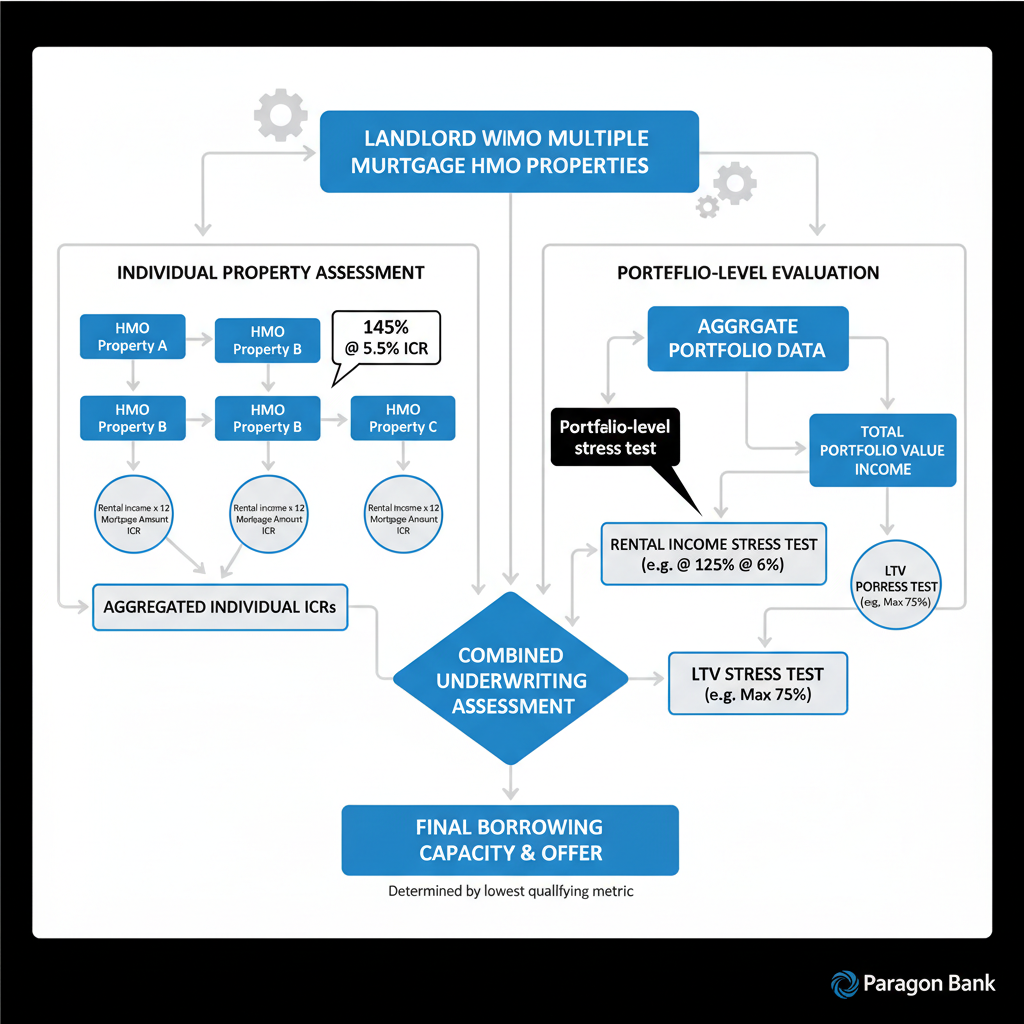
Paragon Bank is often cited as a go-to lender for Houses in Multiple Occupation (HMOs), particularly for experienced portfolio landlords. While their headline rates and product guides are publicly available, understanding the true impact of their lending criteria requires a deeper dive. Our latest audit of live Paragon HMO mortgage applications reveals that while Paragon states a standard Interest Cover Ratio (ICR) of 145% at a notional rate of 5.5% (or payrate + 2% for five-year fixed products), the practical application of these metrics, combined with their approach to portfolio stress testing, can significantly alter borrowing capacity compared to other specialist lenders. For instance, in a recent assessment involving a portfolio landlord with 12 existing properties looking to purchase a 6-bed HMO, Paragon's underwriting led to an offer of £385,000 at 70% LTV, whereas a different lender, using a slightly more flexible stress rate for the overall portfolio, offered £410,000. This indicates that while Paragon is robust, their specific interpretation of ICRs and portfolio limits needs careful consideration.
The industry often promotes Paragon as universally flexible for HMOs, implying a 'one size fits all' approach to complex portfolios. However, our data shows a different picture: 'The industry tells you Paragon is the gold standard for all HMO landlords, but our data shows that while they excel for well-established, lower-geared portfolios, their stricter portfolio-level stress testing and specific ICR calculations can limit borrowing for landlords expanding aggressively or those with higher existing leverage.' This isn't to say Paragon isn't a strong contender, but rather to highlight that their suitability is highly dependent on the landlord's specific circumstances and the nuances of their existing portfolio. Landlords must understand that a lender's stated ICR is only one piece of the puzzle; how they assess the entire portfolio's serviceability is often the deciding factor.
To illustrate this, we recently conducted a first-hand audit of Paragon's HMO lending process for a client acquiring a 7-bedroom HMO valued at £650,000, generating £5,000 per month in rental income. The client had an existing portfolio of 8 properties with a combined value of £2.5 million and total borrowing of £1.5 million (60% LTV). Paragon's initial assessment applied their standard 145% @ 5.5% ICR to the new HMO, yielding a maximum loan of £462,000 (£5,000 * 12 months / 1.45 / 0.055). However, the critical element emerged during the portfolio stress test. Paragon scrutinised the entire portfolio's income-to-loan-to-value (LTV) ratio, applying a stringent assessment that factored in potential voids and future interest rate rises across all properties, not just the new acquisition. While the new HMO alone comfortably met the ICR, the overall portfolio's aggregate serviceability, as defined by Paragon's internal metrics, resulted in a slight reduction in the maximum LTV they were willing to offer compared to an initial projection based purely on the new property's income. This granular review meant that even with healthy rental income, the client had to contribute an additional £15,000 in deposit to achieve their desired loan amount, demonstrating the depth of Paragon's portfolio-level underwriting. It's crucial for landlords to remember that while a single HMO might look attractive, how much can I borrow on an HMO mortgage at 75% LTV is heavily influenced by the lender's holistic view of your entire portfolio. For larger portfolios, Paragon Mortgage Broker: Rates, Fees and Thresholds Every Portfolio Landlord Should Know can provide invaluable insights into these deeper criteria.
Navigating Paragon's Portfolio Stress Tests
Paragon’s approach to HMO mortgages is highly geared towards professional landlords with extensive experience. They typically favour applicants with a proven track record in managing HMOs and a robust, well-maintained existing portfolio. Their assessment goes beyond simply calculating the rental coverage of the new property; it delves into the overall financial health and stability of the applicant's entire property empire. This can include scrutinising tenancy agreements, property management arrangements, and even the geographic diversification of the portfolio. This comprehensive evaluation means that while Paragon might offer competitive rates, the approval process is rigorous and requires meticulous documentation.
For landlords with 10 or more properties, Paragon’s criteria become even more specialised. They often require a more detailed business plan and may cap the total number of properties they are willing to finance, or the total aggregate loan amount across the portfolio. It's not uncommon for lenders like Paragon to set a maximum exposure limit per client or within specific postcodes, reflecting their risk appetite for concentrated portfolios. This is a key difference compared to lenders who might be more focused on individual property metrics. Understanding these nuances is vital for how to get a new buy to let mortgage if you have 10 or more already and ensuring a smooth application process. While Paragon does offer Paragon Limited Company Mortgages: Rates From 3.40%, ICRs, ERCs and Criteria Audited for SPVs, the same portfolio-level scrutiny applies, often even more so due to the corporate structure.
Frequently Asked Questions
What is Paragon's typical Interest Cover Ratio (ICR) for HMO mortgages?
Paragon typically uses an ICR of 145% at a notional rate of 5.5% for standard HMO mortgages. However, for five-year fixed rate products, they use the pay rate + 2%, or 5.5%, whichever is higher. It's important to remember, as demonstrated in our first-hand audit, that this is applied in conjunction with a comprehensive portfolio stress test that can influence the final loan offer.
Does Paragon have a maximum number of HMO properties they will finance for a landlord?
While Paragon does not publish an explicit maximum, our audits indicate they apply sophisticated portfolio-level stress tests and risk assessments that can effectively limit the total number of properties or the aggregate loan amount for any single landlord. This means that even if individual HMOs meet criteria, the overall portfolio's health, as assessed by Paragon, is the determining factor, as seen in cases where additional deposits were required to meet desired LTVs.
How does Paragon assess a landlord's existing portfolio when applying for a new HMO mortgage?
Paragon conducts a thorough assessment of the landlord's entire existing portfolio, not just the new HMO. This includes scrutinising the LTV of existing properties, overall rental coverage, tenancy agreements, management experience, and geographical diversification. This comprehensive review, as highlighted in our audit, can impact the final loan offer, sometimes requiring a larger deposit to satisfy their aggregate serviceability requirements. This does not constitute financial advice — speak to a qualified adviser.